.svg&w=384&q=75 "GoalGist logo")
U.S. Men's Soccer Dominates Paraguay in World Cup Opener
LOS ANGELES — For weeks, the World Cup felt like a storm waiting offshore. Politics, ticket prices, immigration headaches, transit chaos — all of it swirled around this tournament stretched across Mexico, Canada and the United States.
Then the whistle blew. The noise faded. The football took over.
And in Los Angeles, the U.S. men delivered a statement.
A Night to Rewrite the Record Book
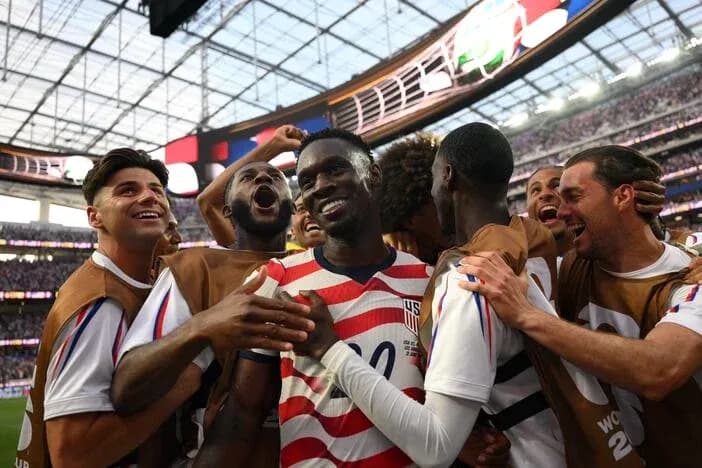
For a program still defining its place in the sport’s global hierarchy, Friday’s opener against Paraguay at Los Angeles Stadium was something else entirely. Not just a win. Not just a good performance. A 4-1 demolition that belongs in any conversation about the finest World Cup display the U.S. men have ever produced.
Four goals — the most the U.S. men have ever scored in a World Cup match.
Folarin Balogun grabbed the spotlight. Two goals, ruthless finishes, and a little slice of history: no American had scored twice in a World Cup game since the very first tournament in 1930. Ninety-four years of waiting, snapped in one night.
Behind him, the team hummed.
Chris Richards, back in the lineup after missing both pre-tournament warm-ups with injury, played like a man making up for lost time. He completed all 83 of his passes. Every single one. No player has completed that many passes in a World Cup game since records began in 1966. From the back line, he dictated tempo and broke lines, turning defense into attack with a calm that belied the stakes.
From front to back, the U.S. sparkled. The movement was sharp, the pressing coordinated, the finishing clinical. For a fan base that has seen its share of cautious, nervy World Cup openers, this was something new: swagger.
Yet the perfect night carried a jolt of concern.
Christian Pulisic, the team’s star forward and emotional reference point, did not emerge from the tunnel after halftime. A calf problem forced him off, and he walked gingerly to the team bus afterward. His status remains unclear, a cloud hanging over an otherwise radiant start.
One game, though. A spectacular one, but still just one. Tournaments are not won in the opening week.
Australia Crash the Party
If the U.S. needed a reminder of how quickly a World Cup can twist, it arrived a day later.
Saturday’s Group D clash between Turkey and Australia was supposed to be a showcase for Turkey’s European pedigree. The Turks brought names that light up scoreboards and transfer gossip: Real Madrid’s Arda Güler, Juventus attacker Kenan Yildiz, and a cast drawn from top-tier leagues across the continent.
On paper, the gulf in star power was obvious.
On the pitch, it meant nothing.
Australia, the underdog, punched first and never blinked. A 2-0 win stunned Turkey and blew Group D wide open. Suddenly, next Friday’s USA–Australia match looms as a potential hinge point for the entire group. If the Americans beat the Socceroos, they seize control of the section and stride toward the knockout rounds with authority.
Drop points, and that opening-night masterpiece against Paraguay starts to feel less like a launchpad and more like a missed opportunity.
Scotland’s Surprise and a Royal Crowd in Trouble
The shocks have not been confined to Group D.
Scotland, back at a World Cup for the first time in 28 years, returned with a vengeance. Their reward: the top of Group C, thanks to a win over Haiti. On its own, that result would be notable. In this group, it’s seismic.
Because Scotland share the stage with royalty.
Brazil, five-time world champions and the sport’s eternal benchmark, sit in this group. So do Morocco, a modern powerhouse and semifinalist at the 2022 World Cup. Those two giants were expected to stride through to the knockouts without too much drama.
Instead, they cancelled each other out in a 1-1 draw.
That single point apiece leaves Scotland, for now, looking down at both of them. It may not last — the weight of history tends to reassert itself — but for the moment, the table tells a story nobody predicted.
Qatar’s First Point, Heavyweights Trade Blows
The weekend brought more firsts and a reminder of just how unforgiving this stage can be.
Qatar, in only its second World Cup appearance, earned its first-ever World Cup point with a 1-1 draw against Switzerland on Saturday. The 2022 hosts qualified automatically last time and lost all three matches. This time, they have something tangible to show for their efforts. One point, and a foothold on the game’s biggest mountain.
In Group F, the Netherlands and Japan traded punches in a 2-2 draw between two heavyweights with serious ambitions. Neither blinked, neither broke. The result leaves the group finely balanced and sets up a tense second round of fixtures.
Curaçao’s Seventeen Glorious Minutes
Then came Curaçao.
Population: 158,000. The smallest country ever to play in a World Cup. On Sunday, they walked out against Germany, one of the sport’s most imposing names, and for a brief, unforgettable stretch, they shared the same dream.
Germany struck first, as expected. Curaçao answered. For 17 minutes, the scoreline read 1-1. Seventeen minutes in which a tiny Caribbean nation stood level with a four-time world champion on the sport’s grandest stage.
Then Germany did what Germany so often does. The machine clicked into gear. Goals flowed. The final score — 7-1 — echoed a famous World Cup result in German history and underlined the brutal reality of this tournament. Fairy tales can flicker into life, but the giants rarely stay asleep for long.
Politics, Pressure and a Late Arrival
The football has provided drama. Off the pitch, geopolitics has cast its own shadow.
On Monday, Iran and New Zealand meet at Los Angeles Stadium in one of the most politically charged fixtures of the opening round. There had been real doubt over Iran’s participation after the U.S. and Israel attacked the country in February. Plans for a training camp in Tucson, Arizona, were scrapped as Iran moved its base to Tijuana, Mexico, citing ongoing hostilities and security concerns.
The restrictions are stark. The U.S. government is allowing the Iranian team to enter the country only the day before each of its three group matches. No extended stays, no leisurely acclimatization. Fly in, play, fly out. It is a World Cup campaign conducted on a tightrope.
Mbappé, Messi and the Week Ahead
If the opening days belonged to the surprise packages and the statement-makers, the next wave belongs to the superstars.
On Tuesday, France begin their World Cup journey in Group I against Senegal, with Kylian Mbappé once again carrying the burden of a nation and the expectation of a tournament. Every World Cup he enters feels like a referendum on his claim to the game’s throne.
Also on Tuesday, the defending champions step into the light.
Argentina and Lionel Messi start their bid for back-to-back titles against Algeria in Group J. Only two countries have ever defended a World Cup crown: Italy in 1938 and Brazil in 1962. That’s the scale of the challenge in front of Messi and his teammates. Win again, and they join a club that has stood nearly untouched for more than six decades.
The political noise hasn’t vanished. The logistical headaches still exist. But as the second week dawns, the story belongs to the football — to Balogun’s goals, Richards’ perfection on the ball, Scotland’s surge, Australia’s shock, Curaçao’s fleeting dream, and the looming shadow of Mbappé and Messi.
The stage is set. Now we find out which of these early sparks can burn all the way to the final.

