.svg&w=384&q=75 "GoalGist logo")
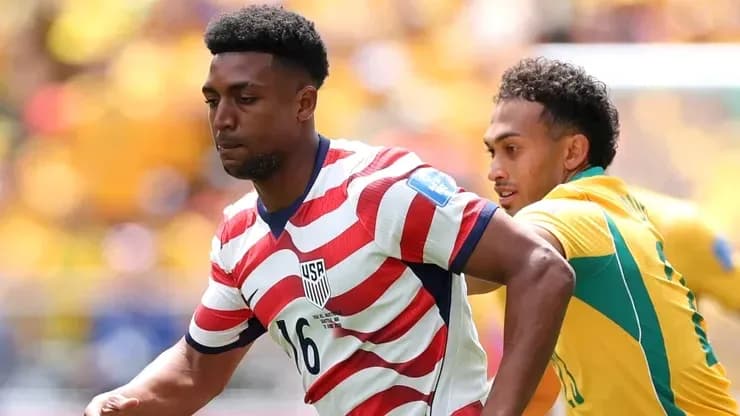
United States Dominates Australia in World Cup Group D Match
The United States walked off at halftime with a 2–0 lead over Australia and the feeling they had this Group D contest exactly where they wanted it.
For 10 minutes, it didn’t look that way. Australia matched the Americans stride for stride, snapping into tackles, trading punches in midfield, refusing to be pushed back. Then the tempo shifted. The U.S. cranked up the intensity, tightened their press, and the game began to tilt.
The pressure told early.
In the 11th minute, a sweeping American move drove straight at the heart of the Australian back line. Folarin Balogun burst into the box, his dangerous run and low ball across goal forcing chaos. Defender Cameron Burgess, scrambling to cut it out, could only divert it into his own net. It was ugly from an Australian perspective, but fully in keeping with the way the U.S. had suddenly seized control.
From there, the Americans didn’t sit on the lead. They hunted in packs, moved the ball quickly, and stretched Australia down both flanks. Weston McKennie set the tone in midfield, snapping into duels and dictating the rhythm, while the wide players repeatedly pinned the Socceroos back.
All of this without Christian Pulisic.
The injured star’s absence might have been the story before kickoff. By the break, it felt like a footnote. The U.S. attack looked fluid and confident, the movement sharp, the rotations down the wings causing constant problems. Australia, forced deeper and deeper, struggled to put any kind of sustained sequence together. Their best moments came on the break, half-chances that never quite developed into clear sights of goal.
Just when Australia seemed to be hanging on for halftime, the U.S. struck again.
Sergino Dest sparked the move, driving forward and helping carve open the right side. The ball eventually found its way to Alex Freeman, who finished the chance to double the lead. For a few seconds, confusion reigned. The ball had taken a touch off an Australian defender, and players from both sides glanced toward the referee, waiting for a decision.
VAR stepped in, checked the contact, and confirmed the goal. The verdict unleashed a roar around Lumen Field and sent American players racing to celebrate in the corner. Australia, shoulders slumped, trudged back to the center circle knowing the damage on the scoreboard matched the pattern of the half.
By the interval, the picture was clear. The U.S. had imposed their pace and power, dominated the wide areas, and forced Australia into reactive football. The Socceroos had flashes on the counterattack but no real control, no sustained spell to disrupt the American rhythm.
Two goals up, playing with authority, and managing the occasion without their marquee name, Team USA walked into the dressing room with a firm grip on this World Cup tie—and a second half to either turn a strong position into a statement, or let Australia back into a contest that already feels like it’s slipping away.

