.svg&w=384&q=75 "GoalGist logo")
UEFA's Firm Stance on FIFA Boycott Amid Infantino's Leadership Crisis
European football has drawn a hard line – and, for now, it is not moving.
UEFA has reiterated that all 55 of its member associations remain committed to boycotting FIFA competitions, insisting that world football’s governing body has failed to meet the conditions required for Europe to return to the global stage.
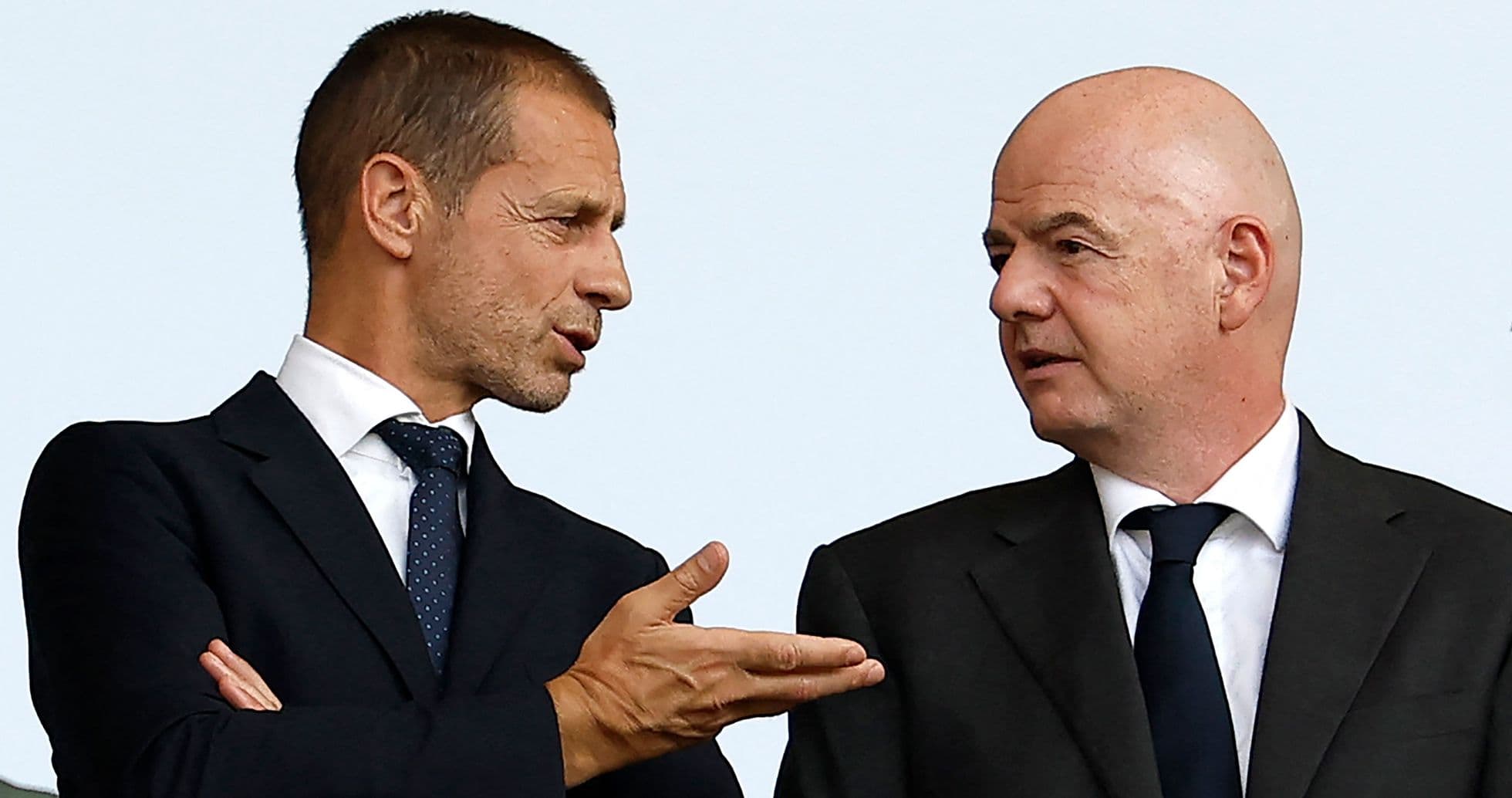
This is no passing protest. It is an open confrontation with Gianni Infantino’s presidency.
A unanimous rupture
The rupture began last Thursday, when UEFA’s member associations voted unanimously to withdraw from all FIFA events. The trigger was Infantino’s plan to sell minority stakes in the World Cup and other major FIFA competitions – a move that cut to the heart of what European officials believe the sport should be.
The backlash was immediate and ferocious. Under intense pressure from across the game, Infantino backed down. The proposal was withdrawn. The FIFA president then flew to Morocco, where he secured the backing of the organisation’s leadership at a high-level meeting on Wednesday.
On paper, that summit was meant to steady the ship. Inside FIFA, it did. Outside, in Europe, it barely made a dent.
‘These conditions have not been met’
UEFA’s new statement makes clear that shelving the sell-off idea was only one part of the equation.
“UEFA’s associations were very clear about the conditions attached to their non-participation in FIFA competitions,” the statement read. “First, the proposals to sell off the major competitions had to be withdrawn and secondly, assurances have to be made that such attempts to disfigure the game in this way will never be made again.
“These conditions have not been met,” it concluded.
That last line is the hinge on which this crisis now turns. Europe is not just demanding a tactical retreat from one controversial project; it wants guarantees that the game’s crown jewels will not be put on the block again.
FIFA, for its part, has tried to project unity. After the Morocco summit, the organisation insisted Infantino had the full support of those present. It even issued an apology to its own council and member associations for “errors” and pledged to ensure “they do not happen again.”
For UEFA, that fell well short.
Confidence lost in Infantino
In Saturday’s earlier communication, UEFA had already crossed a significant threshold: it publicly declared it had lost confidence in Infantino’s presidency. On Thursday, it underlined that nothing in the intervening days had changed its mind.
“UEFA made it abundantly clear in its statement on Saturday that it has lost confidence in Gianni Infantino’s presidency. That position holds,” the latest statement said.
Then came a pointed swipe at those rallying behind the FIFA president.
“Yesterday’s (Wednesday) announcement that some people employed by the FIFA President (and whose careers depend on his favour) agree with him changes nothing.”
That line strips away the diplomatic varnish. UEFA is openly questioning the independence of Infantino’s support base and, by extension, the legitimacy of the backing he claimed in Morocco.
FIFA did not immediately respond to a request for comment.
Legal shadows lengthen
The dispute is not confined to statements and press conferences. It is edging toward the courts.
UEFA confirmed this week that it has served FIFA with a “document preservation letter” – a formal notice designed to ensure that no potential evidence relevant to current or future legal action is deleted or destroyed. It is the kind of move that signals serious preparation for a possible legal battle, not a short-term political skirmish.
Behind the legal manoeuvres sits a deeper question: what kind of leader should sit at the top of world football?
Laura McAllister, UEFA vice president, set out Europe’s vision earlier on Thursday. Any future FIFA president, she argued, should be a “custodian of the sport”, someone capable of uniting the fractured global game.
“There’s so much politics around this. There’s such an imperative to get a candidate who could unite the whole world of football, not just Europe in this case,” she told Deutsche Welle.
Her words cut to the core of UEFA’s frustration. This is no longer just about commercial deals or one abandoned plan; it is about who shapes football’s future and on whose terms.
First test on the horizon
For now, UEFA’s boycott remains a statement of intent. The first real test arrives on September 5, when Poland is due to host the FIFA Women’s Under-20 World Cup.
If Europe stays out, the tournament will go ahead without the continent that has dominated the women’s game at youth and senior level. If it blinks, the power balance shifts back towards Zurich.
The clock is ticking toward that opening kick-off. So is the question hanging over FIFA: can Infantino convince Europe to come back, or is world football heading into a prolonged, historic split?