.svg&w=384&q=75 "GoalGist logo")
Udinese and Como Share Points in Serie A Opener
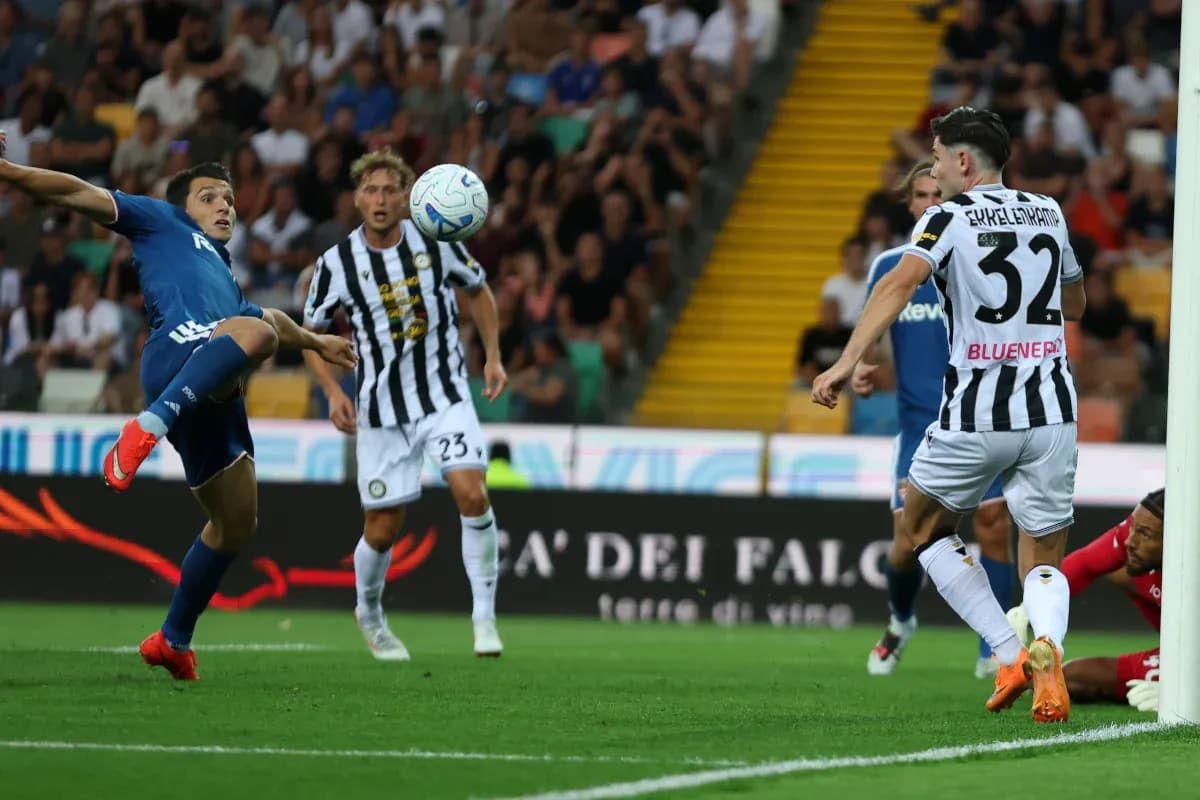
Under the late-summer light at the Bluenergy Stadium – Stadio Friuli, Udinese and Como opened their Serie A campaigns by drawing 1–1, a result that leaves both sides level on points and, more tellingly, still searching for a clear tactical identity. Following this result, Udinese sit 9th with 1 point, Como 8th with the same tally; both have scored 1 and conceded 1 overall, for a goal difference of 0 in each case.
I. The Big Picture – Two New Projects, One Shared Scoreline
Kosta Runjaic set Udinese up in a 3-4-2-1, a shape that immediately framed the story of their evening: three centre-backs and a broad midfield line designed to give freedom to the twin creators behind a lone forward. Como, under Cesc Fabregas, arrived with a 4-2-3-1, the classic modern control system: a double pivot to steady possession, three technicians between the lines, and a single striker asked to both finish and stretch.
The scoreline mirrors their early-season statistical DNA. Heading into this game, Udinese’s home numbers were non-existent; now, with one home match played, they average 1.0 goal scored and 1.0 conceded at home, and 1.0 scored and 1.0 conceded overall. Como, whose story so far is written entirely “on their travels”, also average 1.0 away goal scored and 1.0 away goal conceded, identical to their overall record. Two projects, one shared statistical profile.
II. Tactical Voids – Absences and Discipline
Udinese’s selection was shaped by a conspicuous list of absentees. A. Buksa was inactive, removing a potential reference point up front. G. Chakvetadze’s foot injury stripped Runjaic of a creative, line-breaking midfielder who could have complemented the advanced pair. A. Zanoli’s knee injury reduced flexibility in the wide defensive lanes, while C. Kabasele’s suspension for a red card forced the coach to lean heavily on youth and mobility in the back three.
That context explains the reliance on J. Abankwah, M. Palma and O. Solet as the defensive triangle. Without Kabasele’s experience, Udinese’s back line had to be more conservative in their positioning, often preferring to hold the line rather than step out aggressively. It also placed more responsibility on wing-backs and central midfielders to manage transitions.
Como’s only listed absentee, J. Addai with an Achilles tendon injury, removed a potential wide option for Fabregas but did not distort the core of his preferred structure. The back four and double pivot were intact, allowing Como to play closer to their tactical ideal.
Disciplinary patterns underline the difference in edge between the sides. Udinese have already collected a cluster of yellow cards. Across the campaign so far, their bookings have been spread in three distinct waves: 33.33% between 16–30 minutes, another 33.33% between 31–45, and 33.33% between 91–105, a profile that suggests early-game aggression and late-game desperation. Individually, Unai Gómez, J. Piotrowski and Abankwah all carry a yellow each. Como, by contrast, have yet to pick up a single yellow or red card in the league, hinting at either better control or a side still playing within itself.
III. Key Matchups – Hunter vs Shield, Engine Room vs Engine Room
The clearest “hunter” in Como’s ranks is A. Douvikas. His numbers from this opening stretch are sharp: 1 total goal in 1 appearance, 3 shots all on target, and a rating of 6.6 across 90 minutes. He is not merely a finisher; 9 total duels and 1 foul drawn show a striker willing to contest physically and occupy centre-backs.
Against Udinese’s “shield” of Palma, Solet and Abankwah, Douvikas’ movement between the lines and into the channels was critical. Abankwah, who completed 37 passes at an 86% accuracy and blocked 2 shots, showed he can be a proactive defender, but his yellow card and 6 duels contested underline that Udinese’s back line was stretched into individual battles more often than Runjaic might like. Solet and Palma, both natural central defenders, were tasked with balancing cover and aggression, particularly with Como’s three attacking midfielders rotating behind Douvikas.
For Udinese, the “hunter” role was more distributed. H. Kamara, nominally a midfielder, emerged as their cutting edge. He scored 1 goal from 3 shots (2 on target), completed 36 passes at 69% accuracy, and added 3 tackles plus 2 interceptions. Kamara’s profile tells the story of a box-to-box presence: arriving late into the area, then sprinting back to plug gaps when possession turned.
Behind him, J. Ekkelenkamp functioned as the creative axis. In 85 minutes, he registered 1 assist, 2 shots, 30 passes at 70% accuracy, and 4 tackles with 3 interceptions. Those defensive numbers are significant: Ekkelenkamp was not just threading passes between Como’s lines; he was also the first presser when Udinese lost the ball, often stepping into the lanes of L. Milla and M. Perrone in Como’s double pivot.
That duel in the engine room – Kamara and Piotrowski versus Milla and Perrone – was the game’s tactical heart. Piotrowski’s 30 passes at a 96% accuracy, 1 key pass and 7 duels (winning 3) underline his role as the stabilising conduit, but his yellow card hints at the cost of repeatedly stepping out to meet Como’s central creators. For Como, Milla and Perrone were tasked with both feeding the trio of N. Paz, M. Baturina and J. Rodriguez and screening the spaces Kamara loves to attack. The fact that Udinese still found a way to score from midfield shows that Fabregas’ double pivot, while tidy, can be pierced by well-timed runs from deep.
IV. Statistical Prognosis – Where This Draw Points Next
With both sides posting identical early-season numbers – 1.0 goals scored and 1.0 conceded per match overall, no clean sheets, and no penalties taken or missed – the statistical picture is one of equilibrium rather than dominance. Udinese’s yellow-card clusters suggest a team that plays on emotional edges, something that could become costly against more ruthless opponents. Como’s spotless disciplinary record, meanwhile, may reflect composure but also hints at a side that has not yet pushed the physical limits of Fabregas’ pressing ideas.
In tactical terms, Udinese’s 3-4-2-1 offers a clear platform: Kamara’s two-way influence, Ekkelenkamp’s hybrid creator-enforcer role, and a back three that, once reinforced by returning players, could become more assertive. Como’s 4-2-3-1 already has a reliable spearhead in Douvikas and a structurally sound spine; the next step is turning their controlled possession into a higher volume of high-quality chances.
Following this result, both teams leave Friuli with matching records but different questions. Udinese must refine the balance between aggression and control in midfield and tighten their discipline. Como must find ways to unleash their attacking midfield trio more consistently while protecting their double pivot from overloads. The numbers say parity; the tactical trajectories suggest two projects that may diverge sharply as the season unfolds.