.svg&w=384&q=75 "GoalGist logo")
Turki Al-Sheikh's Bid for Derby County: A Defining Moment for Football's New Regulator
English football’s new independent regulator has barely found its feet. It already faces a moment that could define its credibility.
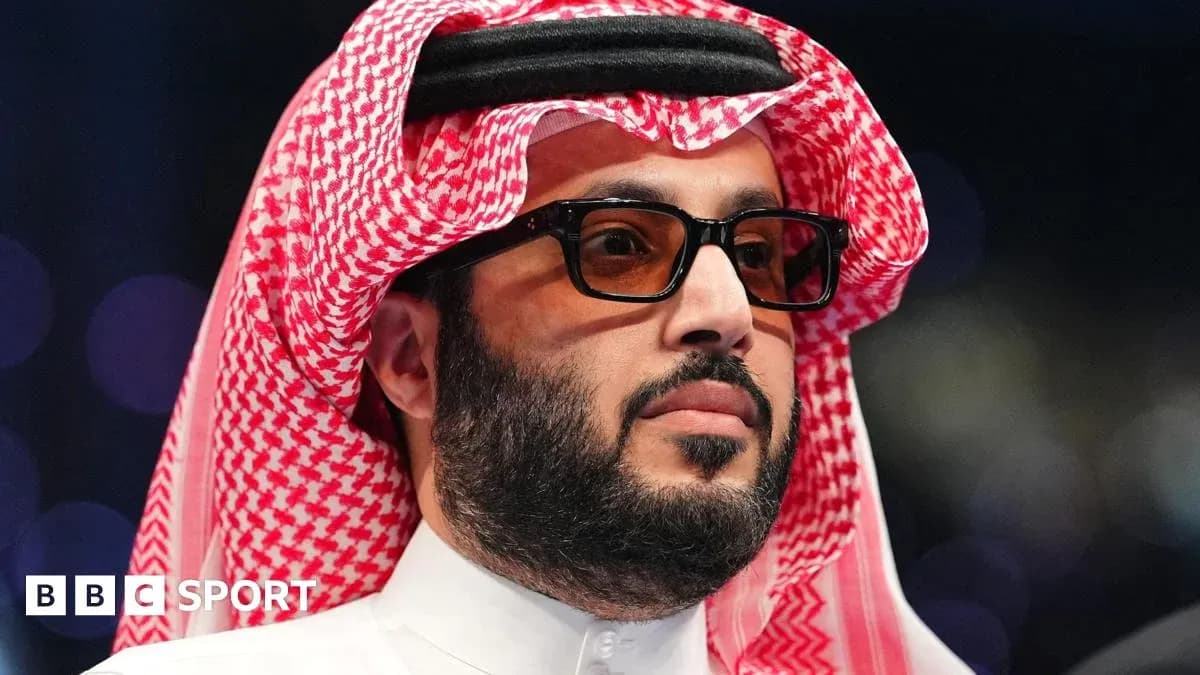
Turki Al-Sheikh, one of the most powerful figures in Saudi sport and entertainment, is trying to buy into Derby County. Not a full takeover, not yet, but a stake in a club that dates back to the 19th century and still sees itself as a sleeping giant.
On paper, it is another investment story in the age of global capital. In reality, it is a collision between money, morality and a brand-new regulatory system that was supposed to protect the game from exactly this kind of unease.
A heavyweight investor, and a heavy question
Al-Sheikh is not some distant fund manager. He is chairman of Saudi Arabia’s General Entertainment Authority, a central figure in the inner circle of the country’s de facto ruler, Mohammed bin Salman. He has owned clubs in Spain and Egypt. In boxing, he has become a kingmaker, stitching together the sport’s biggest nights and reshaping the calendar around Saudi money.
His name is already familiar to English football’s corridors of power. There were previous takeover talks at Bristol City, and interest in Southampton and Millwall. Now Derby County, a Championship club rebuilding after the trauma of administration, has become the latest target.
Any deal cannot move without the sign-off of the Independent Football Regulator (IFR), the new watchdog created last year to safeguard the future and integrity of the game. The IFR has taken over the owners’, directors’ and senior executives’ test for Championship investment from the English Football League.
This is where the stakes sharpen.
“This is a defining test for English football’s new independent regulator,” said Felix Jakens, head of campaigns at Amnesty International UK. He did not dress it up.
“Will it allow a senior representative of a government directly implicated in mass human rights violations to take control of one of the country's oldest football clubs? The regulator must ask these questions and answer them transparently.”
The IFR, the EFL and Derby County have all declined to comment on Al-Sheikh’s interest. So have his representatives. Silence, for now, while the debate rages around them.
Saudi footprint grows, scrutiny deepens
The argument is not new. Saudi Arabia has been accused of using sport and culture to soften its global image, to distract from a human rights record that includes the treatment of women, the use of the death penalty and an anti-LGBT stance that has been widely condemned.
With Newcastle United already majority-owned by Saudi Arabia’s Public Investment Fund, Amnesty International has warned that any stake for Al-Sheikh at Derby “would mark a significant expansion of Saudi Arabia's footprint in English football”.
Amnesty says 356 people were executed in Saudi Arabia last year, a record figure that human rights organisations have attacked. For Jakens, that context cannot be brushed aside simply because the conversation has moved from Tyneside to the East Midlands.
“The serious questions surrounding Saudi involvement in sport anywhere in the world are just as relevant here,” he said. “Al-Sheikh is not a private businessman. He is the chairman of Saudi Arabia's General Entertainment Authority.”
The potential deal also pushes English football towards another sensitive fault line: multi-club ownership.
Al-Sheikh’s links to the Saudi power structure behind Newcastle will only increase scrutiny of how influence is spread and where decisions are really made. The Premier League’s owners’ and directors’ test already forbids any individual or entity from directly or indirectly determining the management of more than one English league club.
If Derby’s new money comes from a figure so embedded in the same ecosystem that bankrolls Newcastle, regulators will be forced to show how robust those rules truly are.
A club rebuilt, and a fanbase split
Derby County have only just clambered back from the brink. Rams owner David Clowes, the Derbyshire property developer who bought the club out of administration in the summer of 2022, stabilised a listing institution and returned it to the Championship. Since 2024, he has been open about needing help to push it further, saying he could be prepared to sell upwards of 80% of his share.
That invitation has now drawn one of the most controversial names in world sport to Pride Park.
The reaction among Derby supporters is exactly what you would expect in 2026’s version of football: torn, noisy, conflicted.
Some fans look at Al-Sheikh and see possibility. A billionaire’s ambition. A fast lane back to the Premier League after almost two decades away. Others see something darker – a club identity bargained away, ethical lines crossed for a shot at promotion.
Rams supporter Nick Webster, speaking on BBC Radio Derby’s Sportscene at Six, did not pretend the fanbase could glide through this unscathed.
He said there is “no skirting around” how divided supporters will be. “Many are excited by the billions that potentially could be invested, and then there are the human rights and all the other issues that are going on. Then there will be people in the middle, and it will make a lot of people uncomfortable.”
That discomfort is precisely where English football now lives: between the dream of financial security and the reality of where that money comes from.
The showman factor
Not everyone at Derby is wrestling with the ethics first. Some are dazzled by the scale of Al-Sheikh’s sporting vision.
Sam Jones, a Derby County fan and boxing manager who has worked with Al-Sheikh, admitted he was “excited straight away” by the idea of the Saudi powerbroker helping bankroll the Rams’ climb back towards the top flight.
He points to May’s extraordinary boxing spectacle at the Pyramids of Giza – headlined by Oleksandr Usyk’s world title fight with Rico Verhoeven and featuring Jones’s own fighter Jack Catterall on the undercard – as a taste of what Al-Sheikh can deliver.
“In my 10 years in boxing I've been to some very mad places, and my fighter Jack has just won a world title [WBA 'regular' welterweight belt] on the foot of the pyramids,” Jones told BBC Radio Derby.
“Before Jack's ring walk, about half an hour before, there was a bit of a sandstorm. It was completely crazy. But to have that type of vision for boxing, to put on a show there, you've got to have serious ambition.
“And if Turki Al-Sheikh does take over the club or invest heavily in the club, whatever he's doing, and he puts in a quarter of the effort that he has done with boxing, making all the biggest fights come true, then Derby County fans need to be very excited.”
That is the seductive side of the equation: the idea that the same man who staged a world title fight at the foot of the pyramids could turn Pride Park into a stage for something bigger than the weekly grind of the Championship.
A new regulator’s first real storm
Strip away the emotion, and one truth remains: this is precisely the kind of scenario the Independent Football Regulator was created to handle.
A powerful foreign political figure. A club with a fragile recent history. A fanbase split between hope and unease. A growing pattern of Saudi involvement in English football. Questions over multi-club influence. All of it lands on the desk of a body barely a year old.
How the IFR applies its new test for owners, directors and senior executives will echo far beyond Derby. It will tell supporters across the country whether this regulator is prepared to challenge state-linked wealth, or simply manage its arrival.
For Derby County, the decision could shape the next decade. For English football’s new watchdog, it could define its entire existence.