.svg&w=384&q=75 "GoalGist logo")
Nigeria Super Falcons Aim for WAFCON Glory and World Cup Qualification
Nigeria are not easing into this title defence. They are going for it.
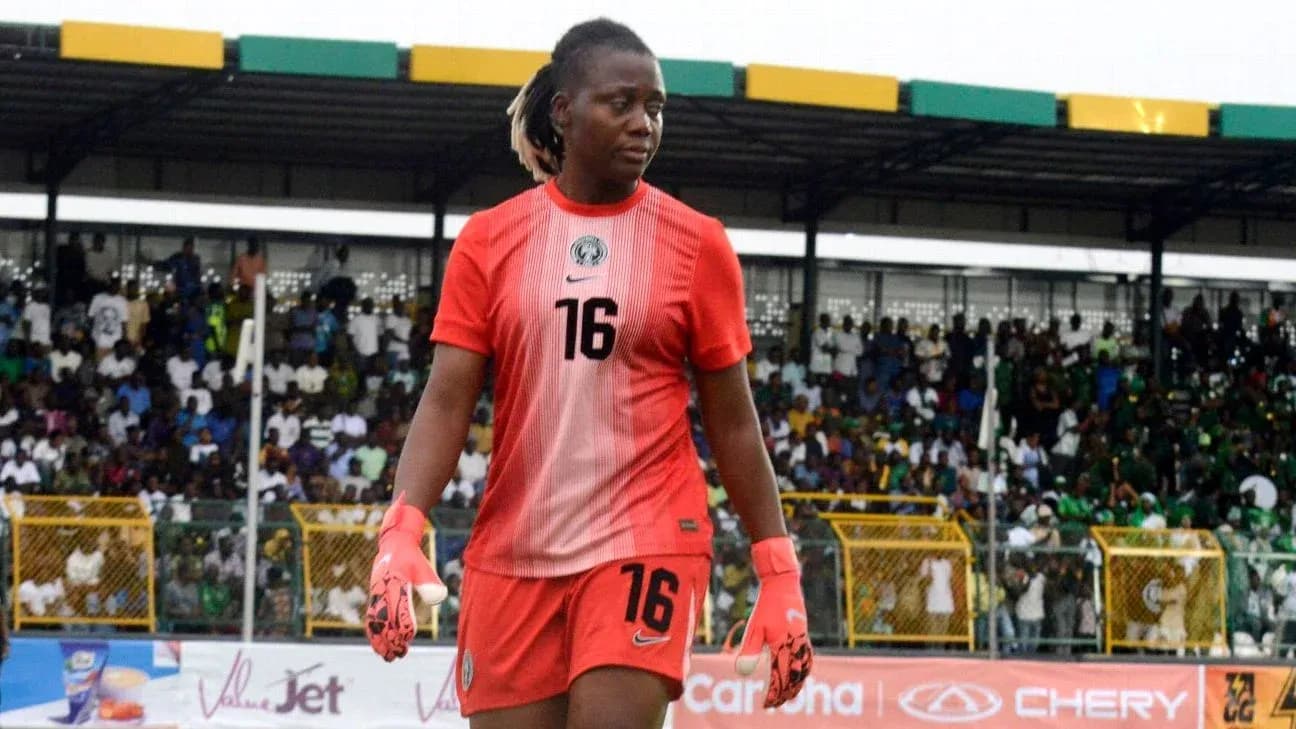
Head coach Justine Madugu has rolled out a 25-player squad built on the spine of the team that claimed a record 10th Women’s Africa Cup of Nations crown last year, with captain Rasheedat Ajibade, goalkeeper Chiamaka Nnadozie and talismanic forward Asisat Oshoala all named for the trip to Morocco.
The mission is two-fold and unforgiving: keep the African throne, and punch an automatic ticket to the 2027 FIFA Women’s World Cup in Brazil.
World Cup streak on the line
Nigeria stand alone on the continent. They are the only African nation to have qualified for every FIFA Women’s World Cup since the inaugural edition in 1991, one of just seven countries worldwide with that perfect record.
That history now hangs on what happens in Morocco.
With WAFCON doubling as World Cup qualifying, Madugu has been blunt about priorities. Reach the semifinals, secure a World Cup berth, and only then worry about polishing the trophy again.
“The next WAFCON will also serve as qualification for the 2027 FIFA Women’s World Cup, so our priority will first be to ensure that we make it to the World Cup,” he told CAFonline. “The second goal will be to defend the trophy and bring it back to Nigeria. We know it won't be easy because as champions everybody will now be looking at us.”
Nigeria know the target on their backs. They helped create it.
Plumptre’s absence, and a message from the sidelines
The most jarring name missing from the list is Ashleigh Plumptre. The defender, a key figure in last year’s run, has not recovered from the injury she suffered in March and will sit out this tournament.
Her absence is more than tactical; it’s emotional. Plumptre addressed it directly on social media, explaining that “the body is asking for more time and I'm listening,” before urging fans to back the team and “go easy on them, they need you.”
She will not be in Morocco, but her words will travel with the squad.
Old guard, new edge
Even without Plumptre, this is a group heavy on experience and hardened by big nights.
Nnadozie, widely regarded as Africa’s standout goalkeeper, anchors a side that has been built to handle pressure. Ajibade returns not just as captain but as a driving force from midfield, while Oshoala remains the reference point in attack, a veteran who has seen almost everything the women’s game can throw at her.
Around them, the core that edged hosts Morocco 3-2 in last year’s final is largely intact. Osinachi Ohale, Michelle Alozie, Christy Ucheibe and Halimatu Ayinde bring steel and know-how, players who understand both the grind of a tournament and the expectation that comes with wearing the green shirt.
The squad is not just about the past, though. The next wave is already on board.
Jennifer Echegini and Deborah Abiodun add fresh legs and ideas in midfield, while Gift Monday, Esther Okoronkwo and Omorinsola Babajide offer pace and unpredictability in the final third. They are no longer simply “ones for the future” – they are part of the present, expected to carry real responsibility as the Super Falcons evolve.
Only one player, goalkeeper Fatima Oloko of Abia Angels, is home-based. The other 24 are drawn from clubs across Europe, North America, Asia and the Middle East, underlining how global this squad has become.
Group C and the road through Rabat
Nigeria have been placed in Group C alongside Egypt, Zambia and debutants Malawi, with all three group matches to be played in Rabat.
On paper, Nigeria will be favourites to top the group. Zambia, with their own growing reputation, will test that. Egypt bring technical quality, Malawi the unpredictability of a first-time participant. Any slip could complicate a campaign where the margins for error are thin.
The tournament itself has grown. Sixteen teams now contest WAFCON, and that expansion has raised both the standard and the stakes. The four semifinalists will qualify automatically for the 2027 World Cup, while the fifth-placed side will head to an intercontinental playoff.
Madugu knows what that means. “We are holding something precious that everybody wants,” he said. “But we will remain resolute and focused and try as much as possible to achieve both objectives.”
History in their sights
Nigeria’s record is already unmatched: 10 WAFCON titles, the standard by which every other African women’s team measures itself.
This time, there is another layer to the challenge. No team has yet defended the trophy in the expanded 16-team format. Nigeria have the chance to become the first.
The pressure is obvious. So is the opportunity.
If the Super Falcons can navigate Group C, punch through to the semifinals and keep their nerve in the knockout rounds, they will not only extend their World Cup streak but also reaffirm their status as the continent’s benchmark.
The rest of Africa is closing the gap. Morocco are investing heavily, Zambia are rising, others are catching up. Nigeria arrive in Morocco with a familiar burden: prove, once again, that the crown still fits.
Nigeria WAFCON squad
Goalkeepers:
- Chiamaka Nnadozie (Brighton & Hove Albion, England)
- Comfort Erhabor (Portsmouth Ladies, England)
- Fatima Oloko (Abia Angels)
Defenders:
- Osinachi Ohale (Pachuca Tuzas, Mexico)
- Michelle Alozie (Chicago Stars, USA)
- Shukurat Oladipo (AS Roma, Italy)
- Rofiat Imuran (London City Lionesses, England)
- Glory Ogbonna (FC Kiryat Gat, Israel)
- Oluwatosin Demehin (Galatasaray Sportive, Turkey)
- Sikiratu Isah (Bnot Netanya, Israel)
- Christy Ucheibe (SL Benfica, Portugal)
Midfielders:
- Rasheedat Ajibade (Paris Saint-Germain, France)
- Halimatu Ayinde (BK Häcken, Sweden)
- Deborah Abiodun (Washington Spirit, USA)
- Toni Payne (Everton Ladies, England)
- Jennifer Echegini (Paris Saint-Germain, France)