.svg&w=384&q=75 "GoalGist logo")
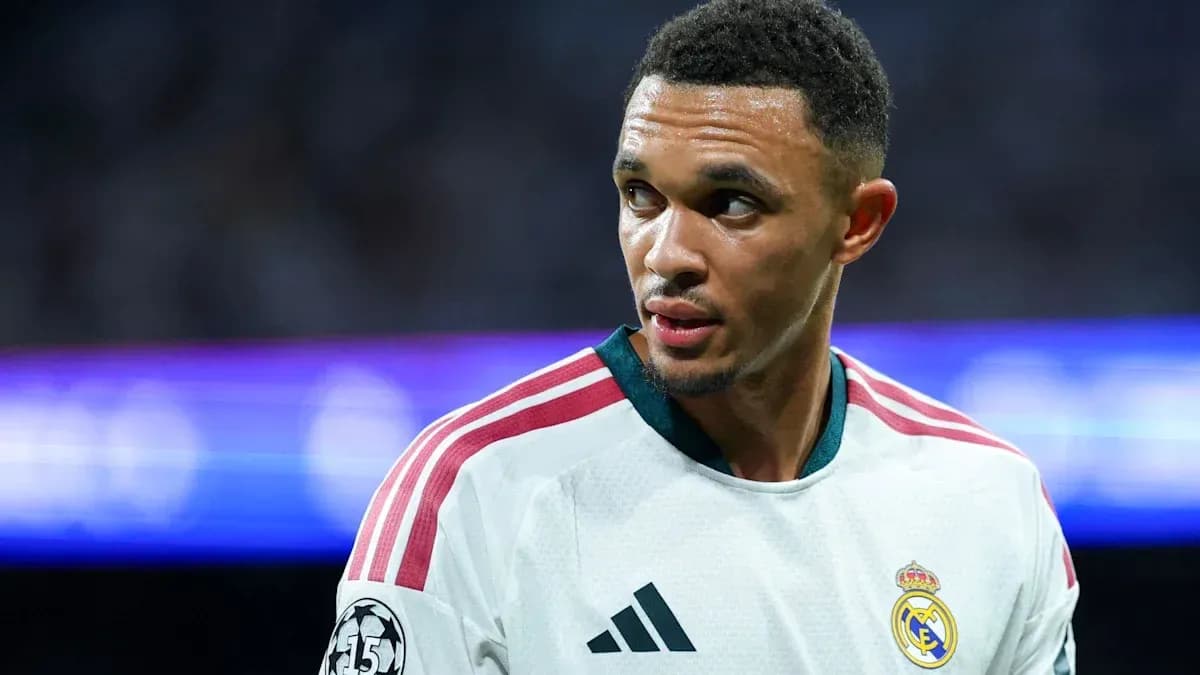
Trent Alexander-Arnold: The Midfield Debate Continues
The Trent Alexander-Arnold midfield debate refuses to die. It keeps circling back, no matter how many managers try it, tweak it or quietly shelve it.
Gareth Southgate gave it a go with England at Euro 2024, pushed him into the centre, then walked away from the idea after just two group games. Jurgen Klopp built entire Liverpool game plans on Alexander-Arnold drifting infield to dictate play, but always from a right-back starting point. Now it is Jose Mourinho’s turn to experiment.
On Tuesday night, under the Champions League lights, Mourinho named Alexander-Arnold in midfield for Real Madrid’s 2-1 win over Inter Milan. Not as an auxiliary full-back stepping inside. As a midfielder.
The obvious question followed: is this finally where he belongs?
Mourinho’s verdict: effective, but not a midfielder
Mourinho’s answer was blunt.
“He has played midfield with England and Liverpool... but he is not a midfielder,” the Real Madrid manager said after an edgy victory at the Bernabeu.
That was the headline. The performance, though, was more nuanced.
“He has played very well. He has interpreted what he needed to really well, tactically. Both him and Valverde have worked very well at this level.”
So Mourinho praised him, leaned on him, then shut down the idea that this would become a permanent switch. He was, he stressed, “very grateful” for Alexander-Arnold’s work in the middle. Just don’t expect to see it every week.
The context mattered. Real Madrid were short. Suspensions for Eduardo Camavinga, Arda Guler and Bernardo Silva stripped Mourinho of three midfield options and forced him to improvise. Alexander-Arnold, 27 now and still fighting for a clear identity in Spain, became the solution.
A mixed night in the middle
Alongside Federico Valverde, Alexander-Arnold produced a performance that felt like a snapshot of his career-long debate: flashes of vision, questions about the rest.
He created two chances. He attempted more crosses than any other Real player. His passing accuracy dipped to 83.3%, and he did not win a single tackle.
When Inter pulled a goal back on 77 minutes, Mourinho reacted. Alexander-Arnold’s number went up. As he walked off, whistles rolled around the stadium. They sounded like irritation at Real’s nervy display rather than a personal verdict on the England international, but the timing did him no favours.
This was the first competitive game in which Alexander-Arnold and fellow right-back Denzel Dumfries started together. Mourinho had tried the pairing in pre-season against Fiorentina, with Alexander-Arnold at right-back and Dumfries pushed further forward on the same flank.
The message is clear: Mourinho is still searching for his definitive right-back. Last season, Alexander-Arnold had to scrap with Dani Carvajal. This season, the battle is with Dumfries.
Even so, those close to the situation say Mourinho has been impressed. He values Alexander-Arnold’s professionalism, his attitude and, crucially, his versatility. That ability to slide into central areas, to act as an extra playmaker, sets him apart from many traditional full-backs.
His strengths remain obvious: passing range, crossing, through balls, set-piece delivery. All the tools of a creative midfielder – just not, in Mourinho’s eyes, the full package.
England’s great midfield experiment
This is not new territory for Alexander-Arnold. Southgate’s attempt to remodel him as a central midfielder for England stretched over more than a year and ended with a quiet retreat.
In June 2023, Southgate handed him the number 10 shirt for a European qualifier away to Malta. England won 4-0, Alexander-Arnold scored from midfield and the idea suddenly looked exciting.
“I haven't played it too much, but it feels comfortable,” he told Channel 4 afterwards. “It feels natural, I will say that. It's somewhere I can see myself playing.”
Southgate kept flirting with the experiment over the following 12 months. Then came Euro 2024. Alexander-Arnold started in midfield, struggled to convince, and the plan collapsed after an underwhelming 1-1 draw with Denmark. He was substituted before the hour, the gamble effectively over.
Mourinho’s words after the Inter game hinted at the same tension.
“He has lost some balls because it is not the same to play in this position compared to at right-back,” he said. “The intensity of physical work is quite difficult. He has a different engine. He has given 100%. He left the pitch with nothing left to give.”
That last line felt telling. No one doubts the effort. The argument is about fit.
A player between roles
Right now, Alexander-Arnold sits in an awkward space. Not fully trusted as Real Madrid’s starting right-back. Not viewed by his club manager as a natural midfielder. Yet still too gifted on the ball, too unique in profile, to be ignored.
For Mourinho, that makes him a tactical tool. Someone who can bend a shape, overload a side, or patch a gap in midfield when suspensions bite. For Alexander-Arnold, it leaves the same old question hanging over his career.
Is he a full-back who plays like a midfielder, or a midfielder trapped in a full-back’s body?
Real Madrid’s season, and England’s next tournament cycle, may finally force a definitive answer. Or the debate might just rumble on, every big night in Europe offering another audition for a role that still doesn’t quite feel his own.