.svg&w=384&q=75 "GoalGist logo")
Serie A Opening Match: Torino vs AC Milan Tactical Analysis
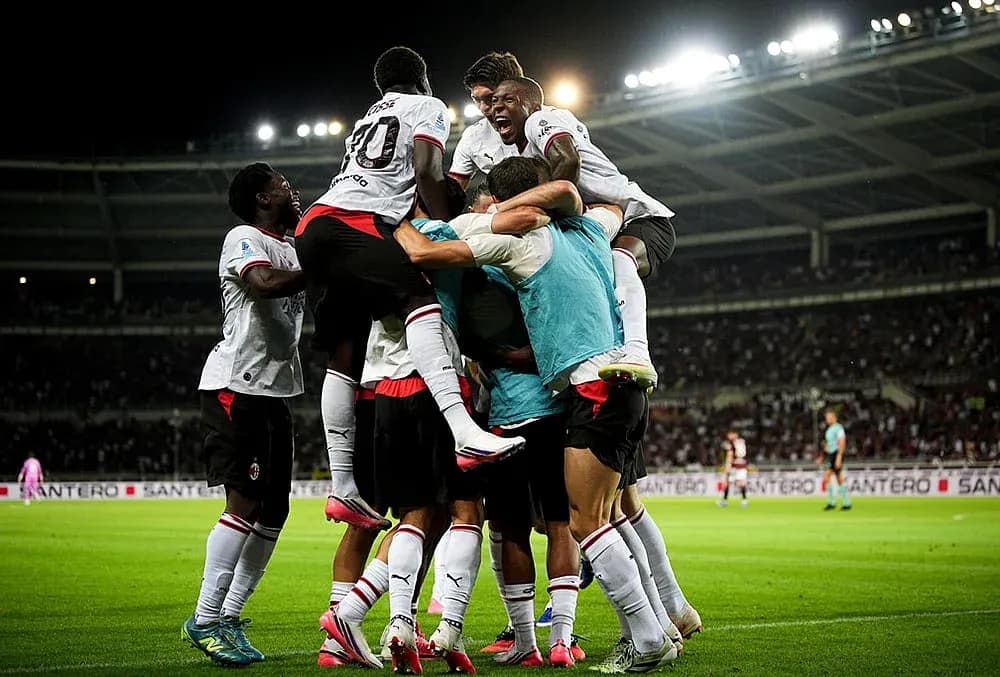
Under the Turin lights at the Stadio Olimpico Grande Torino, Serie A’s new season opened with a tactical mirror match: Torino and AC Milan both stepping into a 3-4-2-1, both trying to define their identities for 2026–27. By full time, Milan had edged a 2–1 win, leaving Torino in 13th with 0 points and a goal difference of -1, while Milan climbed to 5th with 3 points and a goal difference of +1. Beyond the scoreline, this was a study in how the same structure can express two very different footballing ideas.
I. The Big Picture – Same Shape, Different Intent
Torino, under Ignazio Abate, leaned into a compact, almost ascetic version of the 3-4-2-1. With D. Mascardi behind a back three of S. Coco, A. Ismajli and P. Comuzzo, the priority was clear: protect the central lane, funnel Milan wide, and trust the wing-backs and midfield screen to survive the storm.
In front of them, M. Pedersen and G. Gineitis flanked K. Fitz-Jim and A. Cacciamani in a flat four across midfield. Ahead, N. Vlasic and C. Casadei worked in the half-spaces behind G. Simeone. On paper, it was a structure capable of springing quick vertical attacks; in practice, Torino’s attacks often arrived in moments rather than sustained waves.
Heading into this game, Torino’s season numbers were a blank slate; following this result, their overall record stands at 1 match played, 0 wins, 0 draws and 1 defeat, with 1 goal scored and 2 conceded. At home, they have played 1, scored 1 and conceded 2, mirroring that overall profile.
Ruben Amorim’s Milan, also in a 3-4-2-1, felt far more expansive. M. Maignan marshalled a back three of M. Gila, K. De Winter and S. Pavlovic, with P. Estupinan and S. Chukwueze as aggressive wide operators. In central midfield, Y. Musah and A. Jashari provided the engine, while R. Loftus-Cheek and A. Cisse supported G. Ramos up top.
Following this win, Milan’s overall record is 1 match, 1 win, 0 draws, 0 defeats, with 2 goals scored and 1 conceded. On their travels, they have played 1, won 1, scored 2 and conceded 1 – an away profile that already hints at a side comfortable imposing themselves outside San Siro.
II. Tactical Voids – Absences and Discipline
Both squads were reshaped by notable absences. Torino were without F. Anjorin (hip injury), F. Israel (shoulder injury), P. Pellegri (knee injury) and E. Comert, suspended by a red card. The loss of Comert in particular removed an experienced presence from the back line, forcing Abate to trust Coco and Comuzzo to handle Milan’s forward rotations.
Milan’s absences were even more high-profile: R. Leao (muscle injury), S. Gimenez (ankle injury), and the inactive trio of Y. Fofana, C. Nkunku and F. Tomori. Without Leao’s chaos on the left and Tomori’s recovery pace, Amorim leaned into control and structure rather than raw transition speed.
Disciplinary trends were telling. Milan’s season card data shows a single yellow arriving between 46–60 minutes, a 100.00% concentration in that time band. That caution belongs to R. Loftus-Cheek, who, across his 56 minutes, committed 1 foul and took 1 yellow card. It underlines a pattern: Milan’s aggression spikes just after half-time as they try to tilt the game, occasionally stepping over the line.
Torino’s card distribution so far is blank across all time ranges – no yellows, no reds this season. It speaks to a side that defended more by position than by desperate interventions, but also hints at a possible lack of controlled aggression when chasing the game.
III. Key Matchups – Hunter vs Shield, Engine Room Battles
The “Hunter vs Shield” duel in this early-season snapshot sits between Milan’s emerging scorers and Torino’s still-forming defensive identity. For Milan, A. Cisse and A. Rabiot have already announced themselves as decisive figures. Cisse, starting here and now on 1 league goal, produced 3 shots, 1 on target, and won 6 of 10 duels. His willingness to occupy awkward pockets between Torino’s wide centre-backs and wing-backs constantly stretched Abate’s back three.
Rabiot, coming from the bench in this match and already with 1 goal and 1 assist in the league, offers a different kind of threat: late, vertical runs from midfield. His 12 passes with 1 key pass and 1 shot on target show how he can tilt a game with minimal volume but maximum impact. Even when not starting, his profile looms over any tactical plan Torino might build for a future rematch.
Torino’s shield is still being forged. Gineitis is emblematic of that process. Over 90 minutes he completed 30 passes with 86% accuracy, produced 1 key pass and 1 assist, won all 3 of his duels and even blocked 1 shot. He was both metronome and firefighter, dropping into the back line when needed and stepping up to connect with Vlasic and Casadei. If Torino’s defensive record (2 goals conceded at home, 2 overall) is to tighten, it will be through his maturation as a two-way pivot.
In the “Engine Room” matchup, Musah and Jashari had the edge. Musah’s energy and Jashari’s positional discipline allowed Milan to compress the central third, suffocating Torino’s build-up through Fitz-Jim and Cacciamani. With Chukwueze wide right – 45 passes, 4 key passes, 2 shots and 1 assist – Milan effectively turned their right flank into a launchpad. His duel with Pedersen down that side was a recurring motif: Pedersen trying to hold shape, Chukwueze constantly looking to break it.
Further forward, Loftus-Cheek’s role as a hybrid between midfielder and second striker added another layer. Despite a modest rating and that yellow card, his 3 shots and 3 key passes underline how he kept pulling Torino’s back line into uncomfortable decisions: step out and risk space in behind, or sit off and allow him to turn.
For Torino, the late introduction of C. Adams, already on 1 goal this season from just 20 minutes of league action, changed the tone. With 1 shot on target, 11 passes at 72% accuracy and a willingness to attack the near post, Adams offered a more direct threat than Simeone had managed. His chemistry with Gineitis – the scorer finding the assister – is a partnership Abate will likely lean on as the season deepens.
IV. Statistical Prognosis – Where the Numbers Point
With only one league match played for each side, the statistical sample is thin but suggestive. Torino’s overall attacking output stands at 1 goal from 1 match, with an overall average of 1.0 goal scored per game and 2.0 conceded. At home, those averages are identical: 1.0 for, 2.0 against. They have yet to keep a clean sheet, but they have also not failed to score.
Milan, conversely, show a more assertive profile on their travels: 2 goals scored and 1 conceded away, for an away average of 2.0 goals for and 1.0 against. There are no penalties taken or missed for either side so far; finishing has come entirely from open play and crafted chances.
Without explicit xG data, we read intent and sustainability from patterns. Milan’s ability to create through multiple channels – Cisse’s movement, Chukwueze’s wide threat, Rabiot’s late surges, Loftus-Cheek’s half-space presence – suggests their current scoring rate is not a fluke. Their away structure feels robust rather than opportunistic.
Torino, meanwhile, look like a side whose defensive numbers could improve as the back three gels and as Gineitis continues to grow into his role. The fact that their biggest defeat so far is this 1–2 at home, and that they still found a way to score, hints at resilience rather than fragility.
Following this result, the tactical ledger tilts towards Milan: a more layered attack, a midfield capable of controlling tempo, and a defensive unit that, even without Tomori, conceded just once away. Torino’s story is more embryonic – a disciplined structure, flashes from Adams and Gineitis, and the promise that with returning players and more minutes in this system, that -1 goal difference can begin to move in the right direction.