.svg&w=384&q=75 "GoalGist logo")
South Africa's World Cup Journey: A New Era for Bafana Bafana
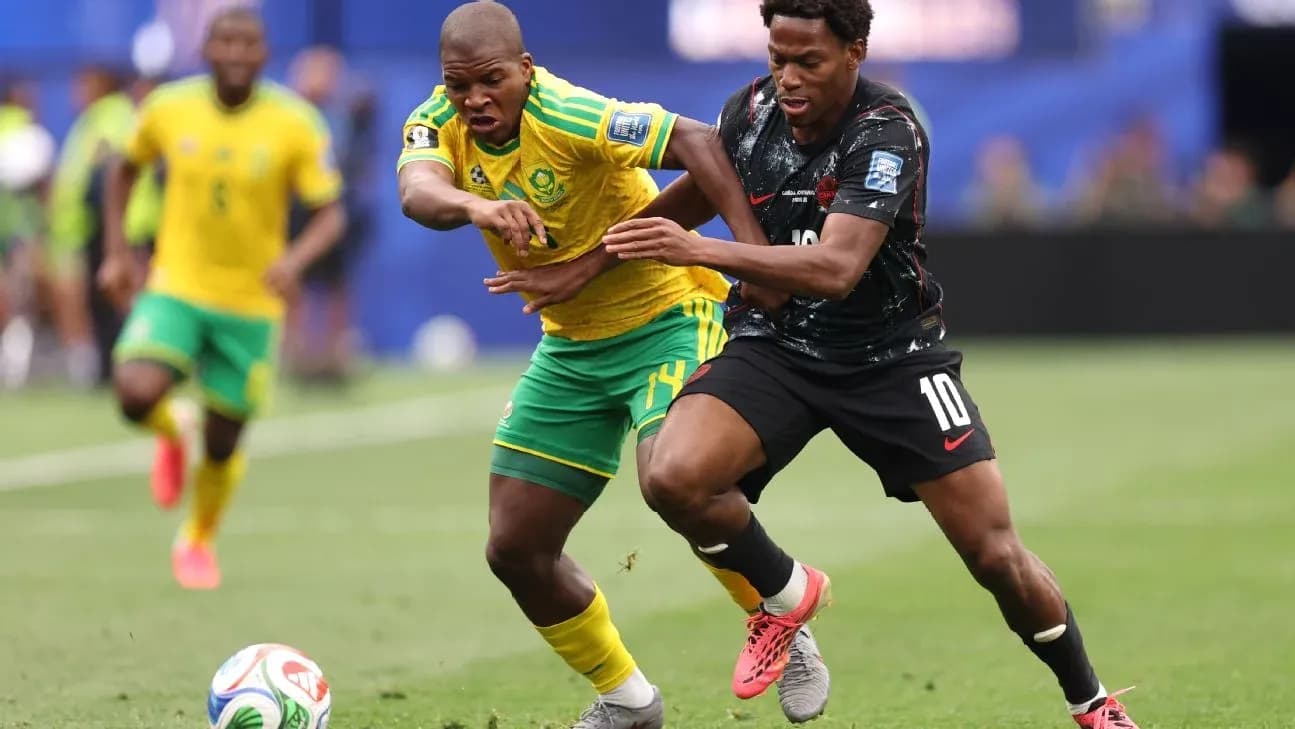
South Africa’s World Cup exit hurt. It had to. A 1-0 defeat to Canada in the round of 32, a tight game decided by fine margins, will sting for a while yet.
But this was no hollow cameo after 16 years away from the biggest stage. Bafana Bafana walked off having made history, and, more importantly, having left behind the outline of a team that can grow into something far more dangerous by 2030.
This wasn’t just nostalgia and flags in the stands. There were hard football truths on show – and most of them were encouraging.
Centre-back for a generation
If there is one department South Africa can file under “sorted”, it is the heart of defence.
Mbokazi and Okon did not simply survive the World Cup. They imposed themselves on it. Thrown into the pressure cooker as starters, both defenders rose with a calm that belied the scale of the occasion. Mbokazi, in particular, emerged as one of the standout centre-backs of the tournament, reading danger early, winning duels, and playing with the authority of a man who plans to be around for a long time.
Behind them, the production line is already humming. Olwethu Makhanya, Khulumani Ndamane, Tylon Smith, Malibongwe Khoza, Aden McCarthy and others form a queue of young defenders ready to step in if anything happens to “TLB” or Okon, whether for a game or for good.
Whoever sits in Hugo Broos’ chair by the next World Cup cycle will not be short of options at centre-back. For a nation that has often scrambled for stability in that area, that is a quiet revolution.
Mofokeng: the ace still in the pack
If there was one selection debate that refused to die during this World Cup, it centred around Relebohile Mofokeng.
Many Bafana supporters wanted to see more of the Orlando Pirates attacking midfielder. Broos did not share their total conviction, at least not yet, and that frustrated a fanbase that sees Mofokeng as a generational talent.
He is 21. Time is firmly on his side.
When he did get his stage, he grabbed it. His performance in the 1-0 win over South Korea carried the swagger of a player who belongs at this level, a youngster unfazed by reputations and bright lights. That display alone suggested he can trade blows with global stars rather than simply admire them.
A move to Belgium’s Royale Union Saint-Gilloise is widely reported to be close. If it materialises, it will offer precisely the kind of platform he needs: regular European football, tactical education, a tougher weekly grind. If he grows as expected, the coach in charge of Bafana in 2030 will not just have a promising midfielder. He will have a match-winner, the kind of player you hide up your sleeve for when a knockout tie drifts towards chaos.
South Africa have unearthed the card. Now the next four years will decide how sharp it becomes.
Homegrown, world-class
One of the most striking features of South Africa’s campaign was who led it.
Not a wave of Europe-based stars parachuted in for a month. Instead, a core of players who have built their careers entirely at home, in the South African Premiership, and then stepped into the World Cup without flinching.
Teboho Mokoena of Mamelodi Sundowns patrolled midfield with a mix of bite and composure. Alongside him, Thalente Mbatha of Orlando Pirates showed why he is so highly rated, pressing intelligently and using the ball with maturity. On the flanks, Sundowns fullbacks Khuliso Mudau and Aubrey Modiba provided energy and balance, switching seamlessly between defence and attack.
Behind them all, Ronwen Williams again justified his status as captain and standard-bearer. The goalkeeper produced key interventions at crucial moments, the kind that keep tournaments alive and remind the world why his name has travelled far beyond South Africa’s borders despite him never leaving home at club level – first at SuperSport United, now at Sundowns.
Their collective impact told its own story. The domestic league is not a backwater. It is a proving ground.
Of course, some of the country’s brightest youngsters will need to test themselves abroad to reach their ceiling. But this World Cup underlined a vital truth for every kid juggling a ball on a dusty pitch: you do not have to leave South Africa to become a serious professional, or to be seen on the world stage.
Maseko, the comeback and a country’s hope
No tale from this campaign carried more human weight than that of Thapelo Maseko.
At 20, he scored his first goal for Bafana at the 2023 Africa Cup of Nations, finally played in early 2024. Hugo Broos clearly liked him. The winger looked set for a straight-line rise.
Then the curveball. A move from SuperSport United to Mamelodi Sundowns should have been a launchpad. Instead, under new coach Miguel Cardoso from December 2024, Maseko found himself on the outside looking in. Rarely used, often dispatched to the reserves, he drifted to the margins.
By mid-2025, the strain showed. In August, he posted on social media about losing his love for football. For a young talent to admit that publicly said everything about where he was mentally.
Five months later, in January 2026, came the lifeline: a loan to AEL Limassol in Cyprus. From there, his story flipped.
He played. He mattered. Confidence returned. By March, he had forced his way back into the Bafana squad. This month, he wrote his name into South African football history.
His goal against South Korea did more than win a match. It pushed Bafana into the World Cup knockout rounds for the first time ever. One swing of his boot, and a country that had learned to manage its expectations suddenly allowed itself to dream again.
Maseko’s journey – from reserves and doubt to national hero – resonated far beyond tactics and formations. It was a reminder that careers can be rescued, that talent can be revived, that hope is sometimes just one opportunity away.
Money, mistakes and a second chance for SAFA
Off the pitch, the picture has been far less romantic.
SAFA walked into this World Cup under a cloud of financial anxiety. Players had been paid late after the previous African Nations Championship. Operating costs had repeatedly outstripped revenue. The governing body looked stuck in a cycle of firefighting and short-term fixes.
This tournament has not magically erased those problems. But it has changed the landscape.
Just by reaching the group stage, SAFA were due at least $9 million in performance-based payouts, excluding preparation fees. Progressing to the round of 32 added another $2 million, taking the total to $11 million.
That is not a windfall that solves everything. It is, however, a crucial buffer. It buys time. It provides breathing space for development projects, for youth structures, for basic operational stability across the game.
The knock-on effect could be even more significant. A team that qualifies for a World Cup and then reaches the knockouts becomes far easier to sell to sponsors. Bafana did not just turn up; they “made a good account of themselves”, as administrators like to say. For commercial partners, that matters.
The challenge now is discipline. A new cash injection can either paper over old cracks or fund a genuine reset. The past few years have shown what happens when South African football lives hand-to-mouth. The next few will reveal whether SAFA can move from survival mode to long-term planning.
South Africa leave this World Cup with tears in their eyes and something far more valuable in their hands: proof.
Proof that they can defend at an elite level for years to come. Proof that a 21-year-old playmaker might yet become a star. Proof that the domestic league can produce global competitors. Proof that a winger who once thought of walking away can drag a nation into the knockouts.
The question now is simple and unforgiving: does South African football have the courage and competence to turn this moment into a new era, rather than just another cherished memory?

