.svg&w=384&q=75 "GoalGist logo")
Socceroos Draw with Paraguay: Australia Unites for World Cup
Australia used to stop for a horse race. On Friday, it stopped for a stalemate.
In pubs and public squares from Sydney to Canberra, the country held its breath as the Socceroos ground out the 0-0 draw with Paraguay that sealed their passage to the World Cup knockout stage for a second successive tournament. No goals, no problem. It was enough.
A nation clocks off
This was history before a ball was kicked. For the first time, a Socceroos World Cup match fell neatly inside Australian working hours. Offices thinned, classrooms emptied, and the country’s productivity graph took a sharp dip around kick-off.
In Sydney’s inner west, the Golden Barley filled early. Gold and green shirts, laptops open, beers half-drunk and emails half-written. Small business owners Jamie and Rick Hayman were among those who decided work could wait.
Rick, who runs a local construction company, tapped away at admin with his staff nearby, eyes constantly drifting to the screen. He has followed the Socceroos “forever” and has seen the shift.
“It unites the community,” he said. “Pubs get filled up, there’s all the talk around town, it’s really good to see.”
A few stools away, four old friends had turned the front row in front of the TV into their own private terrace. Nick, Guinness in hand, wore an original 1974 Socceroos jersey – a relic from the year Australia first made it to a World Cup. The shirt was a reminder: this is no longer a novelty. This is expectation.
Nick and his partner Robyn, veterans of those bleary-eyed 3am kick-offs, admitted they missed the old ritual of dragging themselves from bed in the dark to watch Australia on the other side of the world.
“We were just saying this morning, we used to wake up in the middle of the night, it used to be really good,” he said, laughing. “It’s a unique experience. A family experience.”
This time, though, the family experience came with coffee, sunlight and a packed pub instead of a lonely lounge room.
Sardines in the rain
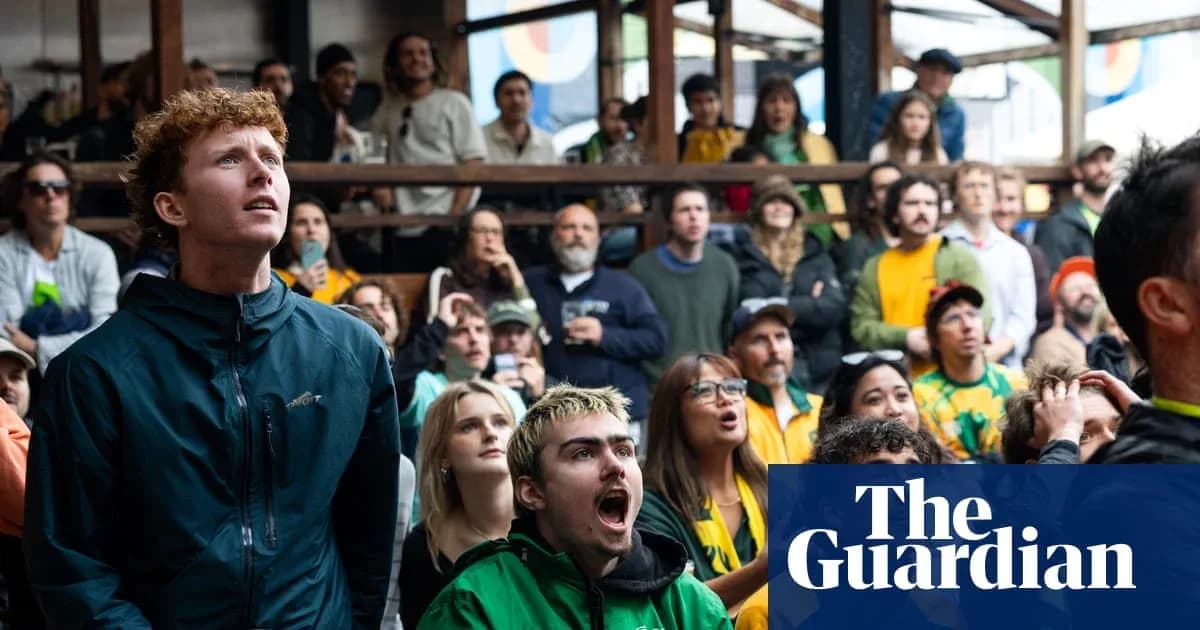
Down the road at the Vic on the Park, the mood swung between joy and dread. Hundreds squeezed in, shoulder to shoulder, the kind of crush that only football and finals jeopardy can produce. When the rain arrived in the first half, jackets went over heads, scarves doubled as makeshift hoods, ponchos were dragged from bags. No one moved from their spot.
The game refused to budge, too. Goalless. Tight. Nerve-shredding.
After 80 minutes of deadlock, the tension needed an outlet. A few “Aussie, Aussie, Aussie” chants cut through the drizzle, answered by the unlikely howl of a dog in the front bar. As the clock wound down and the maths turned in Australia’s favour, the mood shifted. The fear loosened its grip.
When the final whistle went, the relief hit first. A bald man with a stick-on Australian flag tattooed to his head grabbed his friends in a bear hug. Pints flew, phones came out, strangers clapped each other on the back. A scoreless draw rarely feels like this.
Some in the room had planned their day around it months ago, booking leave the moment the fixtures dropped. Others improvised. Sophie and her son Orson, a year 11 student, had been there the previous weekend when Australia lost 2-0 to the USA in the early hours. This time, Orson skipped the last day of term. Sophie worked quietly from her phone, eyes mostly on the game.
“This is of national importance,” she said. “I really want Oscar to hear a goal in the pub, just to hear us lift.”
The goal never came, but the lift did.
Oscar, who dreams of becoming a football coach, watched the packed room and saw more than just a result.
“Football’s growing,” he said. “It’s been brilliant, so cool to see so many people supposed to be working coming to support their country.”
Federation Square erupts – without a goal
In Melbourne, Federation Square turned into a sea of green and gold long before kick-off. Victoria Police put the crowd at 7,500, with capacity reached by 10am as fans streamed in, skipping school, calling in sick, or simply deciding that this was where they needed to be.
Hours before the players walked out, the square became a playground. High-stakes bottle-flip contests drew roars worthy of a last-minute winner. Teenagers bragged loudly about “wagging” school, others waved permission notes from parents like golden tickets.
When the national anthem rang out, seven flares exploded in a burst of colour and smoke. The moment came at a cost: a 16-year-old was arrested. The passion spilled over again later, with three teenagers issued penalty notices for riotous behaviour and moved on by police.
At times, the sheer weight of bodies turned the square into a living, swaying organism. An unseen shove would send a ripple through the masses, people stumbling, then regaining their feet before turning as one to find the culprit and chant a single, unambiguous verdict: “Wanker.”
Among the crowd stood former Socceroos midfielder Craig Foster, watching a new generation fall for the national team.
He called it a “near perfect game” for Australia.
“The squad depth has been demonstrated,” he said. “They’ve done exactly what was required … Australia is managing well, learning very quickly, and it’s a beautiful day anytime the Socceroos get through to knockout rounds.
“We are here. We’re still in this tournament, and we’re fighting all the way. There’s nothing better in life.”
Near him, teenager Ali Abolhasani and his friend were living that emotion at a different volume. In the crush against the barricades they tumbled to the ground, lost their shoes, and got back up still singing.
Asked how he felt after the final whistle, Abolhasani didn’t hesitate.
“Amazing,” he said. “I can’t wait to come back next week. We did an all-nighter, we couldn’t sleep because we knew we’d make it … We’ll do it again.”
Capital fever
Even in Canberra, where the set-up at Garema Place was modest – just two screens and a makeshift fan zone – World Cup fever had clearly arrived. More than 500 fans gathered, wrapped in flags and beanies, turning a small square into a capital cauldron.
ACT senator David Pocock slipped into the crowd and saw what many others did: a national team that looks like the country it represents.
“The Socceroos, as it’s been talked about this week in parliament, represents what is so great about Australia,” he said. “We do have so many people from diverse backgrounds coming together, and you see the way that that resonates across the country.”
On Friday, that resonance sounded like chanting in the rain, like bottle caps clinking on concrete, like a dog howling at the right moment. It looked like teenagers losing their shoes at Federation Square, like a 1974 jersey in a Sydney pub, like a construction boss finishing his paperwork between corners.
No goals. No chaos on the pitch. Just a point that keeps Australia alive, and a nation that has decided, once again, that when the Socceroos play for their future, everything else can wait.