.svg&w=384&q=75 "GoalGist logo")
Sevilla's Narrow Victory Over Real Sociedad: A Tactical Analysis
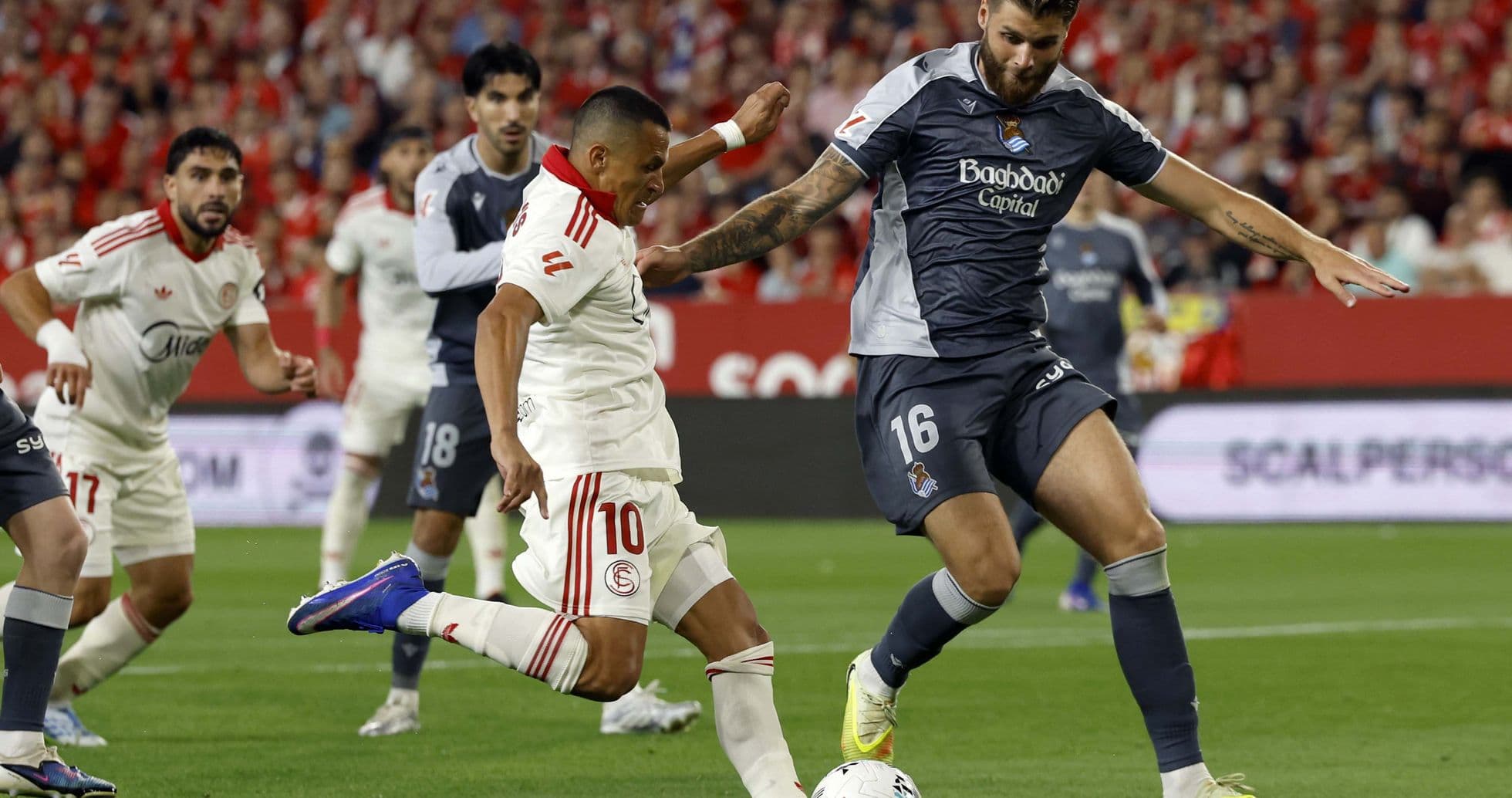
Under the Seville night sky, Estadio Ramón Sánchez Pizjuán watched a season’s tension crystallise into a narrow, vital 1-0 home win for Sevilla over Real Sociedad. Following this result, the league table still paints a stark contrast: Sevilla sitting 17th on 37 points, clinging to safety, Real Sociedad 9th with 43 points and an eye on Europe. Yet for ninety minutes in this Regular Season - 34 clash, the gap in the standings was erased by structure, risk management and a single decisive thrust.
I. The Big Picture – A team remade by necessity
Sevilla’s season-long identity has been fragile: only 10 wins from 34 matches overall, with a negative goal difference of -14 (41 scored, 55 conceded). At home they have been marginally more reliable, with 6 wins from 17, scoring 22 and conceding 23. Luis Garcia Plaza leaned into pragmatism, choosing a 4-4-2 that felt less like nostalgia and more like survival.
O. Vlachodimos anchored a back four of José Ángel Carmona, Castrin, K. Salas and G. Suazo. Ahead of them, a hard-running midfield line of R. Vargas, L. Agoume, N. Gudelj and C. Ejuke provided legs and coverage, while I. Romero and N. Maupay formed a combative, mobile front two. It was a shape built not to dominate the ball, but to compress space and protect a defence that has conceded an overall average of 1.6 goals per game this campaign, including 1.4 at home.
Real Sociedad arrived with a more expansive 4-2-3-1, consistent with a season in which they have scored 52 overall (1.5 per game) but conceded 53 (also 1.6 per game). A. Remiro stood behind a back four of J. Aramburu, J. Martin, D. Caleta-Car and S. Gomez. The double pivot of B. Turrientes and J. Gorrotxategi was tasked with both shielding and initiating, while an attacking trio of A. Barrenetxea, C. Soler and P. Marin supported lone forward M. Oyarzabal, La Liga’s seventh-ranked scorer with 14 goals and 3 assists.
II. Tactical Voids – Absences that reshaped the contest
The absentees list told its own tactical story. Sevilla were without M. Bueno (knee injury), Marcao (wrist injury) and D. Sow (suspension for yellow cards). The loss of Sow in particular stripped Sevilla of a ball-winning presence in midfield, forcing greater responsibility onto Agoume and Gudelj. Both responded with a performance defined by discipline rather than flair: Agoume, who has already collected 10 yellow cards this season, walked a fine line but provided the necessary bite.
At the back, the absence of Marcao placed extra defensive weight on Castrin and K. Salas. Sevilla’s season data shows only 6 clean sheets overall; adding one more here, against one of the league’s more dangerous attacks, underlined how compact the unit became once ahead.
For Real Sociedad, the missing names were all from the attacking and wide corridors: G. Guedes (toe injury), J. Karrikaburu (ankle), A. Odriozola and I. Ruperez (both knee). Deprived of Guedes’ direct running and Odriozola’s overlapping threat, Pellegrino Matarazzo had to lean even more heavily on Barrenetxea and Oyarzabal for incision.
Barrenetxea came into the game as one of La Liga’s leading creators, with 5 assists and 3 goals, plus 42 key passes and 106 dribble attempts. Yet without a full complement of runners around him, many of his touches were forced into congested central areas, where Sevilla’s narrow 4-4-2 block could swarm.
Disciplinary trends also hung over the match. Sevilla’s season card profile shows a late-game spike in yellow cards, with 19 yellows (19.79%) between 76-90' and another 18 (18.75%) between 91-105'. Real Sociedad, meanwhile, pick up 22.22% of their yellows between 46-60' and 16.67% between 76-90'. Both sides, then, are historically at their most combustible just as legs tire and spaces open. That context made the final quarter of an hour feel like a tightrope walk, especially for serial offenders like Carmona (11 yellows) and Agoume (10 yellows), and for the aggressive J. Aramburu, who has committed 63 fouls this season.
III. Key Matchups – Hunter vs Shield, and the engine room war
The headline duel was clear: the “Hunter” M. Oyarzabal against a Sevilla defence that has often leaked goals. Oyarzabal’s 14-goal haul is built on volume and quality: 58 shots, 34 on target, and a perfect penalty record this season with 6 scored from 6. His movement between the lines, drifting off the front to combine with Soler and Barrenetxea, was designed to pull Castrin and K. Salas into uncomfortable zones.
But Sevilla’s “Shield” was collective rather than individual. Carmona, one of the league’s most combative defenders with 59 tackles, 7 blocked shots and 34 interceptions, set the tone on the right. His duels with Barrenetxea were among the game’s defining skirmishes: the dribbler who has attempted 106 take-ons against a full-back who relishes contact and has already committed 45 fouls. Sevilla accepted that Carmona would live on the disciplinary edge; in return, he gave them aggression and verticality down the flank when chances to break appeared.
In the “Engine Room”, Lucien Agoume squared up to Real Sociedad’s double pivot. Agoume’s profile – 1 goal, 2 assists, 1199 passes at 80% accuracy, 59 tackles and 43 interceptions – speaks of a midfielder who can both recycle and destroy. Against Turrientes and Gorrotxategi, his task was to disrupt the first phase of Real Sociedad’s build-up, denying clean service into Oyarzabal’s feet.
On the other side, Barrenetxea’s creative burden was immense. With 5 assists, 42 key passes and 50 successful dribbles, he is the away side’s primary conduit between midfield and attack. Yet Sevilla’s narrow four-man midfield, with Gudelj screening and Vargas and Ejuke pinching in off the flanks, frequently forced him to receive with his back to goal or wide with little support. The result: Real Sociedad had territory but struggled to translate it into clear, central chances.
IV. Statistical Prognosis – Why the 1-0 felt logical
Following this result, the numbers of the season frame the 1-0 as both an outlier and an evolution. Sevilla, who average 1.3 goals scored and 1.4 conceded at home, produced just enough attacking clarity to edge a side that typically scores 1.2 goals per game on their travels and concedes 1.6. Real Sociedad’s overall goal difference of -1 (52 for, 53 against) hints at a team that lives on fine margins; in Seville, those margins finally tilted against them.
With neither side having missed a penalty this season (Sevilla 5 from 5, Real Sociedad 7 from 7), the game was always likely to be decided in open play or by a single moment of transition. Sevilla’s choice of 4-4-2, rarely used this season compared to their more frequent 4-2-3-1, gave them an extra body on the last line to press Real Sociedad’s build-up and to attack second balls. Maupay and Romero, the former a relentless presser, the latter a vertical runner who has already shown his willingness to take risks – including one missed penalty this season – continually threatened to turn loose passes into counters.
In the end, the 1-0 home win felt like the purest expression of context: a relegation-threatened side, with a fragile defence and a history of late yellow-card chaos, choosing structure over spectacle and trusting a compact block to suffocate a more talented but depleted opponent. For Sevilla, it was a night where the squad’s rough edges – Carmona’s edge, Agoume’s aggression, Romero’s directness – were finally sharpened into a single, decisive blade. For Real Sociedad, it was a reminder that even a side with Oyarzabal and Barrenetxea can be blunted when the supporting cast is stripped away and the opposition’s need is greater.