.svg&w=384&q=75 "GoalGist logo")
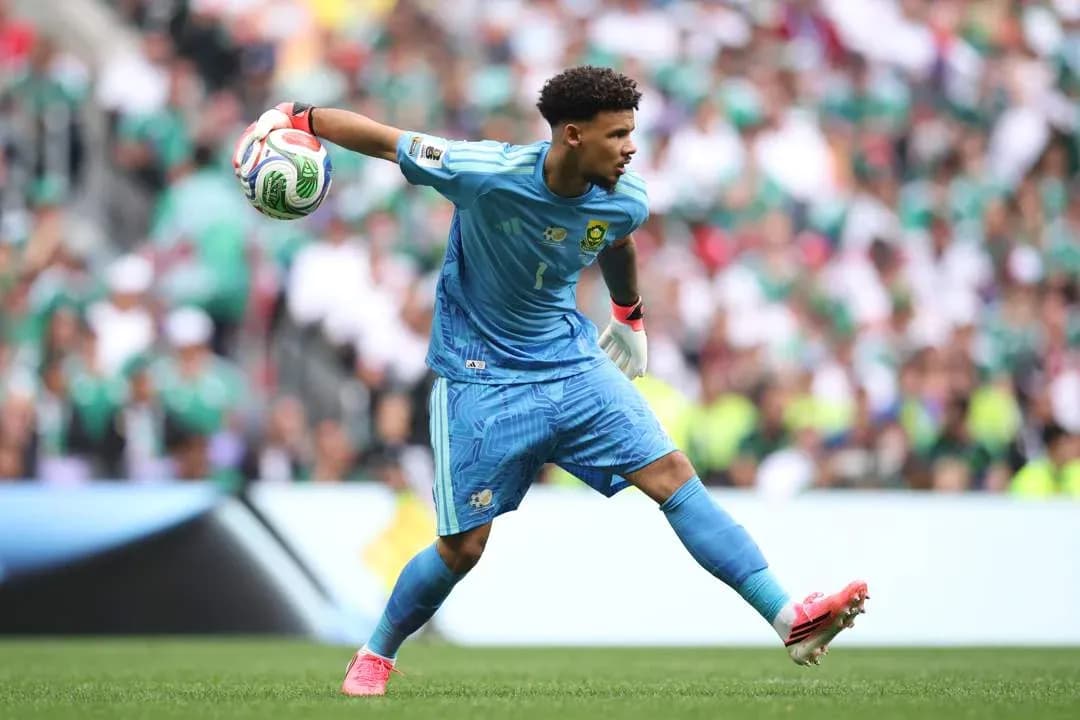
Ronwen Williams Addresses Social Media Abuse Ahead of World Cup Clash
Ronwen Williams stands in the middle of a World Cup storm, and the fiercest blows are not coming from opposition strikers.
They are coming from his phone.
On the eve of Bafana Bafana’s crucial 2026 FIFA World Cup Group A clash against Czechia in Atlanta, the captain laid bare the scale of the social media abuse he and his teammates have absorbed – from South Africans and from angry voices across the continent. The timing is as bitter as it is symbolic: the game falls on the International Day for Countering Hate Speech.
A dream soured by politics and a slow start
For this generation of Bafana players, the World Cup was supposed to be a long-awaited return to the biggest stage. Many of them were kids when South Africa last graced the tournament in 2010 on home soil. This was their chance to write a new chapter.
Instead, the campaign has opened under a cloud.
A limp 2-0 defeat to Mexico at Azteca Stadium on 11 June did more than dent hopes of progression. It lit the fuse. FIFA’s social media protection service has confirmed that Bafana players are facing unprecedented levels of online abuse at this tournament, with the overall volume of incidents across the World Cup already surpassing the entire tally from Qatar 2022 – and we are only a week in.
The football alone would have been enough to provoke criticism. But South Africa’s hardening anti-immigrant posture has poured fuel on the fire, dragging Bafana into a political fight they did not start and cannot control.
Hate-watching Bafana
At the centre of the domestic debate sits March and March, a vigilante-style group that calls itself “a grassroots citizen movement addressing growing concerns about undocumented immigration in South Africa”. Their rhetoric has grown louder, their marches more menacing. They have set 30 June as a deadline for undocumented migrants to leave the country, with scenes from their demonstrations hinting at what might follow if that ultimatum is ignored.
The noise has reached the highest office. President Cyril Ramaphosa has felt compelled to address the nation on border security. Across the continent, anger at South Africa’s stance has morphed into something more personal for Bafana: “hate watching” from some African supporters, hoping the national team fails.
That resentment has bled into the digital space. Fake news has travelled fast, including a fabricated quote attributed to Williams and even carried by reputable outlets. The bogus statement claimed the captain criticised Africans who backed Mexico over Bafana and said the team “almost shed a tear”.
Williams’ response is weary but firm.
“We know how difficult it is now on social media, where everyone is attacking you,” he said. “Sometimes it’s because of false information. If you lose a game, and you don’t perform, you can take it as players. You can put your hand up. But when there’s false information that goes around, then it hurts.
“I have been a target over the last few days over things I didn’t say. I didn’t say anything about Africa, or people supporting Mexico. I have always said that as Africa, we are one. We support each other in good and bad moments.
“We’ve all got our own politics, our own problems and our own fights that we deal with back home. Every country has that. I don’t know where that stems from. It does hurt. I have been attacked... my country as well, for things that are going on back home.”
Old wounds, new tournament
This is not the first time South Africa’s internal tensions have spilled onto the pitch.
In 2019, amid a spate of xenophobic attacks in the country, Madagascar and Zambia refused to play scheduled international friendlies against Bafana. Coach Molefi Ntseki, newly installed after Stuart Baxter, was forced into the 2021 Africa Cup of Nations qualifiers without the proper preparation those games would have provided.
The fallout was brutal. Bafana failed to reach Afcon, finishing third in a group containing Ghana, Sudan, and São Tomé and Príncipe.
Six years on, the backlash has evolved. The anger is now global, amplified by algorithms and anonymous accounts, and directed squarely at the players’ mentions.
“Players are human beings as well. We go through it. Sometimes it gets a lot,” Williams admitted. “You want to focus on doing your job, which is being a footballer, but then you get involved in politics even though you don’t want to get into that space.”
Football as refuge – and battleground
For all the toxicity, Williams still clings to football’s power to heal.
“But the wonderful thing about sport is that it can unite, it can make or break you. It can bring people together,” he said. “We are in Atlanta now, and I see so many Africans... so many South Africans and people from Mexico, in one room. That’s the beauty of sport. That’s the beauty of football.
“So, let’s just enjoy and have a wonderful time, and we leave politics to the politicians. Let us just play football, and enjoy ourselves.
“Criticise us for what happens on the field, but off the field things – we can’t deal with that, and it has nothing to do with us. As Africans, let’s unite and keep going because we are all in this together.”
The reality, though, is that there is no escape. The team’s World Cup path is now intertwined with how they cope with the hostility – from beyond South Africa’s borders and from their own fans. The stakes are harshly clear: the top two teams in each group reach the last 32 automatically, with eight of the best third-placed sides from the 12 groups also advancing.
A win against Czechia would drag Bafana back into contention. Anything less, and the noise grows louder.
Blocking out a million opinions
Inside the camp, the players have tried to wrestle back control of their environment.
“As sad as this sounds, players have accepted it, that that’s how things are in the world now,” Williams said of the online abuse. “We’ve had meetings to discuss this as players. But you have an experienced coach in coach Hugo (Broos), who says that the most important thing is to analyse the game.
“That is the most important thing, to block out the noise, focus on how we can do better, learn from our mistakes and just stick together as a team.
“If you are going to listen to a million people’s opinions, then you will lose your mind. So, at this moment, the most important comment and the person to listen to is our coach and technical team. He knows us, and we know him. He knows our strengths and weaknesses.
“We are there for one another. We came here together, and we will leave here together. So, let us stick together as a team and keep the focus.”
On Thursday in Atlanta, under the glare of a global audience and the shadow of a divided nation, Bafana Bafana must prove they can do exactly that – play a football match, and not be consumed by a country’s politics and a continent’s rage.