.svg&w=384&q=75 "GoalGist logo")
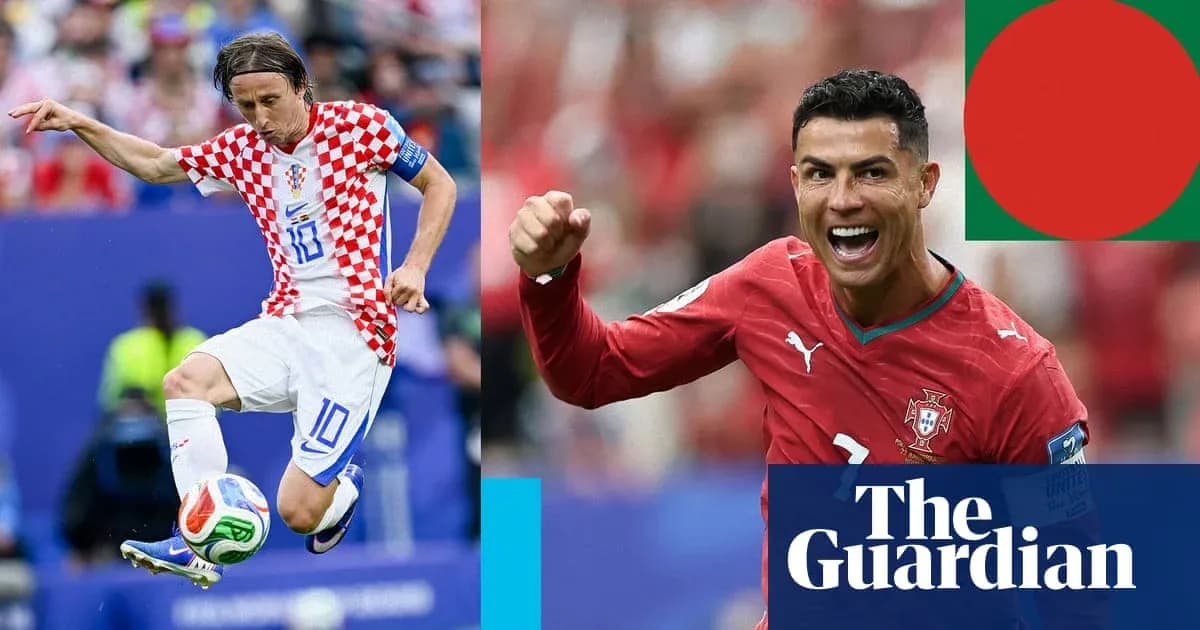
Ronaldo and Modric: A Legendary Football Era Approaches Its End
Can you remember what you were doing on 1 March 2006?
Maybe you were at Anfield, watching England edge Uruguay 2-1. Maybe you saw Switzerland put three past Scotland at Hampden. Or maybe you were tuned into a friendly in Basel where a skinny playmaker named Luka Modric quietly stepped into international football for the first time.
That night Croatia beat Argentina 3-2. Lionel Messi scored his first international goal. In Riyadh, Cristiano Ronaldo struck twice in a 3-0 win for Portugal against Saudi Arabia, already looking like a man who expected the world to bend to his ambition.
Messi and Ronaldo went on to split football’s stage between them, trading Ballons d’Or and Champions League finals like heavyweight belts. Through it all, Modric stayed in the picture too – not as the billboard star, but as the rhythm, the metronome, the one who kept everything moving while others chased headlines.
Three men, one era. And yet their story now loops back to that first night.
Ronaldo, now 41, and Modric, 40, stand on the brink of their 232nd and 202nd caps respectively as Portugal face Croatia in the last 32 of the World Cup. Two hundred caps is a frontier only four men have ever crossed. Ronaldo and Modric are already in that club, shoulder to shoulder in a tiny, exclusive room.
This meeting might be the last time they share a pitch. It feels like a curtain call.
What sets them apart is not just the quality, but the sheer relentlessness of their service. When Modric made his Croatia debut, Ronaldo had already played 29 times for Portugal. More than two decades on, the gap has grown by just one cap. Year after year, tournament after tournament, they kept picking up the phone when their country rang.
No managed exits. No quiet retirements. Just an unbroken line of games, almost in parallel.
Their paths first crossed in England in 2008‑09, long before the statues and the Ballons d’Or and the parades in Madrid. The Carling Cup final at Wembley: Manchester United v Tottenham. Modric in white, Ronaldo in red. Both played the full 120 minutes, both rated a 7, both already central to how their teams functioned. United won on penalties. It felt like just another domestic final at the time. In hindsight, it was the opening chapter of a long, shared story.
They met again with higher stakes in the 2010‑11 Champions League quarter-finals, by which point Ronaldo had swapped Manchester for Madrid. Real Madrid went through, as they so often would in the seasons to come, but Modric had done enough over those two legs to catch a few important eyes in Spain.
Soon they were not opponents but allies.
When Modric arrived at Real Madrid, he walked into a dressing room dominated by Ronaldo’s presence and demands. Over six seasons together, they turned that tension into trophies. Four Champions League titles. Semi-finals in the other two campaigns. A dynasty built on Ronaldo’s ruthless finishing and Modric’s control of time and space.
If there was a single image that captured their partnership, it came in Cardiff in 2017. Real Madrid v Juventus, Champions League final. Madrid already 2-1 up, the game stretched, nerves frayed. Modric darted into the right channel, cut the ball back with precision, and Ronaldo met it to make it 3-1. A simple finish at the end of a move that summed them up: the creator and the executioner, working in perfect sync.
That goal was one moment from a staggering shared catalogue. They played 222 matches together. No central midfielder has spent more time on a pitch with Ronaldo than Modric. He fed the No 7’s runs, took the ball under pressure when others hid, and stitched together games that Ronaldo so often decided.
Now they arrive at another crossroads, no longer in their prime but still in the arena, still insisting on relevance. One has reinvented himself as a penalty-box predator, the other as a deep-lying conductor who plays as much with his head as with his legs. The numbers remain absurd: 232 caps for Portugal, 202 for Croatia, and counting.
As Portugal and Croatia line up in the knockout rounds, the stakes are simple. One will go on. One will go home. The era they helped define is already fading in the rear-view mirror, but neither man has quite let go of the wheel.
If this is the last time Modric and Ronaldo share a pitch, it will not just close a chapter for two players. It will close one for international football itself.