.svg&w=384&q=75 "GoalGist logo")
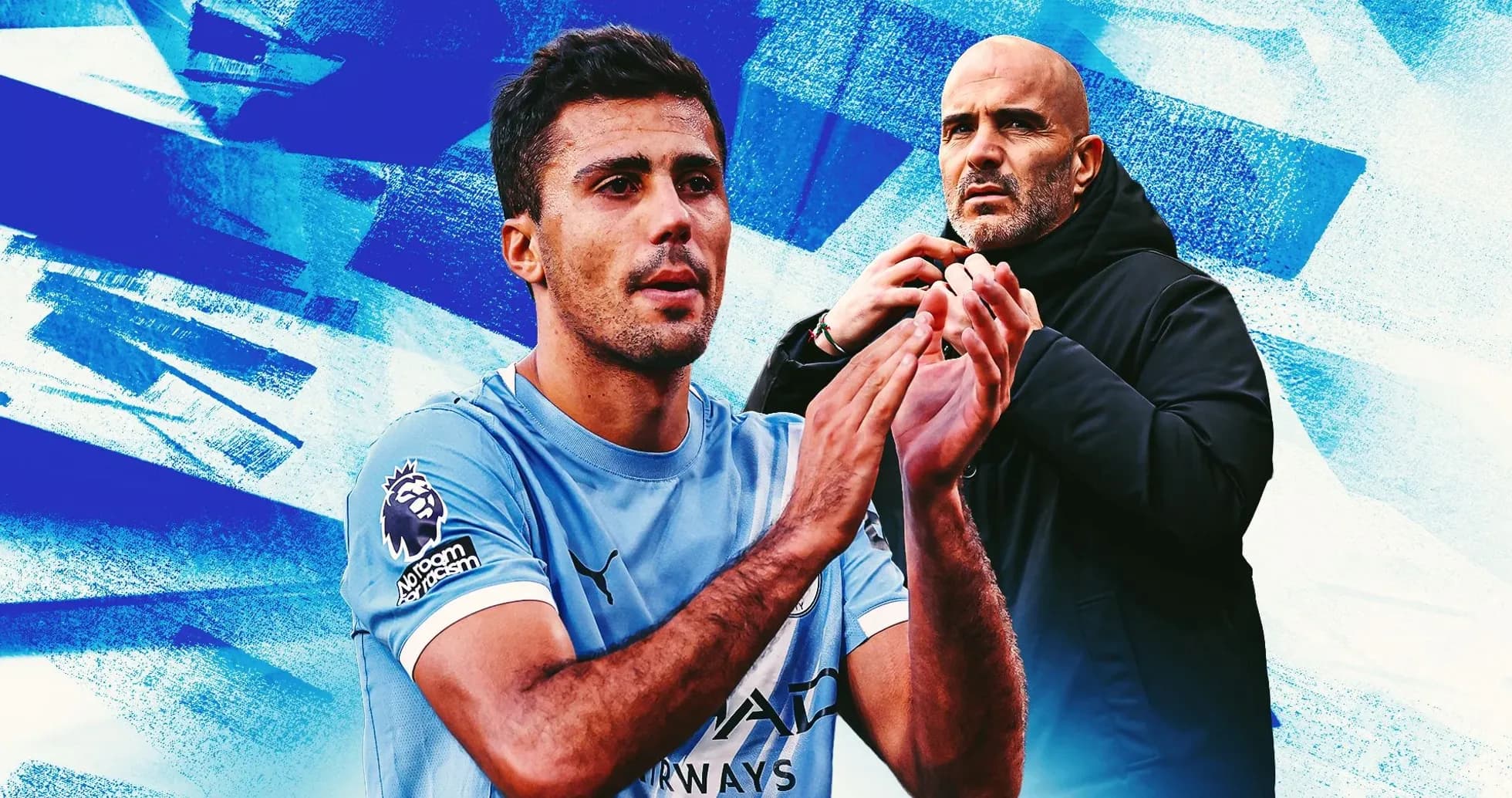
Rodri's Impact on Manchester City's Future After Injury
Rodri has spent the last year learning what happens when football’s most reliable metronome suddenly falls silent.
An ACL rupture in September 2024 ripped through his rhythm a month before he walked onto the Paris stage to collect the Ballon d'Or. The accolade confirmed his status as the game’s outstanding midfielder; the injury stripped him of the chance to play like it. What followed was a stop‑start campaign of setbacks and careful reintroductions, a player once indestructible reduced to a managed minutes plan.
For Manchester City, the cost has been brutal. Before that knee buckled, Rodri had missed only seven games for the club. With him, they had dominated the Premier League. Without him at full tilt, they have not reclaimed the title since 2023-24. Inside the Etihad, they can point to many reasons for that shift, but his absence sits near the top of the list.
Pep Guardiola saw this coming. Not the injury, but the response. Back in October, as Rodri’s rehab dragged on, he predicted: “In the World Cup, he will be the best Rodri, and next season he will be the best Rodri.” The first part has already landed.
In North America this summer, Rodri ran Spain’s World Cup from the base of midfield. He dictated tempo, shut down counters, and turned defensive scrambles into controlled possession. Luis de la Fuente’s side had stars across the pitch, yet every passage of authority seemed to begin with the No. 16 dropping into a pocket, opening his body and deciding, almost casually, what came next.
Spain lifted the trophy. Rodri lifted his reputation again. Any lingering doubt about his importance to City evaporated. He is not just central to what they do; he is the system’s anchor, the reference point, the calm in the chaos. And that is exactly why the prospect of him leaving, with only a year left on his contract and Guardiola’s era over, feels like an earthquake waiting to happen.
Enzo Maresca, the man tasked with following Guardiola, knows the noise around his midfield general will not stop. He also knows he cannot show panic.
“First of all I have to say, that around big players there are always speculations so I am not worried about that,” he said at his first press conference back at the City Football Academy. “I think it is normal, also because they won the World Cup, because he is one of the best players.
“I think every manager wants to have Rodri because he is a top player. But now, surgery on Monday [on his back]. He needs a holiday, he needs to rest and recover and then he will be back with us.”
The words are calm. The reality is anything but. Maresca’s blueprint is built on fluidity, on players who can drift between roles and build attacks from deep. Rodri does all of that and then adds leadership as a World Cup‑winning captain. Remove him, and the tactical puzzle becomes something else entirely.
The new coach is not inheriting a midfield brimming with ready-made heirs. Beyond Rodri and £116 million signing Elliot Anderson, the cupboard looks worryingly thin at the level City demand.
Nico Gonzalez, brought in partly to cover during Rodri’s ACL layoff, has been one of the more painful reminders that money does not guarantee fit. His January 2025 arrival was supposed to ease the burden. Instead, he faded into the background, barely trusted in the second half of the season and now a candidate to be moved on.
Tijjani Reijnders followed a different arc. A sharp start after his £46m switch from AC Milan hinted at a long-term solution. Then the performances flattened. By spring, he was more rotation option than cornerstone. The hope at City is that a full year of English football will harden him, but hope is not a plan when your midfield axis might be ripped out.
Then there is the trio already pointed towards the exit. Mateo Kovacic, Rico Lewis and Kalvin Phillips have all reportedly been deemed surplus to requirements. Take Rodri out of that mix as well and the picture changes from “needs a refresh” to “needs a rebuild.”
This is where Anderson comes in.
The former Nottingham Forest midfielder, now England regular under Thomas Tuchel, has arrived with numbers that scream readiness. Last season in the Premier League, he won possession more than any other player (306 times), topped the duels chart (297 won), and still managed to be Forest’s most creative force, carving out 54 chances, nine of them classified as big chances. At the 2026 World Cup, he finished with the joint-most tackles (18) – level with Rodri.
He tackles, he presses, he passes through lines. He looks, on paper and often on grass, like the modern No.6 built for the Premier League’s heaviest traffic. At 23, he will fancy the idea of being City’s next midfield boss, not just Rodri’s understudy. If the Ballon d'Or winner does head back to Spain, Anderson will see a vacancy, not a void.
City might not ask him to fill it alone. Ayyoub Bouaddi, the 18-year-old who exploded onto the scene during Morocco’s World Cup run, has been lined up as a defensive midfield target. The original plan involved signing him and sending him straight back to Lille on loan. That timeline could be ripped up if Rodri leaves. Raw or not, talent like Bouaddi’s rarely waits on the shelf when the first team is suddenly short.
All of this unfolds against the backdrop of a club stepping into life after Guardiola. That alone would have made 2025-26 a season of adjustment. The Spaniard’s departure leaves a gap in the dugout, in the training ground, in the dressing room. His voice and his standards have defined City for years. You do not replace that with a smooth handover and a few PowerPoint slides.
Key figures have already walked out alongside him. Bernardo Silva, captain last season and one of the era’s most intelligent footballers, has gone to Real Madrid. John Stones, another serial winner and tactical chameleon, has joined Inter. Two leaders, two reference points, gone for nothing more than the expiry of contracts and the lure of a new challenge.
Strip that from a squad and you are already asking for new hierarchies to form. Strip Rodri out as well and you are daring instability to take root.
Inside City, the warning signs are clear. Manchester United and Arsenal both stumbled badly when Sir Alex Ferguson and Arsene Wenger left. Years of dominance gave way to drift, missteps, and managers who never quite found their footing. The hierarchy at the Etihad will be desperate to avoid that fate, but Maresca arrives with a mixed body of work from his time at Chelsea. This is not a guaranteed seamless succession.
The Italian is not pretending otherwise.
“I want to say it is a privilege because the reason why the club decided to go for me, that is a privilege,” he said when asked about following Guardiola. “I have said many times, I consider Pep the best coach in the world in the last 20-25 years. It is a challenge.
“Also the history of the manager with many years in the same club, they struggle a bit. Sir Alex, Arsene. But it is also a challenge to do the right things.”
For Maresca, the word that keeps returning is time.
“Whatever happens, time is key,” he insisted. He pointed to City’s stability: three managers in 17 years, from Roberto Mancini’s arrival onwards, as evidence that the club understands the value of patience. The structure is strong, he argues. The organisation serious. The pathway proven.
He will need every ounce of that backing if this summer takes the turn many in Madrid hope it will. A move for Rodri would not just be another headline transfer. It would be a raid on the very core of how City play and who they are.
Next season at the Etihad is already shaping up as a test of identity as much as talent. Maresca will walk into a dressing room without Guardiola, without Bernardo Silva, without John Stones. He may yet look across the room and find the seat usually occupied by Rodri also empty.
If City want this transition to be evolution rather than rupture, they know exactly which signature they cannot afford to lose.

