.svg&w=384&q=75 "GoalGist logo")
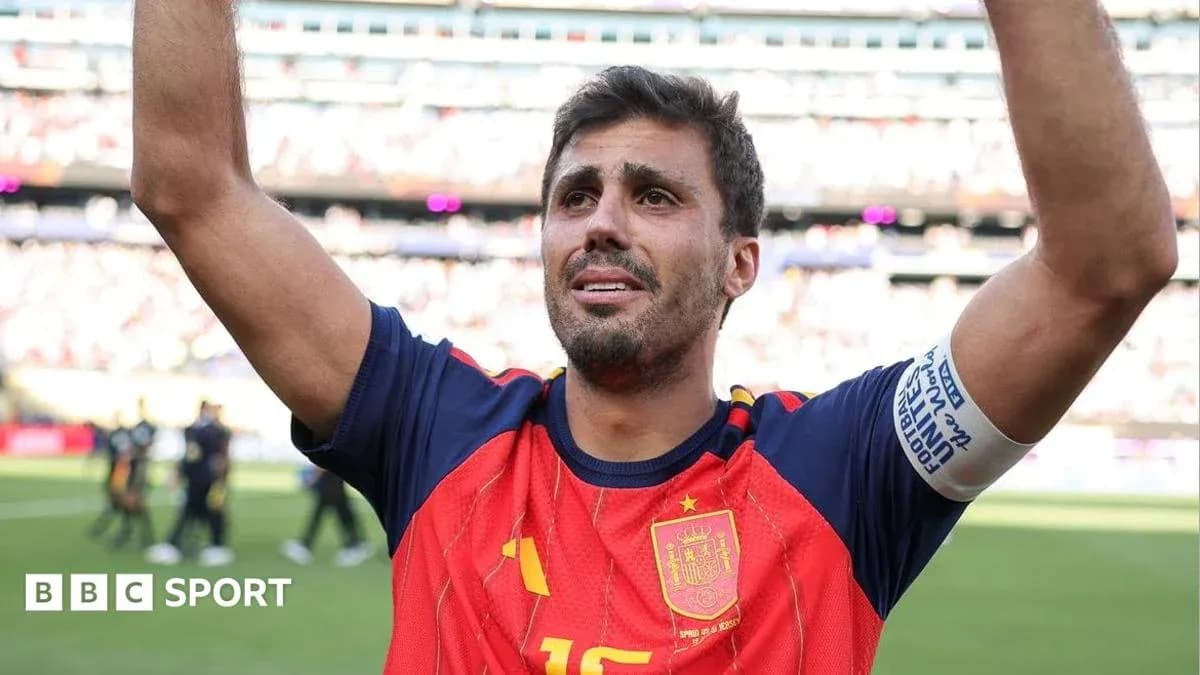
Rodri Faces Career-Defining Decision at Manchester City
Rodri stands at a crossroads that could reshape not only his career, but the balance of power in European football.
The Manchester City midfielder, fresh from winning the 2024 Ballon d'Or and driving Spain to a second World Cup title as player of the tournament, is heading into the final year of his contract at Etihad Stadium. At 29, with no new deal yet signed, the decision in front of him is stark and loaded with consequence.
Stay. Run down the deal. Or go home.
A superstar with time ticking
City have made their position clear behind closed doors. Club sources insist they are “counting on” him for next season, and it would take a significant offer to drag him away from Pep Guardiola’s midfield. For years he has been the metronome, the security blanket, the one player City look worse without.
But the clock is loud now. One year left. No agreement. And two of the biggest institutions in football circling.
Real Madrid’s interest is no secret. They have tracked him for a long time, seeing in him the natural heir to the line of great midfield anchors that have defined their modern era. This summer, though, the plot has thickened.
Two separate sources have told BBC Sport that Barcelona have entered the race.
That twist alone would be enough to ignite a transfer saga. Yet when approached, Barca figures have quietly distanced themselves from the idea, publicly at least, adding another layer of intrigue to an already complex situation.
A body tested, a reputation enhanced
Rodri’s recent club seasons have been far from straightforward. A serious knee injury wiped out much of his 2024-25 campaign. Before that, a hamstring problem disrupted his rhythm and City’s control in key stretches.
And then came the summer.
On the biggest stage, he looked untouched by the wear and tear. In Spain colours, he dictated games again, set the tempo, and walked away with the World Cup’s top individual honour and, later, the Ballon d'Or. Any doubts about his level after injury were answered with cold authority.
Earlier this season, he made it clear that his future would be resolved once the tournament was over. Instead, he is now sidelined again, having undergone back surgery, watching events move around him while he recovers.
City are in the Far East on their pre-season tour and will face Arsenal in the Community Shield next Sunday. Rodri is yet to join up with his team-mates. When he does, the questions will follow him off the plane.
Three doors, one career-defining choice
The options are brutally simple on paper, emotionally complex in reality.
He can sign the new contract on the table and commit the peak of his career to Manchester, to a club that has made him a champion of England and Europe and helped elevate him to world player of the year status.
He can refuse, see out the final months of his deal and walk away as a free agent next summer, in total control of his destination and with a queue of elite clubs willing to build around him.
Or he can force the issue now, take the plunge, and return to Spain while City can still command a major fee.
A move to Barcelona would drop him straight into a side that has claimed the last two La Liga titles, a team built around a new generation of Spanish talent. He would walk into a dressing room already populated by familiar faces: Ferran Torres, Lamine Yamal, Pau Cubarsi, Pedri. For a player who has just led his country to glory, the idea of anchoring that group at club level is powerful.
Across the divide, Real Madrid offer something different but equally compelling. The chance to reunite quickly with former City team-mate Bernardo Silva, who arrived at the Bernabeu on a free this summer. The prospect of working under Jose Mourinho, back at the club and charged with restoring a more ruthless edge to a serial winner. The lure of the white shirt he once described in simple, telling terms: “you can't turn down the best clubs in the world.”
Old loyalties, new tensions
Nothing about a return to Spain will be straightforward.
Rodri is an Atletico Madrid product, shaped by their intensity and identity. Any move to either Real or Barcelona would come with emotional baggage and political noise. At the Bernabeu, he would cross the fiercest of lines. At Camp Nou, he would arrive as a former Atleti midfielder who has openly spoken of Real’s irresistible pull.
The Nou Camp reception, should he choose Catalonia, would be fascinating. Would fans fully embrace a player who has previously spoken so glowingly about their greatest rival? Or would his World Cup heroics and current status as Spain’s leading midfielder override any lingering doubts?
These are not small details in Spain. They are the fabric of careers.
City’s quiet tension
Back in Manchester, the stakes are just as high, even if the language remains calm.
Losing Rodri now would rip out the core of Guardiola’s structure. Letting him walk for free next summer would be a financial and sporting blow for a club that prides itself on control, planning and minimal drama. Keeping him, on a new deal, would send a message that City remain the final destination, not a stepping stone, even for a Spanish World Cup-winning Ballon d'Or holder.
For the moment, City cling to their belief that he will stay. They point to his importance, to the environment they have built around him, to the trophies and the trust. Yet they know as well as anyone that when Real Madrid and Barcelona start circling a Spanish star, the pull can be relentless.
Rodri’s decision will not just define his next contract. It will say something about where power lies in the modern game: in the Premier League’s financial might, or in the enduring magnetism of Spain’s two superclubs.
He is recovering, waiting, weighing it all up.
When he finally walks back into City’s dressing room and looks around at what he has built there, he will have to ask himself a simple question with enormous consequences: does the next chapter of his story still belong in Manchester, or is it time to go home and choose a side in Spain’s eternal divide?

