.svg&w=384&q=75 "GoalGist logo")
Real Madrid's €590m Attack: Mourinho's Vision at Valdebebas
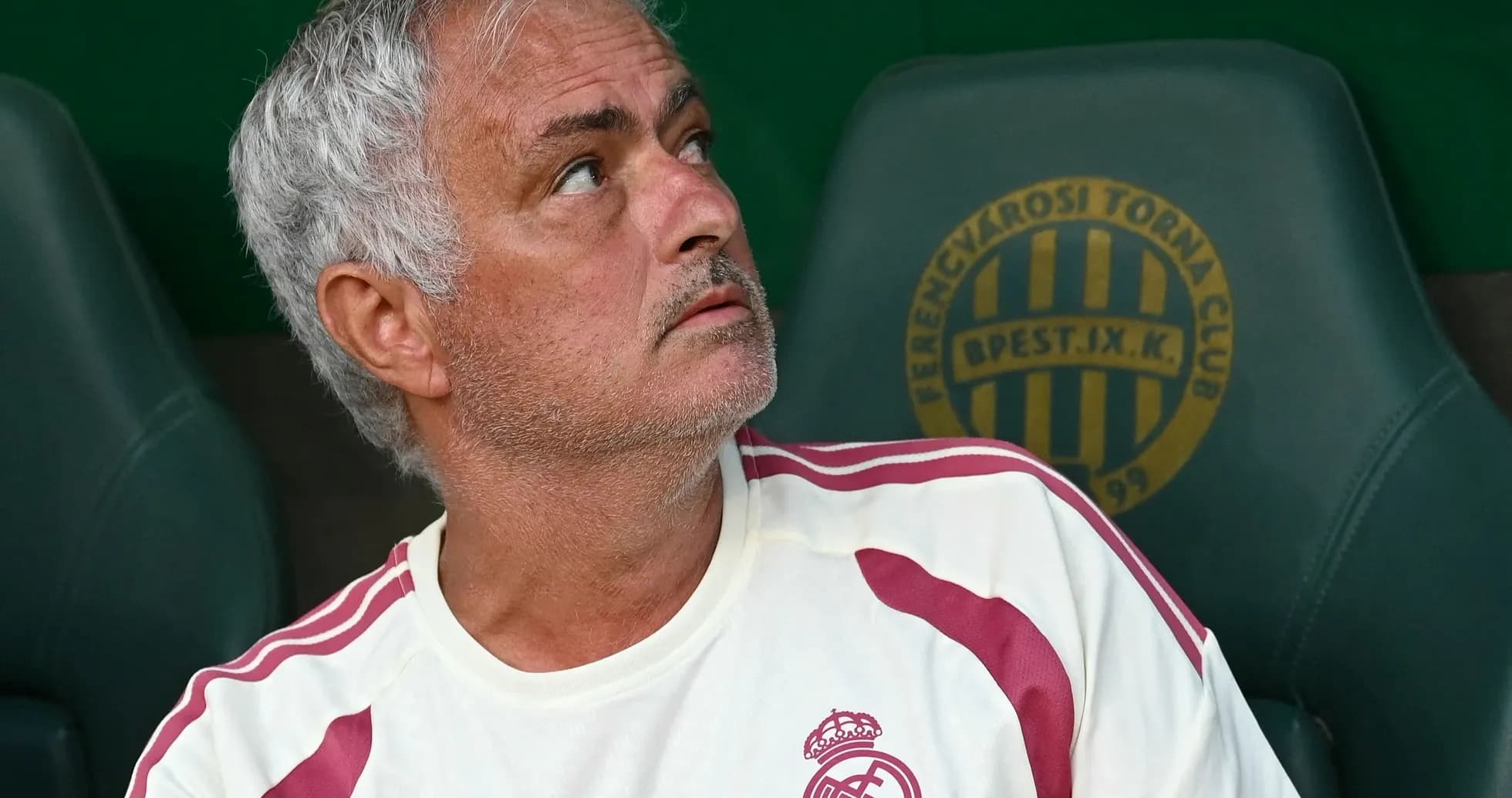
José Mourinho finally has the picture he has been waiting for at Valdebebas: the full Real Madrid squad on the pitch, and an attacking line that looks like something built on a video game rather than a balance sheet.
Kylian Mbappé through the middle. Vinícius Júnior on one flank. Yan Diomande on the other. Jude Bellingham floating behind them, back in his favourite role. Four players, one idea: overwhelm everyone.
A €590m frontline, built for €313m
The numbers behind this project are as striking as the names. Transfermarkt values the quartet at a combined 590 million euros: Mbappé at 200m, Bellingham at 160m, Vinícius at 140m and Diomande at 90m.
Madrid, though, did not pay anywhere near that to assemble them.
The club’s outlay, before add-ons, sits at around 313 million euros. The operation breaks down as follows: an estimated 40 million signing-on bonus for Mbappé – never officially confirmed by the club – plus 125m for Diomande, 45m for Vinícius and 103m for Bellingham.
Once the variables are included, the bill rises to 358 million euros. Leipzig could receive an extra 15m in the Diomande deal, while around 30m more is tied to Bellingham’s transfer. Even so, the total still falls comfortably short of their current market valuation.
For a club that once built the “BBC” – Karim Benzema, Gareth Bale and Cristiano Ronaldo – that financial gap is part of the appeal. This time, the investment looks designed not just to recreate a golden era, but to outgrow it.
Mourinho’s plan: 4-2-3-1, and Bellingham back in the 10
On the training ground, Mourinho has kept things simple. For now, the shape is a 4-2-3-1. Mbappé leads the line as the centre-forward, Bellingham operates as the classic number 10, with Vinícius and Diomande stretching the pitch from the wings.
It is the position in which Bellingham exploded during his first season at Real Madrid, and where he shone for England at the last World Cup under Thomas Tuchel. Close to the box. Facing goal. Arriving late, not chasing full-backs.
When Mourinho briefly moved to a 4-4-2 late in the friendly against Deportivo, and when he toyed with a 4-3-3, the risk was obvious: Bellingham gets dragged away from the scoring zone and loaded with extra defensive work. That is not what this project is built for.
Madrid want him high, dangerous and free. The structure bends around that idea.
First glimpse in Gelsenkirchen?
The wait to see all four together might end in Germany. The quartet could make their first appearance as a unit on Sunday against Schalke in Gelsenkirchen, Real Madrid’s final friendly before the league opener against Espanyol on 22 August.
It is only a pre-season match, but the sense of occasion is hard to ignore. This is not just another attacking line. It is a statement of intent.
Chasing – and surpassing – the BBC
Inside the club, the comparison is inevitable. The “BBC” era delivered goals, titles and a global brand. This time, Madrid are openly betting on a pure attacking force that, on paper, carries a weight rarely seen in the modern game.
The raw production is already there. Last season, the quartet combined for 121 goals and 36 assists. Mbappé scored 42, Vinícius 22, Diomande 13 and Bellingham 8, the latter held back by injuries. In terms of creativity, they added 7, 14, 10 and 5 assists respectively.
Those figures are the floor, not the ceiling, at least in Madrid’s eyes. Bellingham hit 23 goals and 13 assists in his first campaign at the Bernabéu. Diomande now steps into an attacking line far more powerful than the one he left behind at Leipzig, with more movement around him and more space to attack.
The club’s calculation is simple: put that level of individual output into one system, and the numbers should spike.
How they stack up against Europe’s elite
Strip Bellingham out and look only at the front three, and the picture remains impressive. Mbappé, Vinícius and Diomande combined for 77 goals and 31 assists last season.
Only two attacking trios in Europe did better.
At Bayern Munich, Harry Kane, Luis Díaz and Michael Olise amassed 109 goals and 61 assists. At Barcelona, Ferran Torres, Raphinha and Lamine Yamal produced 85 goals and 33 assists.
Elsewhere, the drop-off is clear. Manchester City’s Erling Haaland, Jérémy Doku and Savinho delivered 57 goals and 26 assists. At Paris Saint-Germain, Khvicha Kvaratskhelia, Ousmane Dembélé and Désiré Doué combined for 52 goals and 33 assists. Arsenal’s Viktor Gyökeres, Gabriel Martinelli and Bukayo Saka finished with 43 goals and 19 assists.
Madrid’s trio already sits among the most productive in Europe before a single minute together in white this season.
Now Mourinho has them all in one dressing room, one system, one idea. The financial gamble is on the books. The talent is on the grass. The only question left is the one that will define their season: can this quartet turn frightening numbers on paper into something even more ruthless on the pitch?