.svg&w=384&q=75 "GoalGist logo")
Osasuna vs Espanyol: A Tactical Breakdown of La Liga Clash
The evening at Estadio El Sadar closed not with relief, but with a verdict. In a La Liga campaign defined by narrow margins and fragile momentum, Osasuna’s 2–1 home defeat to Espanyol felt like a condensed version of their season: honest effort, structural clarity, and just enough fragility to be punished.
Following this result in Round 37, the table tells a blunt story. Osasuna sit 16th on 42 points, with a goal difference of -5, built from 44 goals for and 49 against overall. Espanyol, 11th with 45 points and a goal difference of -12 (42 scored, 54 conceded overall), arrive as a side that has flirted with danger but learned how to win on their travels. The final scoreline in Pamplona mirrored that: Espanyol efficient, Osasuna belatedly brave.
I. The Big Picture – Structures and Seasonal DNA
Osasuna lined up in their familiar 4-2-3-1 under Alessio Lisci, a shape that has been their backbone all season. At home they have been notably stronger: 9 wins, 5 draws, and 5 defeats from 19 matches, scoring 31 and conceding 24. That home identity – 1.6 goals scored and 1.3 conceded at El Sadar on average – framed this fixture as an opportunity to secure safety with authority.
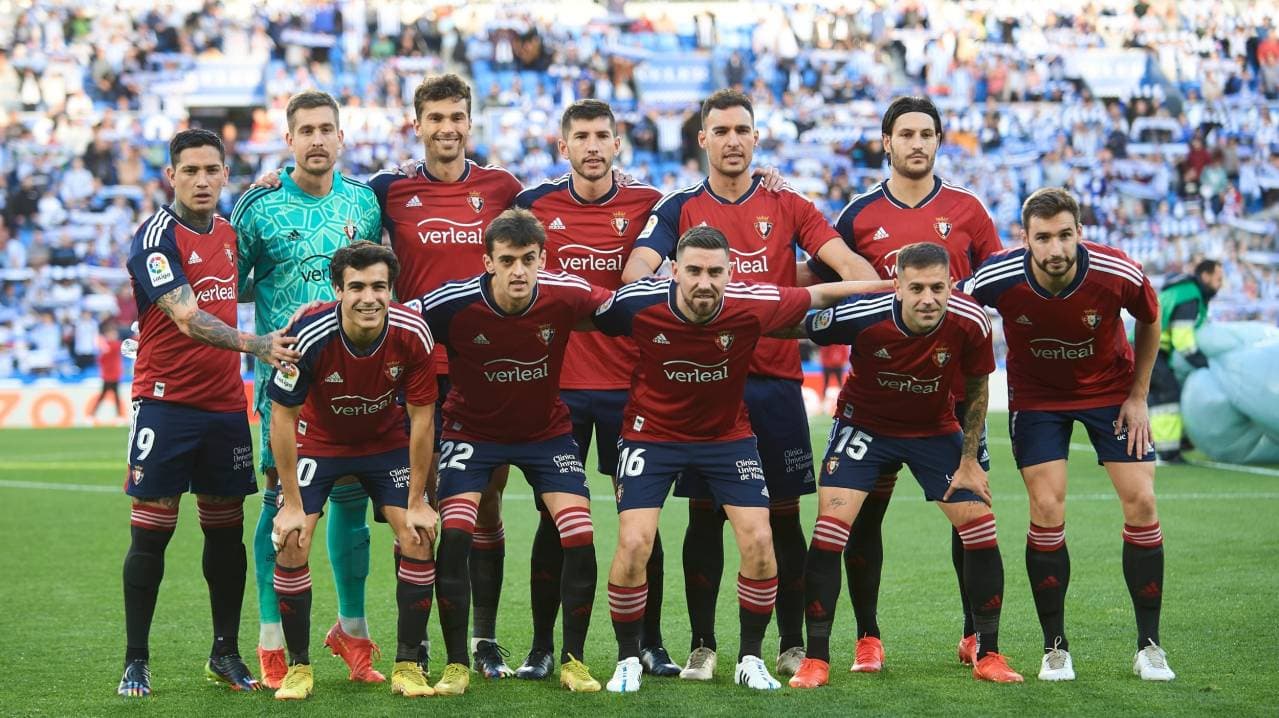
The XI reflected that intent. Sergio Herrera in goal behind a back four of Victor Rosier, Alejandro Catena, Flavien Boyomo and Aitor Bretones. Lucas Torro and Jon Moncayola formed the double pivot, with Ruben Garcia, Aimar Oroz and Vicente Munoz supporting Ante Budimir, Osasuna’s attacking reference and one of La Liga’s standout forwards this season with 17 total league goals.
Espanyol, by contrast, arrived with a 4-4-2 that has become their away-day armour. On their travels they have 5 wins, 5 draws and 9 defeats from 19, scoring 22 and conceding 31 – an away profile of 1.2 goals for and 1.6 against. Manolo Gonzalez trusted a compact back four of Omar El Hilali, C. Riedel, Leandro Cabrera and C. Romero ahead of Marko Dmitrovic, with a hard-working midfield line of T. Dolan, U. Gonzalez, Pol Lozano and Pere Milla behind the front pair of Edu Expósito and K. Garcia.
The tactical contrast was clear from the first whistle: Osasuna’s 4-2-3-1 seeking controlled possession and vertical runs from Oroz and Munoz; Espanyol’s 4-4-2 built to compress space centrally, counter quickly, and lean on the craft of Expósito and the timing of Milla from the second line.
II. Tactical Voids – Absences and Discipline
Both squads carried notable absences into this match. Osasuna were without R. Moro through injury, depriving Lisci of a wide option who could stretch the pitch and change tempo from the bench. For a side that has failed to score 11 times overall – with all 11 of those blanks coming away – their home attacking depth still matters, especially when chasing a game late.
Espanyol were hit harder in terms of attacking options: C. Ngonge and Javi Puado both missed out with knee injuries. In a squad that has scored 42 overall but leans on collective production rather than a single prolific striker, those absences narrowed Gonzalez’s in-game flexibility. It made the starting roles of Expósito and Milla even more central to their plan.
From a disciplinary standpoint, both teams came into this fixture with a clear tendency to walk the edge. Osasuna’s yellow-card profile shows a late-game spike: 21.35% of their bookings arrive between 76–90 minutes, with another 14.61% in 91–105. Espanyol are similar, with 30.00% of their yellows coming in the 76–90 window and 16.67% in 91–105. This is not just trivia; it shapes closing phases. In a match where Osasuna were chasing and Espanyol defending a lead, the probability of late fouls, stoppages and emotional swings was always high.
Red cards have also hovered over both squads. Catena’s season includes 1 red card, while Pere Milla and Charles Pickel have each seen red for Espanyol. That underlying volatility explains the cagey midfield duels and the emphasis on structured blocks rather than wild pressing in the second half.
III. Key Matchups – Hunter vs Shield, Engine Room Battles
The headline duel was always going to be Ante Budimir against an Espanyol defence that, on their travels, concedes 1.6 goals per match. Budimir’s season has been quietly outstanding: 17 total league goals from 36 appearances, backed by 88 total shots and 41 on target. He is not just a finisher but a reference point, winning 169 duels from 365 and providing 15 key passes. His aerial presence and penalty-box craft were designed to test Cabrera and Riedel repeatedly.
Yet Espanyol’s back line, shielded by a tenacious midfield, managed to limit his influence for long stretches. Cabrera’s experience in the air and Riedel’s positioning were crucial, while El Hilali’s season profile – 72 tackles, 15 blocked shots and 40 interceptions – underlined why he is trusted to handle wide overloads and late crosses. The fact that Budimir has missed 2 penalties this season despite scoring 6 from the spot also hung over any potential set-piece drama: a reminder that even Osasuna’s sharpest weapon carries a hint of fallibility.
In midfield, the “engine room” belonged to the duel between Moncayola and Lozano, with Expósito as the creative wildcard. Moncayola has been one of Osasuna’s most complete midfielders this season: 1369 passes overall with 38 key passes, 52 tackles and 20 interceptions. He is the hinge between Torro’s screening and the three attacking midfielders’ freedom.
Opposite him, Pol Lozano brings a mix of distribution and edge. His 945 passes overall with 23 key passes and an 87% accuracy mark him out as Espanyol’s metronome, but the 64 fouls committed and 11 yellow cards (plus a yellow-red) show how often he is willing to break rhythm with tactical fouls. Alongside him, Expósito has been Espanyol’s creative brain: 965 passes with 80 key passes, 6 assists and 44 dribble attempts with 33 successes. His ability to receive between the lines and feed the front two was decisive in turning Espanyol’s rare attacking phases into genuine chances.
Pere Milla, too, embodied Espanyol’s dual nature. With 7 total league goals, 33 key passes and a willingness to press and tackle (36 tackles, 17 interceptions), he oscillated between third man runner and auxiliary midfielder. His presence on the left forced Rosier and Boyomo to constantly adjust their positioning, preventing Osasuna from overcommitting their full-backs.
IV. Statistical Prognosis – What This Game Tells Us
Following this result, the numbers reinforce the eye test. Osasuna’s overall profile – 1.2 goals scored and 1.3 conceded per match in total – is the definition of a team living on the knife-edge. At home, they remain more potent, but the defensive slips that have yielded 49 goals against overall continue to haunt them in key moments. Their 7 clean sheets overall (5 at home) show they can be solid, but not consistently so.
Espanyol, for their part, remain a paradox: 42 goals scored and 54 conceded overall, with 10 clean sheets split evenly between home and away. On their travels they concede more (31 away goals against, 1.6 per game) but still find ways to win, helped by a midfield that can control tempo and a structure that punishes mistakes.
In xG terms – even without explicit values – the pattern is clear. Osasuna’s volume of home chances and Budimir’s shot profile suggest they usually generate enough to score at least once. Espanyol’s away record, with 22 goals from 19 matches, points to a team that does not flood the box but finishes selectively. A 2–1 away win fits that statistical logic: Osasuna likely produced a similar or slightly higher xG, but Espanyol’s sharper execution and better game management in key phases tilted the outcome.
Tactically, this match underlines three truths. First, Osasuna’s 4-2-3-1 has a strong spine – Herrera, Catena, Moncayola, Budimir – but needs more protection in transition and more unpredictability in wide areas, especially when chasing a deficit. Second, Espanyol’s 4-4-2, anchored by Lozano’s aggression and Expósito’s vision, is built for away ambushes: absorb, frustrate, and strike through well-timed runs from Milla and K. Garcia. Third, discipline and late-game composure remain decisive for both sides; with such high percentages of cards in the final quarter-hour, the margins between a rescue point and a decisive defeat are often found in a single mistimed challenge.
Following this result, Osasuna’s survival instincts will be tested one last time, while Espanyol can look at Pamplona as confirmation that their tactical identity – compact, pragmatic, and guided by a clever midfield – can travel.