.svg&w=384&q=75 "GoalGist logo")
Rayo Vallecano vs Girona: Tactical Analysis of the 1-1 Draw
Rayo Vallecano and Girona shared a 1-1 draw at Campo de Futbol de Vallecas in a match where the tactical story was one of Rayo’s territorial control against Girona’s calculated compactness and late punch. The scoreline matched the balance of threat more than the balance of possession, with Rayo’s 59% of the ball and 18 shots set against Girona’s more economical 9 attempts and a decisive impact from the bench.
Inigo Perez set Rayo up in a 4-3-3 that was clearly designed to dominate the ball and pin Girona deep. The back four of A. Ratiu, P. Ciss, F. Lejeune and P. Chavarria held an aggressively high line, compressing the pitch so that the midfield trio of Pedro Díaz, O. Valentin and U. Lopez could operate almost permanently in the opposition half. With 486 passes and 83% accuracy (486 passes, 405 accurate, 83%), Rayo circulated patiently, using the full-backs as width and the three forwards J. de Frutos, S. Camello and F. Perez to constantly occupy the last line.
The shot profile underlined that plan: 18 total shots, split evenly between inside and outside the box (9 and 9), and 7 blocked efforts. Girona’s 4-2-3-1 under Michel accepted long spells without the ball, defending in a mid-to-low block with A. Witsel and F. Beltran screening the centre and full-backs A. Martinez and Álex Moreno staying narrow to protect the half-spaces. Girona’s 343 passes at 79% accuracy (343 passes, 271 accurate, 79%) reflected a more direct, transition-focused approach, looking to spring V. Tsygankov and T. Lemar once possession was recovered.
First Half
The first half was defined by Rayo’s control without incision. Pedro Díaz’s 44' yellow card for Foul highlighted how high Rayo’s midfield line was; he repeatedly stepped in front of Girona’s first pass out, accepting risk to maintain territorial pressure. Girona, meanwhile, were content to survive and wait for moments to counter, which kept the shot count low but the game tactically tense.
Second Half
The second half’s key inflection came around the hour mark. Before that, at 56', VAR intervened to cancel a potential Girona penalty involving Álex Moreno, a pivotal moment that could have flipped the game state and forced Rayo to chase in a different way. Instead, with the score still 0-0, both coaches turned to their benches to tilt the tactical balance.
Perez’s changes at 58' were structurally significant. G. Gumbau (IN) came on for P. Diaz (OUT), and Alemao (IN) came on for F. Perez (OUT). Swapping Diaz for Gumbau traded some ball-winning for more progressive passing from deep, while Alemao’s presence as a more direct, penalty-box forward altered the reference point up front. Rayo’s 4-3-3 became more vertically oriented: Gumbau dropping to dictate from the base, Alemao attacking crosses and cutbacks.
Michel responded at 60' with a double change that reshaped Girona’s attacking line. C. Echeverri (IN) came on for T. Lemar (OUT) and I. Martin (IN) came on for A. Ounahi (OUT). This refreshed the three behind the striker, adding more ball-carrying and late runs, even as Girona remained compact without the ball. Later, A. Martinez (OUT) made way for H. Rincon (IN) at 72', a defensive tweak to bring fresh legs into the back line as Rayo’s pressure mounted.
Perez doubled down on width and energy at 68', with Pacha (IN) coming on for S. Camello (OUT) and C. Martin (IN) for J. de Frutos (OUT). This subtly rebalanced the front line: more natural wide running, more overlaps, and an emphasis on flooding the box from crosses rather than intricate combinations through the middle. Girona’s late substitution of C. Stuani (IN) for F. Beltran (OUT) at 85' was a clear signal to go more direct, adding a classic penalty-box striker and shifting the structure toward a 4-2-4 in attacking phases.
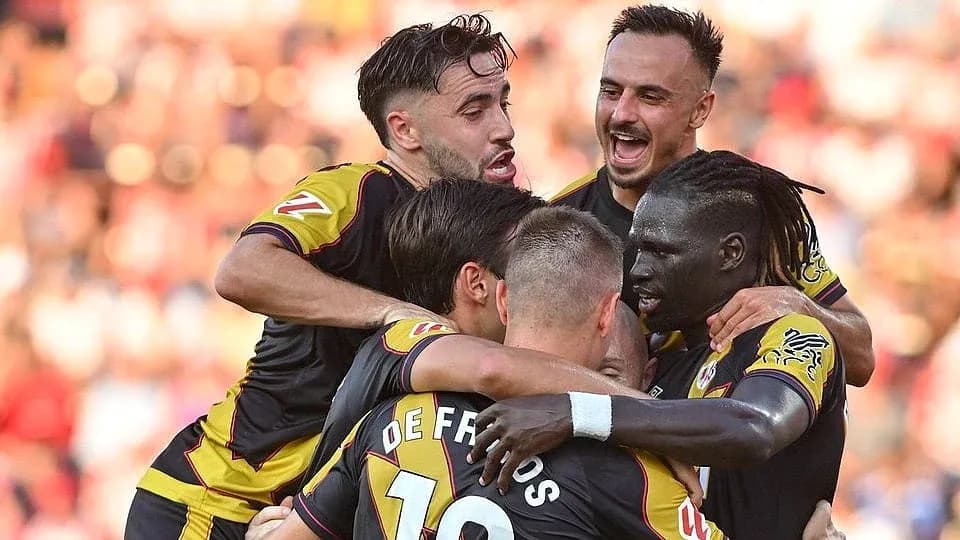
The tactical logic of Rayo’s changes paid off on 86'. With Girona increasingly pinned and their block dropping deeper, U. Lopez found space to create, and Alemao attacked the delivery to score for Rayo. It was the archetypal product of Rayo’s approach: sustained possession, territorial pressure, and a substitution-designed target man finishing from inside the box. At that point, Rayo’s xG of 1.09 against Girona’s 0.86 felt justified by the pattern of chances, with Rayo having 5 shots on goal to Girona’s 5 but from a higher volume of overall attempts.
Yet the game state after the goal exposed Rayo’s main tactical flaw: game management. U. Lopez (OUT) was withdrawn almost immediately after his assist, with N. Mendy (IN) at 88' intended to solidify the midfield and help protect the 1-0 lead. However, the shift did not translate into effective control of transitions. Girona, now with Stuani on the pitch, had a clear route: early balls into the box and second-ball aggression.
Cristhian Stuani’s yellow card at 90+4' for Argument illustrated the emotional edge of Girona’s late push, but the decisive tactical moment came even earlier at 90'. V. Tsygankov, operating from a more liberated attacking role after the substitutions, delivered the assist for C. Stuani’s equaliser. Girona’s 1-1 goal encapsulated their strategy: fewer attacks, but with a structure that maximised the value of crosses and central presence once Stuani was introduced.
From a defensive standpoint, both goalkeepers had similar workloads: A. Batalla made 3 saves for Rayo, P. Gazzaniga 4 for Girona. The goals prevented metric of -0.15 for each suggests both conceded slightly more than the post-shot chances implied, underlining that neither side’s last line fully bailed out their defensive structures. Instead, the story was about collective organisation: Rayo’s high line and pressing limiting Girona to 9 shots, Girona’s compact block and clearances holding Rayo to 1.09 xG despite 18 attempts.
Discipline was controlled overall, with only two yellow cards: Pedro Díaz’s 44' Foul for Rayo and Cristhian Stuani’s 90+4' Argument for Girona. That low card count aligned with a match more defined by tactical adjustments than by physicality.
In statistical terms, Rayo’s higher possession, shot volume, and pass accuracy reflected a team comfortable as protagonists, but their inability to convert control into a secure result will concern Perez. Girona, by contrast, showed resilience and clarity: accept the opponent’s dominance, manage space rather than the ball, and use targeted substitutions to change the attacking profile late. The 1-1 draw, when set against xG and the flow of chances, felt like a fair equilibrium between Rayo’s territorial superiority and Girona’s strategic efficiency.