.svg&w=384&q=75 "GoalGist logo")
The Premier League Tax: Inside English Football's Transfer Market
The old cliché used to be that English players carried the premium. Now the surcharge is simpler: if you’re already in the Premier League, you cost more.
This summer’s window underlined it in bold. As English clubs smashed spending records yet again, the average fee for a player signed from another Premier League side hit £39.4m. For those brought in from abroad? £20.2m. Almost half the price.
Kieran Maguire, professor of football finance at the University of Liverpool, has a neat label for it: “a Premier League tax”.
The league that buys from itself
What once felt taboo – selling to a domestic rival – is now routine. Premier League clubs are not just willing to deal with one another, they are actively feeding a self-contained ecosystem.
Total outlay remains higher on players from outside England, but the big-money action has shifted decisively inwards. The largest deals are increasingly Premier League-to-Premier League.
Look at the top end of the market. Transfers worth £40m or more have exploded. In 2024-25, there were 13 such deals. This summer, there were 27.
Two years ago, seven of those big deals were done with clubs on the continent and six between Premier League sides. This time the split looks very different: nine with European clubs, a staggering 18 between English teams. Overall domestic spending has more than doubled.
The Premier League has become both buyer and seller, a closed loop of money and talent.
The ‘algorithm kids’ and the petri dish
Part of the explanation lies in how English clubs scour the globe. The Premier League’s reach is so deep that many of the best overseas players arrive earlier than ever – not at the elite clubs, but via smart operators further down the table.
“We’ve got a new tranche of clubs, sort of the algorithm kids, who are recruiting from the international markets,” Maguire told BBC Sport. “They’re bringing players to the Premier League, and then the Big Six clubs are signing the best players.”
Carlos Baleba is the perfect case study. Brighton picked him up from Lille three years ago for £23m. Last week, they sold him to Manchester United for £70m.
Maguire describes this as a “petri dish” for talent: mid-ranking Premier League clubs test which overseas players can handle the league’s intensity. If they pass the experiment, the giants swoop. Everyone gets paid.
Yet that only explains the rational end of the market. Some of this summer’s deals look like they could only exist inside the Premier League bubble.
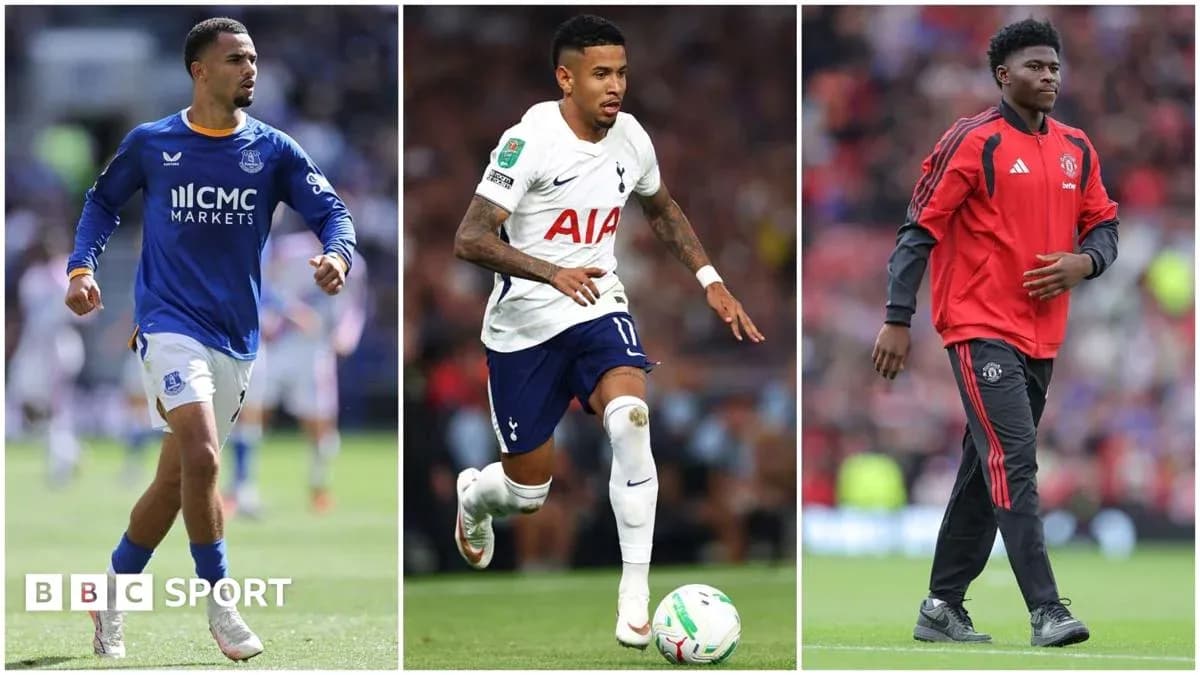
Would a European club really hand Manchester City the £75m Tottenham spent on Savio? Or wire Everton £65m for Iliman Ndiaye? And what of the £85m West Ham banked from Spurs for Mateus Fernandes?
On the continent, the picture is far more restrained. Only seven transfers of £40m or more took place this summer from one European club to another, all involving Barcelona, Bayern Munich or Paris St-Germain. Three superclubs and PSG, effectively, trying to keep pace.
A bubble with its own rules
Trevor Watkins, former Bournemouth chairman and now a sports lawyer, told BBC 5 Live Breakfast that the Premier League has drifted into its own financial universe.
“The revenues dwarf what other leagues generate,” he said. “And what you see this year is a lot of deals between clubs in England.
“A lot of money going down to lower leagues, but also between Premier League sides because, to be honest, they’re probably the only ones that will pay the wages or pay the fees.”
The transfer market has become a spreadsheet game. On-pitch value – saves, clearances, assists, goals – is only half the story. The other half is what a player looks like in an accounting column.
Profit on a sale is now a weapon. It fuels reinvestment and helps clubs stay on the right side of financial rules.
How £35m becomes £95m
Take Elliot Anderson. Nottingham Forest paid Newcastle £35m for him. Manchester City later paid Forest £116m. On the face of it, that’s an £81m gain.
The books tell a different story.
Clubs spread transfer fees over the length of a player’s contract. When Anderson left, Forest still had around £21m of his original fee on their accounts. Against a £116m sale, that produces a profit of £95m.
Under the Premier League’s new squad cost ratio (SCR) rules, that £95m isn’t booked in one go. It’s spread over three years, at £31.67m per season for Forest.
The days of flogging a player for a one-off windfall to save a single window – or a single set of accounts – are gone. SCR forces clubs to think longer term, but it also cranks up the pressure to sell high.
The higher the fee, the bigger the profit line, the more room a club has to manoeuvre.
Big Six armour up
SCR, by design or not, favours the heavyweights. The ‘Big Six’ – Arsenal, Chelsea, Liverpool, Manchester City, Manchester United and Tottenham – operate on a different commercial plane.
This summer they spent £1.658bn between them.
“Those clubs have future-proofed themselves by trying to generate more income,” Maguire said. “Spurs is a classic example. Spurs now have a multi-function, multi-sport stadium, of which the football club is the biggest part.
“It is a reward for those clubs that have expanded their stadiums, or thought outside of the box in terms of trying to generate additional revenues.”
For the other 14 clubs, who together still managed to spend £1.833bn, player trading is lifeblood. They cannot rely on global sponsorships or mega-matchday incomes. They rely on buying well and selling better.
Aston Villa and Newcastle illustrate the model. Between them they completed five deals worth £40m or more this summer – but only after cashing in hundreds of millions of pounds in outgoing transfers.
Europe feels the ripple
As Premier League money circulates internally, less flows to the rest of Europe. Yet the impact is still felt across the continent.
On Wednesday, Javier Gomez, La Liga’s corporate general director, criticised what he called a “loss-making model which is an issue exclusive to the Premier League”.
“It has other consequences,” Gomez said. “It inflates the entire sector – it inflates the Premier League, the Bundesliga, the French League, and eventually us as well.”
Some of Europe’s traditional heavyweights already struggle to compete with the top English sides in the market. Outside a tiny elite, the gap has become a chasm.
“With the exception of some of the global brands within football, and I think you’d look at Real Madrid, Barcelona, PSG and Bayern Munich, the Premier League can outspend anyone and everyone,” Maguire said.
The latest Deloitte Money League backs that up: 14 Premier League clubs sit among the 30 biggest teams in world football. Real Madrid, Barcelona, PSG and Bayern Munich occupy the top four spots, but Liverpool lead six English clubs that round out the top 10.
For the rest, the battleground has shifted.
Andre Villas-Boas, president of FC Porto, told BBC Sport his club has been forced to double down on scouting rather than chase auctions they cannot win.
“For Porto, it means we are competing for talent not with Man City or Liverpool but with (the likes of) Coventry and Brentford, without any disrespect,” he said.
“The fact that they have this spending power makes it difficult for us.
The Premier League is set apart from all the rest, which means English clubs are becoming more and more dominant of European competitions.”
That dominance is already showing on the pitch. Aston Villa and Crystal Palace lifted the Europa League and Conference League last season. Arsenal reached the Champions League final, losing to PSG.
A bubble that refuses to burst
The Premier League’s transfer market has been called a bubble for years. It keeps swelling. It does not pop.
Domestic deals are getting bigger. The internal tax on Premier League talent grows heavier. Europe watches as English clubs trade players among themselves for sums that reshape balance sheets and warp benchmarks.
The question now is not whether this model changes European football. It already has.
The question is how much further the gap can stretch before the rest of the continent decides it cannot, or will not, play the same game.