.svg&w=384&q=75 "GoalGist logo")
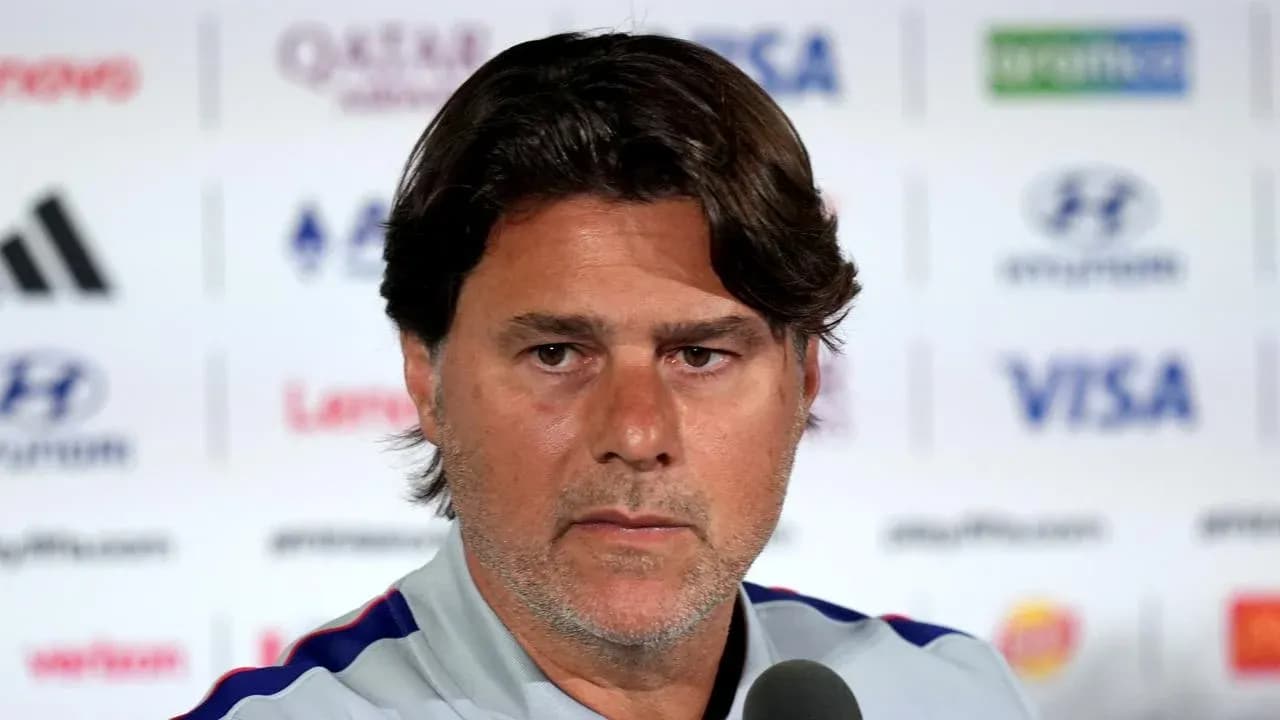
Pochettino Defends Team After Loss to Turkiye
Mauricio Pochettino bristled as he sat down in front of the microphones. His team had just lost 3-2 to Turkiye, the questions were all about stumbles, slumps and squandered momentum – and he’d had enough.
The United States had already won their World Cup group. Nobody in the room had mentioned it.
“The mood is like we [are going] home tonight and Turkey is staying,” he snapped. “I need to [remind] you and everyone that we won the group. Sorry guys, we won.”
It was classic Pochettino: combative, proud, and utterly unwilling to let the narrative drift away from what he sees as the bigger picture. Reporters pressed him on whether this defeat, with the knockouts looming, hinted at a team losing its edge. He pushed back hard.
Group winners, but no back-patting
The irony wasn’t lost on anyone. Before the match, Pochettino had spoken about wanting another win, about maintaining standards. Then he rang the changes. Nine of them. The side that beat Australia was largely broken up, the lineup full of reserves, the decisions screaming rotation rather than relentlessness.
He knew the stakes in a historical sense. One more victory and the USMNT would have become the first team in program history to win all three group games at a World Cup. That milestone never arrived.
Pochettino didn’t seem remotely bothered.
“Making history is winning the World Cup,” he said. “It’s not winning three matches only within the World Cup. I don’t really understand. It’s a little bit petty if you will — you’re thinking a little too small. You’re telling me you could make history — what does it mean to win three matches if you lose the next one?”
For him, the obsession with group-stage perfection misses the point. He framed the Turkiye loss as a calculated risk, a necessary step in managing minutes and minds for the long run, not a warning sign.
He pointed to Germany as his supporting evidence. A few hours before the US kicked off, the Germans had fielded many of their regulars and still lost to a desperate Ecuador side. Strong XI, same outcome: defeat. The message was clear – there are no guarantees at this tournament, no matter who you start.
Pulisic back, lessons banked
Behind the frustration with the media, there were positives Pochettino clearly valued. Chief among them: Christian Pulisic back on the pitch.
The AC Milan forward had missed the win over Australia with a calf problem, that same issue forcing him off at half-time in the victory over Paraguay. Getting him back into competitive action before the knockouts mattered more to the coach than a footnote in the record books.
Pochettino insisted his team had “handled the situation well” despite the loss, a nod to squad management, rotation and the psychological demands of a long tournament. The group is won, the route is set. He wants his players – and the country – looking at the trophy, not the trivia.
The questions about momentum will linger. The coach doesn’t seem remotely interested in entertaining them.
Arnold’s Iraq hammered, future in the balance
While Pochettino fought over narratives, Graham Arnold faced a far harsher reality: a 5-0 defeat to Senegal and Iraq’s World Cup exit.
The match turned ugly early. Rebin Sulaka’s red card in the 13th minute, with Iraq already trailing 1-0, left Arnold’s side chasing shadows. He didn’t hide his anger at the dismissal.
Arnold called it a “stupid red card,” and he knew exactly what it did to his players’ heads. “The early red card was mentally tough on the players. Against a team like Senegal, mistakes are always punished,” he said.
The numbers behind Iraq’s collapse were damning. Arnold revealed that of the 11 goals they conceded at this World Cup, nine came directly from individual errors. That statistic cut deeper than the scoreline.
“I told the players after the match that we conceded 11 goals at this World Cup, and nine came from our own individual mistakes. We have to learn from that.
“In the second half, we ran out of energy. I also made changes to give more players the chance to experience representing Iraq at the World Cup, and I take full responsibility for that.”
Group I, with France and Norway alongside Senegal, was always going to be unforgiving. Iraq were the last team to qualify, sneaking through an intercontinental playoff to reach their first World Cup in 40 years. Just getting here was a feat in itself, and Arnold wanted that remembered.
“Everyone in Iraq should be proud of the fact that we made it here and we performed very well in two out of the three games,” he said in Toronto.
His own future is less clear. Arnold’s contract expires at the end of the tournament, and the question now is whether he stays on to lead Iraq into an Asian Cup group that includes a reunion with the Socceroos in Saudi Arabia next year.
“I’ve just asked them to leave it until after World Cup, then we can have a chat then,” he said.
For Arnold, the next conversation may define whether this campaign is a starting point or the end of the road.
Panama’s flashpoint that pleased the coach
Not every confrontation this week came in front of cameras. Panama’s Cecilio Waterman and Jose Luis Rodriguez clashed in training on Friday, with the team already eliminated after back-to-back 1-0 defeats to Ghana and Croatia in Group L.
Thomas Christiansen didn’t flinch. He welcomed it.
“What happened today in training, this is a normal situation,” the Panama coach said. “I would’ve liked to see these situations more often, that means the team is alive. They are willing to do a good effort... to be in the first XI for the game.
“If this happens another time, it’s a good sign that they are alive.”
Panama’s World Cup record is brutal: five matches, five defeats, including a 6-1 hammering by England in 2018. They are still hunting their first point on this stage.
Now they face England again, this time in New Jersey, already out but not checked out.
“Now we have the last game against England, a good way to finish a World Cup if it goes our way,” said Christiansen, who has been in charge since 2020 but is out of contract after the competition.
“I think we have made changes from the last time they faced Panama eight years ago, but we need to show it tomorrow.
“It will be a tough one but I’m thinking that the team will be able to compete and do a good game.”
One last shot at a statement. One last chance to leave a mark on a tournament that has so far offered only lessons and scars.
France win, Deschamps absent, armband row
France cruised to a 4-1 win over Norway, but their head coach wasn’t on the touchline to see it.
Didier Deschamps returned home to attend his mother’s funeral, leaving his staff to oversee a comfortable victory on Saturday morning. The players wanted to show their support in the most visible way they could: by wearing black armbands.
They weren’t allowed.
The French Football Federation confirmed to The Athletic that FIFA had denied the request. On top of that, confusion swirled around a pre-match minute’s silence.
It had initially been briefed that the silence would be held in memory of Deschamps’s mother. The FFF later clarified that it was in honour of the victims of the Venezuelan earthquake instead.
FIFA have been contacted for an explanation but have yet to respond.
On the pitch, France rolled on. Off it, questions about how football’s governing body handles moments of grief and solidarity will not disappear quietly.

