.svg&w=384&q=75 "GoalGist logo")
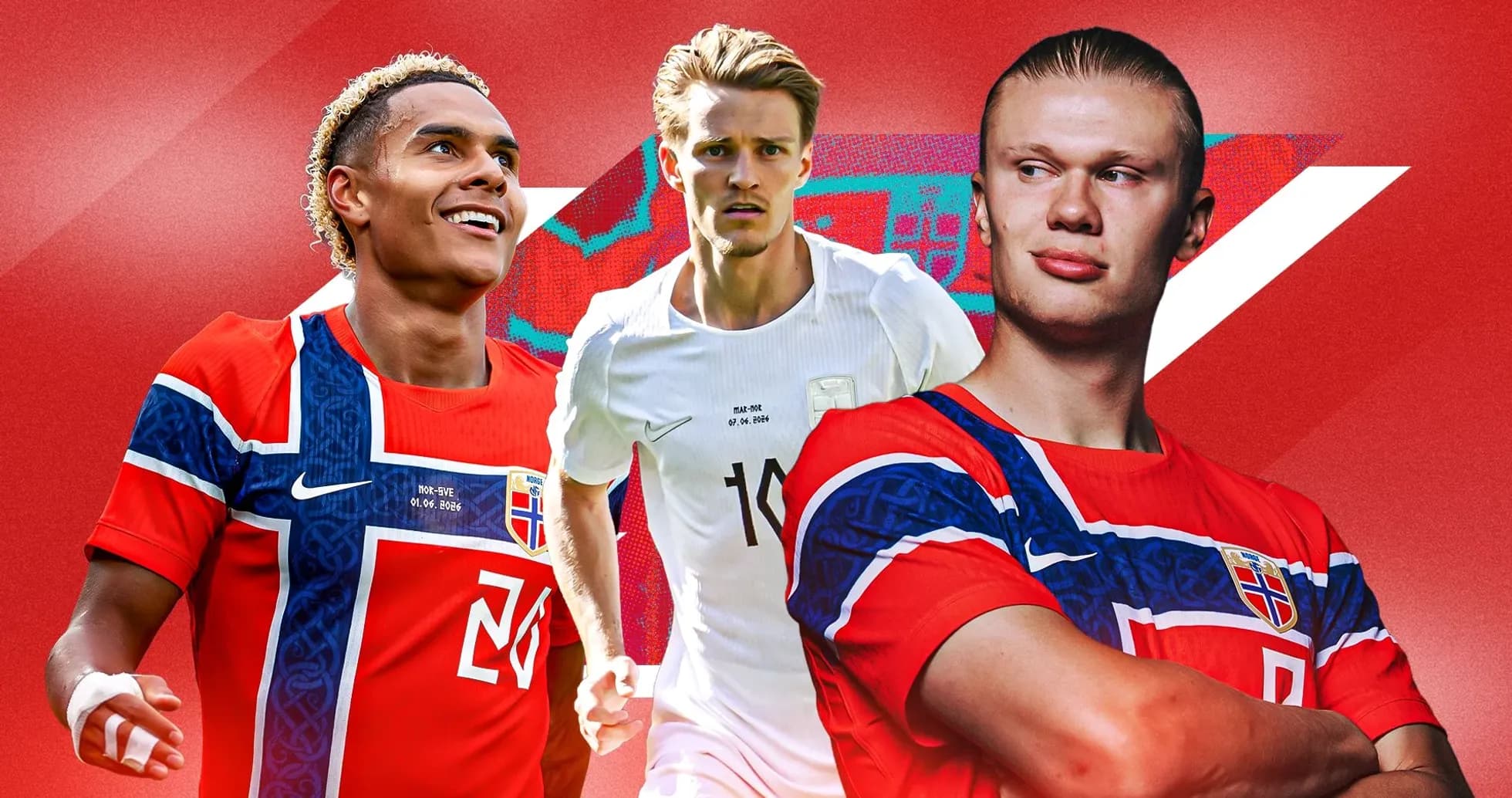
Norway's World Cup Strategy: Beyond Haaland
Norway’s World Cup return has an obvious headline act. Erling Haaland will dominate the billboards, the highlight reels and the opposition’s team talks. But the real intrigue with Stale Solbakken’s side lies in everything built around him – a carefully constructed, sometimes unconventional system designed to squeeze every drop out of a golden generation that has waited 28 years to step back onto football’s biggest stage.
This is not just “give it to Haaland and hope”. Not anymore.
Wide men built to feed a monster
The plan starts out wide. Norway have stacked the flanks with young, fearless talent, then twisted the traditional roles to suit their No.9.
On the left, Antonio Nusa looks set to own the touchline. The RB Leipzig winger is only 21 but already carries himself like a man who knows defenders hate facing him. He drifts past markers, rides tackles and, crucially, turns danger into numbers. Six goal contributions in six qualifying games underline that. Italy felt the full force: a goal and an assist in a 3-0 win, then another decisive contribution in a 4-1 demolition in the return fixture. He doesn’t just decorate games. He changes them.
Waiting behind him is another prodigy with a rising reputation. Andreas Schjelderup arrives in North America off a surge of form at Benfica under Jose Mourinho, having racked up 10 combined goals and assists in 14 league matches in the second half of the season. He also hit a brace against Real Madrid in the Champions League in January – the kind of stage where pretenders are usually exposed. He is not yet a nailed-on starter for Norway, but few doubt where his career is heading.
The right flank is where Solbakken tears up convention. Alexander Sorloth, all 6ft 5in of him, often starts wide on the team sheet. In reality, he becomes a second centre-forward the moment Norway have the ball. It worked in qualifying: eight goal contributions in eight games tell their own story. That awkward, in-between positioning – not quite winger, not quite traditional strike partner – drags defences into places they don’t want to go and opens the corridors Haaland loves.
If Solbakken wants a more natural wide threat, Fulham’s Oscar Bobb offers another angle on the right, even if his start in west London has been steady rather than explosive. Jens Petter Hauge, revived at Bodo/Glimt after his AC Milan spell, also forces his way into the picture. He didn’t play a single minute in qualifying but his club form, including standout displays in Champions League wins over Man City and Inter, has pushed him back into the national setup.
Odegaard, the conductor in national colours
Behind that front line sits a midfield that would not look out of place at any major tournament. Solbakken can call on Premier League and Champions League regulars, with Arsenal’s Martin Odegaard at the heart of it all.
This is Odegaard’s team. Whatever doubts occasionally surface about his consistency at club level, they fade when he pulls on the national shirt. Even in an injury-hit qualifying campaign that saw him miss three of eight games, he still produced seven assists – more than any other player in Europe – including a hat-trick of assists in a single match against Israel. When Norway need a pass to break a line, a disguised ball into Haaland, or a quick combination with the wingers, he is the one they look for.
He will not carry the load alone. Sander Berge, now anchoring Fulham’s midfield, gives Norway a reliable shield and a simple outlet, the kind of player who makes others look better. Alongside him, Benfica’s Fredrik Aursnes brings energy and balance as a true No.8, a player comfortable in the grind of elite competition.
Aursnes’ story is one of the more intriguing subplots. Two years ago, at 30, he walked away from international football, saying he wanted “more time and freedom to prioritise other things in my life besides football”. In February, he reversed that decision. Now, despite playing no part in qualifying, he looks poised to start at the World Cup. Few teams can afford to ignore a player of his experience and versatility; Norway certainly don’t intend to.
Depth in midfield is not an afterthought either. Patrick Berg, the elegant Bodo/Glimt captain, offers control and intelligence on the ball, while Serie A-based pair Kristian Thorstvedt and Morten Thorsby add legs, bite and tactical flexibility.
Still, everything in that unit orbits around Odegaard. His job is clear: connect the wide threats, find Haaland early and often, and set the tempo in games where Norway cannot simply rely on physicality. If he plays to his peak, this team looks very different.
Life after Haaland? Norway have a plan
Haaland will start every game and, if Solbakken has his way, finish them too. The Manchester City striker is the axis around which the entire attack turns. Yet Norway are better prepared than most to cope with the unthinkable.
Sorloth is the first in line. When he moves inside, he does so with a proven record. He scored 20 times for Atletico Madrid this season despite not always being first choice, and his international numbers are solid. Solbakken summed him up neatly in a recent interview with FIFA: a physical presence, a loyal worker, a player who can operate across the front line, a threat to score and to create. Crucially, he accepts roles he “maybe doesn’t prefer” for the good of the team.
Behind him, Jorgen Strand Larsen waits, and he will likely see plenty of minutes even with Haaland fit, given Sorloth’s hybrid role. Since joining Crystal Palace in 2024, Strand Larsen has built a strong reputation in the Premier League and arrives in good rhythm after scoring twice in a warm-up friendly against Sweden. He also found the net against Italy in qualifying. If Norway need a stand-in, he is no token option.
The right-back who plays like a winger
The most unexpected twist in Norway’s attacking blueprint comes from the back. Their most dangerous wide threat might not be a winger at all, but right-back Julian Ryerson.
The Borussia Dortmund defender thrives when given permission to fly forward. Norway’s shape bends to make that possible: Sorloth’s move into the middle creates space for Ryerson to attack the flank, and the numbers to justify it are staggering. He racked up 18 Bundesliga assists in 2025-26, a total most wingers would envy.
Those crosses rarely arrive into an empty box. With Haaland and an inverted Sorloth both lurking centrally, Ryerson often has two towering targets to aim at. The combination is brutally simple and brutally effective.
He is just as lethal from set pieces. A significant chunk of those assists came from corners and free-kicks, where his delivery turns every dead ball into a live threat. Opponents who obsess over Haaland and Odegaard may find the right-back is the one who cuts them open.
Dark horses with limits – and belief
All of this feeds into a Norway side that, for the first time in a generation, travels to a World Cup with genuine expectations. The country’s long absence has built a pressure of its own. When qualification was finally sealed, 50,000 fans braved minus four degrees on a Monday to welcome the team home. That kind of reception stays with a squad.
Solbakken knows the scale of the challenge. Norway have landed in the so-called Group of Death with France, Senegal and Iraq. He has no interest in selling illusions. He does not label his team dark horses to win the whole thing. What he does believe is that, on their day, they can bloody the nose of any heavyweight.
This World Cup, in his eyes, is Norway’s chance to show a different face to the world: an offensive side, rich in individual talent, willing to work relentlessly for each other and unafraid to attack from unusual angles.
The dream scenario? Solbakken keeps that to himself. The structure is in place, the stars are fit, the system is bold. If the chemistry clicks and the match-winners rise to the moment, the question will not be whether Norway belong at this level.
It will be how far this long-awaited team can push the ceiling of what Norwegian football thought possible.

