.svg&w=384&q=75 "GoalGist logo")
Newcastle vs Liverpool: Tactical Insights from Premier League Opener
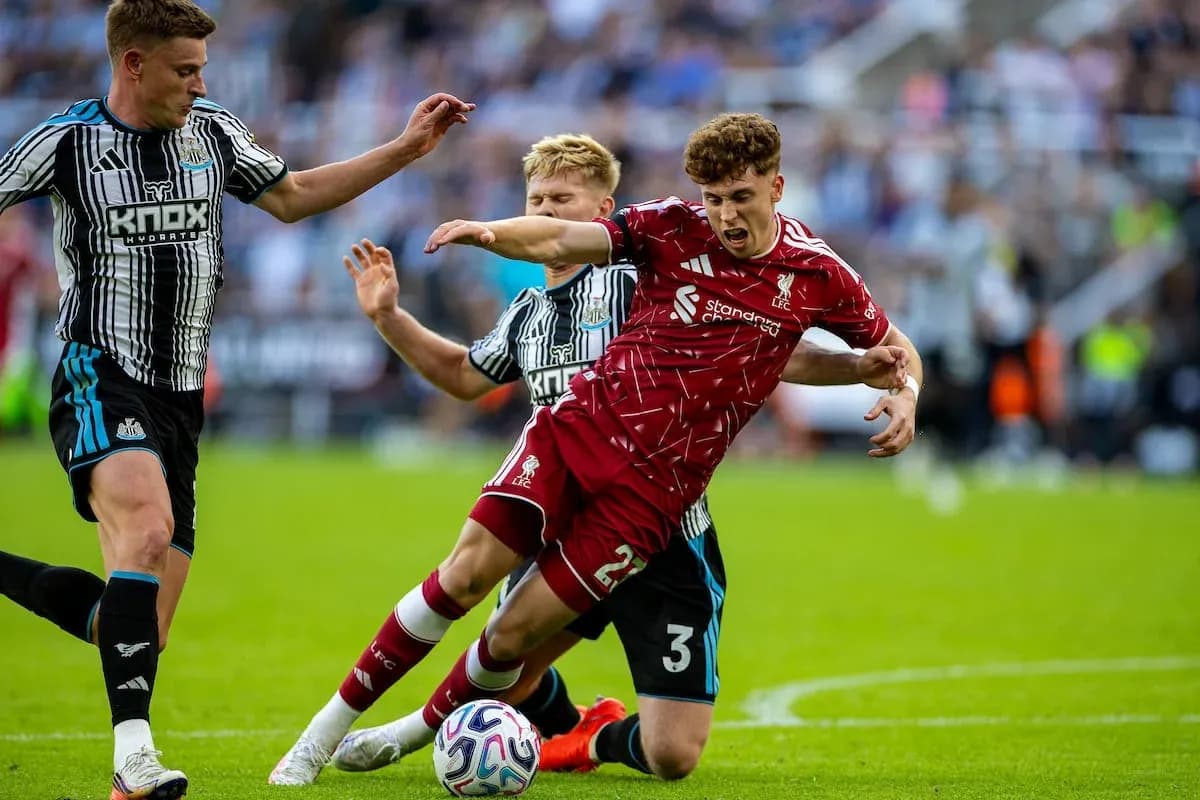
Under the grey Tyneside sky at St James’ Park, Newcastle and Liverpool opened their 2026 Premier League campaigns with a 2–2 draw that felt less like a settling of accounts and more like the first chapter of two evolving projects. Following this result, both sides sit on 1 point from 1 match, level on overall goals scored and conceded at 2–2, with a goal difference of 0. Liverpool occupy 10th, Newcastle 11th, but the standings barely scratch the surface of the tactical stories beginning to form.
The Big Picture – Two 4-2-3-1s, Two Different Identities
Both coaches leaned into a 4-2-3-1, but the shapes carried very different intentions.
Matthias Jaissle’s Newcastle were built around verticality and energy. L. Hornicek started in goal behind a back four of A. Dedic, M. Thiaw, S. Botman and L. Hall. Ahead of them, the double pivot of S. Steur and L. Miley provided legs and progression, while a fluid trio of A. Elanga, Y. Wissa and H. Barnes buzzed behind central forward W. Osula.
Andoni Iraola’s Liverpool mirrored the structure but not the rhythm. Alisson anchored a back line of J. Frimpong, J. Jacquet, V. van Dijk and M. Kerkez. In midfield, D. Szoboszlai and R. Gravenberch formed a technical double pivot, with R. Ngumoha and C. Gakpo flanking the central creator F. Wirtz, all supplying lone striker A. Isak.
Statistically, both teams emerged from Round 1 with the same overall profile: 1 draw, no wins, no defeats, 2 goals scored and 2 conceded. At home, Newcastle’s early-season identity is that of a high-event side: 2.0 goals scored and 2.0 conceded on average. On their travels, Liverpool mirror that volatility, averaging 2.0 goals scored and 2.0 conceded away.
Tactical Voids – The Missing Pieces and the Card Story
The absences framed the contest before a ball was kicked.
For Newcastle, Joelinton and V. Livramento were both ruled out. Without Joelinton’s physical presence and ball-carrying from midfield, Jaissle leaned into the youth and dynamism of L. Miley and S. Steur. Miley’s display – 76 minutes, 36 passes at 83% accuracy, 2 key passes, and 1 tackle, 1 block, 1 interception – hinted at a new organising hub, but also underlined that Newcastle’s midfield is more about circulation and press than brute force.
For Liverpool, the defensive rotation was even more pronounced. C. Bradley, J. Gomez, H. Ekitike and G. Leoni all missed out, forcing Iraola to commit fully to the Frimpong–Kerkez full-back pairing and trust J. Jacquet next to V. van Dijk. That back four, with Gravenberch and Szoboszlai ahead, is built to dominate the ball but can be exposed if the counter-press is even half a beat late.
Discipline told its own story. Newcastle’s yellow cards this season are spread almost evenly across the timeline: 20.00% in each of the 16–30, 31–45, 61–75, 76–90 and 91–105 minute ranges. That distribution points to a side that defends aggressively in every phase rather than switching on and off. Individuals like L. Miley, J. Ramsey, J. Murphy and Y. Wissa already feature among the league’s leading yellow-card recipients, suggesting Jaissle’s pressing game will live on the edge all year.
Liverpool’s bookings have clustered in the first half of matches. So far, 66.67% of their yellows have arrived between 16–30 minutes, with 33.33% coming in the 76–90 window. That profile hints at an early-game intensity – or occasional mistiming – as Iraola’s side tries to impose its press, then a late-game scramble when legs tire and distances grow.
Key Matchups – Hunter vs Shield, Engine Room vs Engine Room
The early top scorers and creators give us a clear view of where these teams are most dangerous.
For Newcastle, A. Elanga and J. Willock have already found the net. Elanga’s 1 goal from 2 shots on target, coupled with 9 duels and 3 fouls drawn, paints him as the chaos winger who can destabilise full-backs one-on-one. Willock, with 1 goal in just 34 minutes, 100% passing accuracy and 2 tackles, offers late-arriving threat from midfield – a shadow runner who can punish teams that focus too heavily on the front line.
Behind them, W. Osula and Y. Wissa headline the creative and pressing effort. Osula’s 1 assist, 5 passes at 80% accuracy and 2 successful blocks show a forward willing to work backwards as much as forwards. Wissa, with 1 assist, 4 shots, 1 key pass, 4 tackles and 19 total duels (winning 11), is Newcastle’s all-action wide operator: part winger, part second striker, part auxiliary midfielder.
Liverpool’s creative heartbeat, meanwhile, runs through R. Gravenberch and F. Wirtz. Gravenberch’s 47 passes at 91% accuracy, 1 key pass, 2 interceptions and 1 tackle underline his dual role as deep playmaker and first line of resistance in transition. Wirtz, stationed as the central attacking midfielder, is the natural conduit between that double pivot and A. Isak.
The “Hunter vs Shield” dynamic is clear. Newcastle’s wide and second-line scorers will repeatedly test Liverpool’s full-backs and the space around J. Jacquet, while Isak’s movement will drag Botman and Thiaw into uncomfortable channels. Conversely, Liverpool’s technical midfield will look to pull Steur and Miley out of position, creating pockets for Wirtz and Gakpo to exploit between the lines.
Statistical Prognosis – What the Numbers Whisper About the Season
With only one league match played for each side, the sample is small, but certain trends are already visible.
Newcastle’s reliance on a 4-2-3-1 is total: they have used it in 100% of their league fixtures so far, scoring 2 and conceding 2 at home. Their clean-sheet count is 0 in total, and they have not failed to score in any match. This is the profile of a team committed to trading blows rather than locking games down.
Liverpool, too, have leaned exclusively on 4-2-3-1, also without a clean sheet and without drawing a blank in front of goal. They have already scored once from the penalty spot this season, converting 1 of 1 penalties for a 100.00% success rate, which reinforces the idea that Iraola’s side will spend plenty of time in the opposition box.
Defensively, both sides are at parity: 2 goals conceded overall, 2.0 per match in their respective dimensions (home for Newcastle, away for Liverpool). The goal difference of 0 for each underlines how fine the margins are.
Projecting forward, the statistical and tactical blend suggests a season of high-tempo, high-risk football for both clubs. Newcastle’s broad yellow-card distribution and aggressive duelling from players like Wissa and Miley point to a side that will live by the press and occasionally suffer for it. Liverpool’s early flurries of bookings and heavy creative load on Gravenberch and Wirtz hint at a team that will dominate territory but can be caught if the counter-press is broken.
In that sense, the 2–2 at St James’ Park felt less like a stalemate and more like a mirror: two ambitious 4-2-3-1 projects, both willing to stretch the pitch, both still learning how to protect themselves when the game breaks open. As the season unfolds, the team that best tightens its defensive structure without blunting its attacking edge will turn these wild, open contests into the kind of controlled wins that lift them from mid-table parity into the European conversation.