.svg&w=384&q=75 "GoalGist logo")
Morocco Dominates Canada 3-0 to Reach World Cup Quarterfinals
HOUSTON — Morocco no longer walks into these stages as a fairy tale. It walks in as a problem.
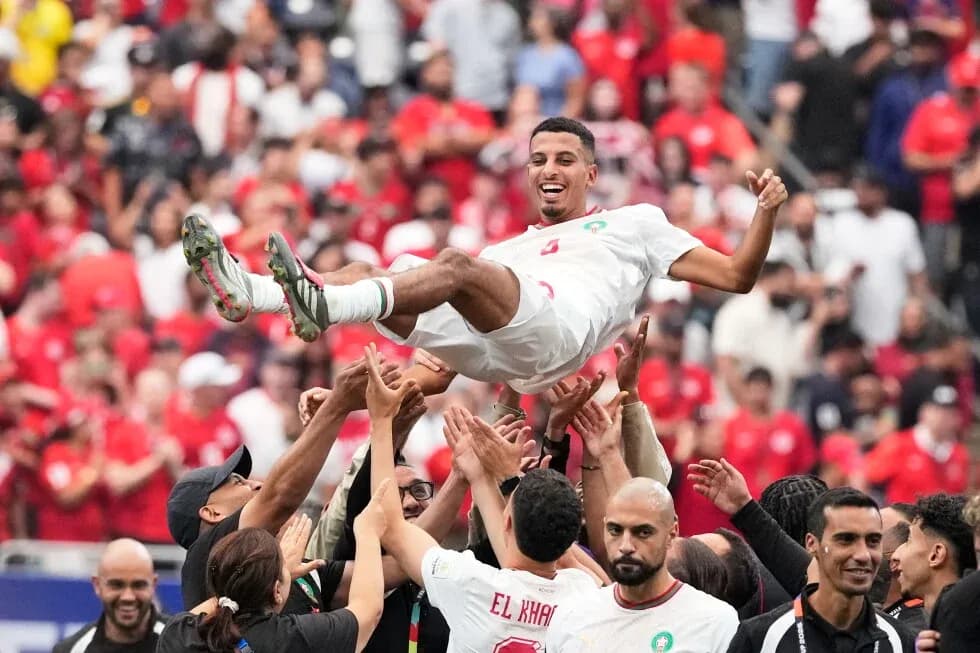
Azzedine Ounahi struck twice and Soufiane Rahimi added a late flourish as Morocco beat Canada 3-0 in the World Cup round of 16 on Saturday, booking a return to the quarterfinals and underlining a new reality: this team now belongs among the game’s heavyweights.
“We are no longer a surprise,” coach Mohamed Ouahbi said through a translator. “Now when people talk about Morocco we’re a major contender and it’s a great source of pride. I think it’s only the beginning and I hope we continue to have runs like this.”
They don’t intend to stop here.
“We want to keep going,” he added. “We don’t want to stop.”
This is no one-off surge. Morocco, the first African nation ever to reach the World Cup semifinals in 2022, has now become the first African country to reach the quarterfinals more than once. A statement of continuity, not just history.
Goalkeeper Yassine Bounou, born in Canada to Moroccan parents, framed it simply.
“We are so proud to represent Africa because it’s a continent with a lot of talent and Africa deserves to be in the best level in football,” he said.
Ounahi breaks Canada’s resistance
For 49 minutes, Canada went stride for stride with the No. 6 team in the FIFA rankings. They pressed, they snapped into tackles, they moved the ball with ambition. What they didn’t do was pierce Morocco’s core.
Then the quality told.
In the 50th minute, Achraf Hakimi stood over a free kick, wide and inviting. His delivery skipped into a crowded zone outside the box, where Ounahi pounced. One touch, right foot, low and true through traffic, arrowing into the bottom right corner. Morocco 1, Canada 0. The breakthrough, finally.
Canada didn’t fold. They pushed harder.
Jonathan David had a free kick from outside the area in the 78th minute but leaned back and sent it over the bar. Moments later, Tajon Buchanan tried to drag his side back into it with a fierce strike from around 30 yards. Bounou, who had watched much of the Canadian pressure with calm assurance, sprang to his right and clawed it away with a full-stretch, diving save.
Three saves in total for him. None more symbolic than that one.
Late show, sharp edge
As Canada chased, spaces opened. Morocco didn’t waste them.
In the 82nd minute, Brahim Díaz slipped into a pocket and spotted Ounahi darting into the heart of the box. The pass arrived at just the right angle, and Ounahi, again on his right foot, drilled his finish from the middle of the area. Clinical. 2-0. The kind of chance a serious contender buries without fuss.
Canada, to their credit, kept coming. The scoreline, though, began to mirror the reality of Morocco’s ruthlessness.
Deep into stoppage time, with legs heavy and the game stretched, Rahimi added the exclamation mark. His goal in the final minute of added time sealed a 3-0 win that looked emphatic on the scoreboard and felt even bigger in the broader arc of Moroccan football.
Next up: a quarterfinal on Thursday at Boston Stadium against the winner of Paraguay vs. France. Another stage, another chance to push the ceiling higher.
Canada’s dream run meets a hard edge
For Canada, co-hosts of this World Cup and a country still learning to love the sport at this level, the journey ends here but not without leaving a mark.
They arrived in Houston having already made history, beating South Africa 1-0 to claim their first-ever World Cup knockout victory. This is only their third appearance at the tournament, yet the run gripped a nation more accustomed to frozen rinks than summer pitches.
Coach Jesse Marsch, whose team matched Morocco’s intensity for long stretches, chose pride and challenge over consolation.
“I told them that I was proud of them and I challenged them to understand that we can play like this all the time against the best teams in the world,” he said. “We can be better on the day. And then the challenge is, can we hold that standard for 90 minutes?”
Marsch went further when assessing the performance.
“The way we pushed, the way we were in the match, the quality we showed, the overall impact in the match, we were better,” he said. “We were better than the No. 7 team in the world today.”
He misspoke on the ranking — Morocco sits sixth, not seventh — and Ouahbi did not let the broader point slide.
“In terms of intensity they were good,” the Morocco coach replied. “They were good for 98 minutes. Were they better? It’s hard to say. It takes some nerve to say that when you lose 3-nil.”
That exchange summed up the afternoon: Canada’s growing confidence against Morocco’s hardened belief.
Physical, raw, and unforgiving
The contest never drifted into a friendly sparring match. It was sharp, edgy, and often combustible.
Eight yellow cards flew — four for each side. The flashpoint came in the 40th minute when Hakimi and Richie Laryea clashed. Hakimi shoved Laryea to the turf, Laryea responded with a push of his own, and a brief scuffle drew teammates into the fray. Both went into the book, a snapshot of a match played on the edge.
Morocco also had to absorb a setback early on when midfielder Ismael Saibari limped off injured in the 22nd minute. The disruption didn’t derail them. If anything, it underlined the depth and resilience that now define this squad.
This was, too, a rerun with a different stage. At the last World Cup, Morocco beat Canada 2-1 in the group phase on their way to a fourth-place finish and a place in global folklore. This time the stakes were higher, the margin wider, and the message clearer.
Canada’s effort came without their brightest star for most of the tournament. Alphonso Davies, limited to just 15 minutes as a substitute in the win over South Africa because of a hamstring issue, never made it onto the pitch in Houston.
“His hamstring didn’t feel right,” Marsch said. “We were hoping that by the time he woke up this morning that he would feel better, but he didn’t.”
Even so, Canada stayed brave, front-footed, and willing to attack. They leave with a blueprint and a belief that this level is no longer out of reach.
Morocco leaves with something else: momentum, status, and a growing expectation that this is not just a golden moment, but a golden era.
The quarterfinal awaits. The question now is not whether Morocco belongs here. It’s how far this team can push the limits of what African football has ever known.