.svg&w=384&q=75 "GoalGist logo")
Mikel Arteta: From Arsenal Injury to Champions League Success
Santi Cazorla can’t get the story out without laughing. Back then, both injured at Arsenal, he and Mikel Arteta would meet at home to watch games. It sounded like a good way to pass the time. It wasn’t.
Arteta would seize the remote, stop the action dead and start rewinding. Thirty seconds back. Pause. Silence.
“‘What are you stopping it for?’” Cazorla remembers asking. “‘No, go back, go back,’” Arteta insisted. Then the quiz: “‘What do you see?’”
Cazorla saw a frozen frame and a ruined evening. Arteta saw everything.
“‘Don’t you think this player is badly positioned? If he goes a bit deeper, this space opens up … if the pivot goes there, this happens … that line should be deeper …’” Cazorla recalls. “He was a coach already. All game, every game: pausing, rewinding. The match is finished and we’re only in the 35th minute.”
Cazorla loved football. Arteta dissected it. There’s a difference. And that difference now leads Arsenal into a Champions League final.
The kid who was “alive”
To understand how he got here, you go back to Gipuzkoa, the smallest province in Spain and a strange little factory of elite coaches. From early on, everyone who crossed Arteta’s path agreed on one thing: he wasn’t normal.
“Mikel caught your attention very young,” says Jon Ayerbe, who played with him at Antiguoko, the San Sebastián youth club that regularly bloodied the noses of professional academies. “The word I’d use is alive; you saw it in his eyes. He grasped everything fast, had character and was so competitive. Give him the ball, he’ll find a solution. And he was a year younger than us, eh.”
Álvaro Parra doesn’t hesitate either: “Above all, he was the most intelligent.” Mikel Yanguas adds: “You looked at him and thought: ‘Bloody hell, he’s got something special. If anyone makes it, it’s him.’ He had personality, ambition.”
This wasn’t just about talent, though there was plenty of that. It was about something underneath: clarity, drive, a way of seeing the game that stuck.
Arteta might never have been a footballer at all. He was good enough at tennis to choose that path, his father forcing the decision. Football won. Antiguoko’s former coach Roberto Montiel still tells the story of a goal against Real Sociedad, all cheek and technique, that reminds him of Lionel Messi. Back then Arteta was tiny, two-footed, a No 10. He would later drop deeper, become a No 4, but the ball always obeyed him.
“He was always clear he would make it and sacrificed his life for it,” Parra says. “He went to Barcelona, leaving everything behind. And later he turned down lucrative offers – Dubai, Qatar, the US – to work with Guardiola at Man City because it was the right step.”
From Antiguoko to La Masia
By 14, Arteta was already training with Athletic Club, 100km away along the AP-8. One of his coaches there was José Luis Mendilibar, who would go on to manage Athletic, Eibar, Sevilla and Olympiakos. What struck him was simple: this kid never lost the ball.
He played with “clarity and sense”, Mendilibar wrote later. And with that came a thought: if someone understands the game this well, maybe one day he’ll be able to explain it too.
Luis Fernández, who signed an 18-year-old Arteta for Paris Saint‑Germain in 2001, felt something similar. “When you told him what you wanted, he did it first time,” Fernández says.
Before Paris, though, came Barcelona, the first real break from home and the place that would define his footballing religion.
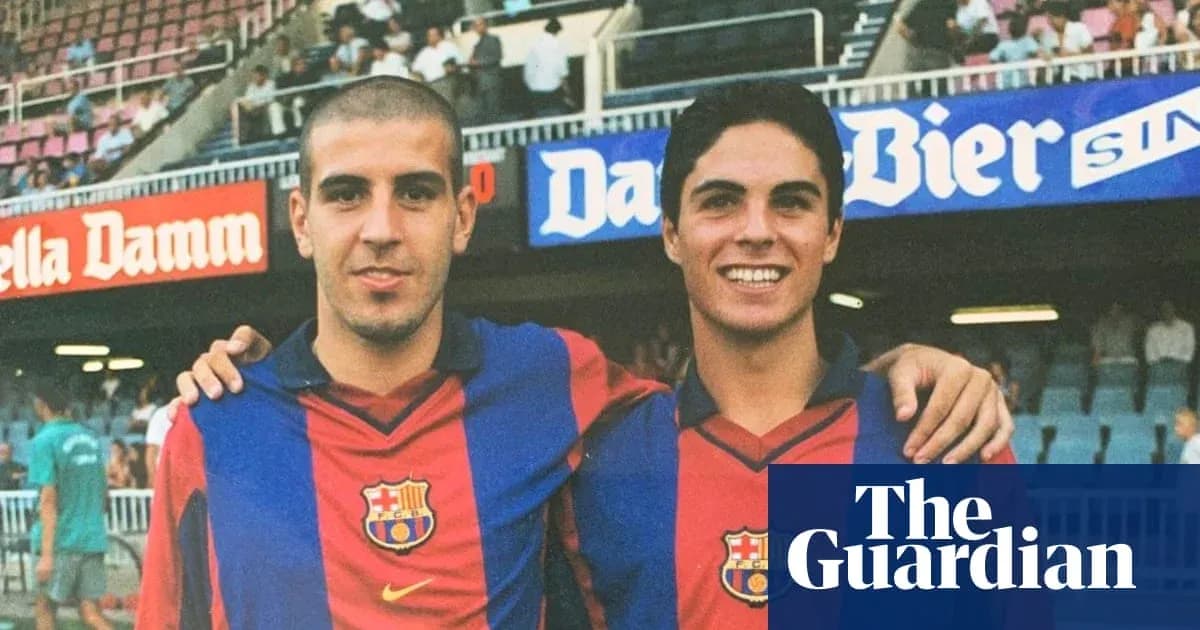
“It was 1997,” Yanguas recalls. “Someone saw us representing Gipuzkoa at an Easter tournament and invited us to a trial at Barcelona. We stayed near Pedralbes and at the end they said yes to the three of us: me, Mikel and Jon Álvarez. We left that summer: 17 August, the day of San Sebastián’s fiestas, so I remember it well.”
They moved into La Masia, the old farmhouse beside Camp Nou that served as both myth and dormitory. Thirty-two boys, aged 11 to 18, crammed into bunks and camp beds. A few basketball players. And a roll call of names that would shape an era: Andrés Iniesta, Carles Puyol, Iván de la Peña. Pepe Reina became one of Arteta’s closest friends.
From the window they could see part of the training pitch where Bobby Robson’s Barça worked. Only part, because a screen blocked half the view. The rest they had to imagine.
“It was just us, the cooks, the security guard and one guy overseeing everything,” says Roberto Trashorras, another of Arteta’s close friends there. “It’s totally different nowadays. We sorted things out among ourselves. Because we were alone, we looked after each other. There were no mobiles. I remember queueing at midnight to ring home from the payphone, Puyol and De la Peña ahead of me.”
They were teenagers. So there were pranks, water bombs, late‑night jokes. “Mikel was funny, extroverted, but we were the victims usually … until you get a bit older and it’s your turn,” Trashorras says.
Days followed a strict rhythm: bus to school – parents picked from three options – then training, then not much. “We would go to El Corte Inglés; we were from San Sebastián, a small city, and we didn’t have an El Corte Inglés there,” Yanguas says. “Or we’d go to the cinema. I remember seeing Titanic with Mikel, Victor Valdés, Fernando Macedo. At weekends your parents would come.”
They were 15. It was a lot.
Yanguas admits now he wasn’t ready. That cadete team became national champions, but he went home after a year. “It was hard for me,” he says. “I think about it now and I was an introvert. Mikel was different, better prepared: more outgoing, more adaptable, better at relating. Maybe inside he was struggling but we saw someone who handled it very well.”
On the pitch, the difference was even clearer. “He would demand the ball,” Yanguas says. “I thought it was natural then but I coach now and realise it’s not. No one offers, no one asks for the ball. Mikel did constantly. It’s hard to do that: ‘Give it to me, I’ll sort this.’ He was surrounded by great players but had the confidence and self assurance to do that.”
Crashing cars and calming fights
Jofre Mateu, two years older, had already played for Barcelona’s first team when he shared a dressing room with Arteta in the B side. The memories come quickly.
“Mikel used to laugh about his hair. He said he had ‘bull’s hair’: so hard and it didn’t move,” Jofre says. Then there’s the car.
“One day he took my car when he was learning or recently passed and crashed it into the Masia wall. It was three metres, impossible to crash. Impossible. And he goes: ‘Nah, nah, relax, I‑don’t‑know‑what.’ He puts his arm on the window, looks back to reverse, but he’s putting it in first. ‘Yeah, I think you need more lessons. You can take taxis from now on.’ My car was only two months old: a VW Golf.”
So, were you stupid to give him the keys? “Totally,” Jofre says, laughing. But then he pauses, because the car crash doesn’t really fit the larger picture.
“He wasn’t there to piss about, he was there to do the right thing,” Jofre says. “He was super‑responsible, he had something.”
A different scene captures Arteta better. Training. Thiago Motta, hot‑headed as ever, gets into a fight. That wasn’t unusual. What was unusual was who stepped in.
“I don’t remember who with, but it wasn’t Mikel, yet he steps in: ‘Thiago, man, you’re teammates: you can’t do this,’” Jofre says. “I remember it because Mikel didn’t really have the ‘weight’ to do that. It would be like Marc Bernal standing up to, say, Gavi now. He didn’t do it in an ugly way, but he did it. Clearly, firmly. And we just all stopped. Like: ‘Olé tus huevos.’”
He wasn’t the star. But he wasn’t going to let it slide. That, Jofre says, told you who he was.
A football education like a religion
La Masia was a different world. Not just technically, but mentally.
“The players who arrive are the best in their teams but Barcelona make you think about tactics, space in a way that’s not normal,” says Luis Carrión, another Barcelona B teammate. “At Antiguoko, Mikel would have had the ball all the time; here he had to wait, occupy the right space. By standing still, you see a solution, a way out.”
They drilled concepts constantly: third man, triangles, final line. Not in a classroom, but on the pitch, every day, with endless passing exercises.
Trashorras remembers the shock. “Mikel was a dribbler, arriving in the area, but he learned to play one, two touches, not lose his position,” he says. “One of the things that most struck me when I first got there is they would say: ‘Don’t go looking for the ball, the ball will come to you.’ ‘Yeah, but, it’s just there, I can …’ ‘No, no, no. Don’t invade someone else’s space.’”
For a teenager used to dominating the ball, that was hard. For Arteta, it was an education he absorbed quickly. “Mikel was sharp,” Trashorras says. “It’s really, genuinely different. Pffff, it’s like a religion. And then when you leave it’s different too.”
Blocked by Xavi and Iniesta, shaped by the world
Barcelona shaped him, but it didn’t keep him. The reason is brutally simple: two names, Xavi Hernández and Andrés Iniesta. There was no room to grow into the role he wanted.
So he went out into the world instead. Spain, France, Scotland, England. Four countries, four football cultures, all feeding into the coach he would become.
“When I became PSG coach I asked for Mikel because I watched him in the juvenil,” Fernández says. “I followed Johan Cruyff’s ideas, the importance of the pivot, loved Pep Guardiola and wanted a player of that type.
“On the pitch you see Mikel’s intelligence, his understanding and, for sure, that comes out later when he becomes a coach. He had the perfect attitude to coach: professionalism. He was responsible, listened, learned and you didn’t need to keep telling him. He was an example for everyone. I admire him. I’m sensitive and when I see him and Gabi Heinze, his very good friend in Paris, it makes me so happy.”
Did Fernández see a future coach then? “If you had asked me then if he would be a coach, I’d have said: ‘No.’ He wasn’t: ‘Do this, do that.’ I think he learned with Pep. I went to see him do a session and thought: ‘Bloody hell, look at Mikel.’ But it was always in him.”
The spaces he always saw
Carrión remembers a polite, serious kid, already living like a professional. “He was a kid with personality: polite, very professional for his age,” he says. “A coach? You never know, but he watched a lot of football. I ran into him recently and we chatted about football; it’s always football.”
Yanguas believes the understanding was always there, even if the language to express it came later. With time, he says, you learn to put into words the spaces you instinctively saw. Arteta always saw those spaces. Focus and passion came built in.
Ask Jofre if he saw a future coach and he’s blunt. “Zero,” he says. “But if you asked me about Xavi, I would have said zero. Luis Enrique, zero. Guardiola … OK, yes. But we were kids still, teenagers at La Masia more interested in the next game, some girl or where we’re going on Saturday.”
Trashorras nods to that. “With Pep, you saw it; with Mikel I couldn’t claim to have done, but you can’t argue with what he’s done.”
You can’t, because Pep Guardiola did see it. He brought Arteta to Manchester City, handed him a key role, watched him grow into the voice Cazorla would later hear in that living room, pausing and rewinding, demanding to know what others could not yet see.
Now Arteta stands on the touchline as Arsenal’s manager, guiding a club back to the top table of Europe. The remote control is gone. The habit isn’t.