.svg&w=384&q=75 "GoalGist logo")
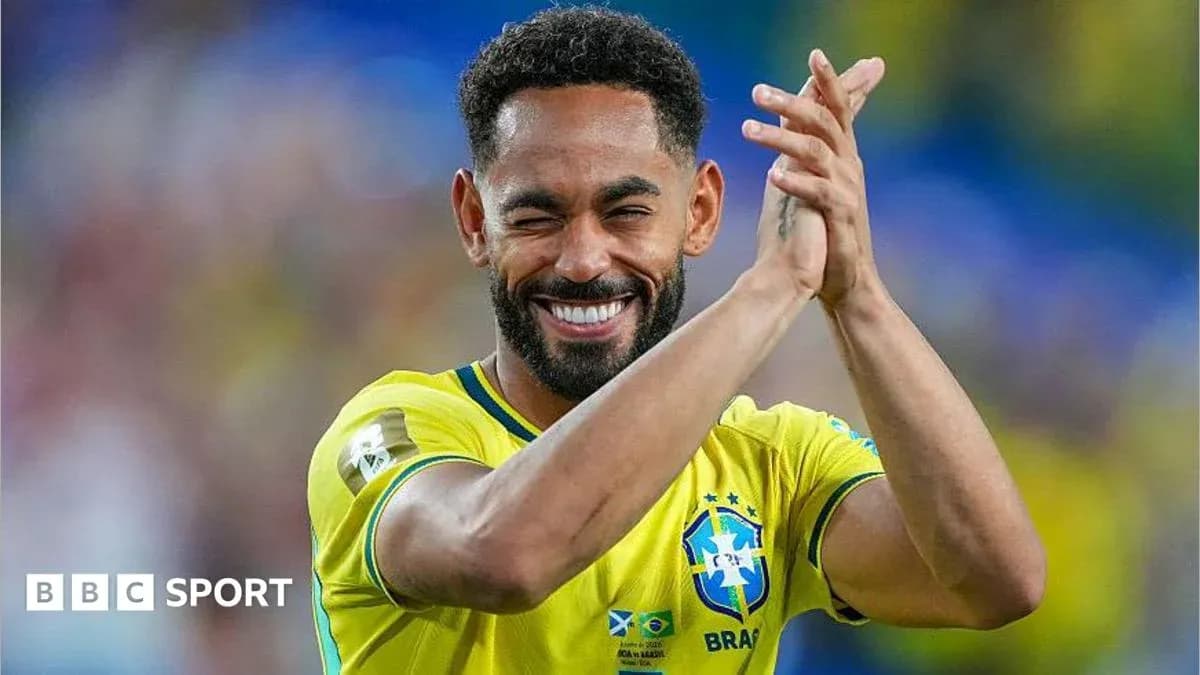
Matheus Cunha: Brazil’s Dynamic Forward Redefining the Number Nine
Brazil’s World Cup machine is finally whirring into gear – and at the heart of it, unexpectedly, stands Matheus Cunha.
For a country raised on classic number nines, this feels different. No Ronaldo, no Adriano, no Romario leading the line in familiar fashion. Instead, Carlo Ancelotti has built his emerging side around a forward who refuses to fit neatly into any old template.
Cunha is not a pure striker. He is not a pure playmaker. He is both, and neither. And right now, he is exactly what Brazil need.
A “nine-and-a-half” who bends the game
Ancelotti has spent the group stage searching, adjusting, trimming away uncertainty. The sense now is that he has found his best XI. Brazil have grown with every game, collecting not just points but conviction. Seven goals scored, one conceded, and a team that looks sharper with each passing test.
At the centre of it all: Cunha, with three goals already at this tournament and a role that stretches far beyond the penalty area.
He plays as what Lucas Leiva calls a “nine-and-a-half” – able to occupy centre-backs like a traditional striker, yet just as comfortable dropping into pockets of space to link play. His movement constantly poses a question to his marker: follow him into midfield and leave space behind, or hold the line and allow him time on the ball?
When defenders step out, Vinicius Jr and Rayan feast on the space. When they hold, Cunha receives between the lines, turns, and either slides passes through or goes for goal himself. It is a dynamic that Brazil’s public are not entirely used to from their centre-forward, but one that is rapidly winning them over.
There is a touch of Roberto Firmino in the way Cunha plays. The Liverpool comparison is not about statistics, but about disruption. He drops deep, he drags defenders where they do not want to go, he presses from the front, and he never stops working. At times he even looks like a number six when Brazil are out of possession, the first line of defence screening in front of midfield.
That defensive commitment has given Brazil something they have often lacked in major tournaments: balance. The attack is not just about flair now; it has structure.
Ancelotti’s accident that became a plan
Brazil arrived at this World Cup in a rare state of uncertainty: no clear first-choice number nine. Even as late as the Scotland game, the shirt felt up for grabs. Ancelotti rotated through Cunha, Igor Thiago, Endrick, Joao Pedro and Richarlison, searching for chemistry as much as goals.
Then injury nudged the pieces into place.
Raphinha, a gifted, restless attacker who drifts across the front line, started the tournament in a central role behind Thiago and can operate on either wing. His hamstring injury against Morocco changed everything. On came Rayan, a far more fixed presence on the right.
That single switch altered the geometry of Brazil’s attack. With Vinicius wide on one flank and Rayan holding width on the other, Cunha suddenly owned the central lanes. He no longer had to share those spaces with a roaming playmaker. The middle of the pitch became his playground.
For a player who thrives on freedom between the lines, it was perfect. He could drop off, pull away, spin in behind, or step up as a penalty-box finisher, always with room to operate.
Igor Thiago still offers a very different option – a more traditional reference point who pins centre-backs and thrives in physical battles, especially useful if Brazil are chasing a game or need more aerial presence. That variety is precisely what Ancelotti wanted. Now, though, the growing feeling in Brazil is that Cunha is the answer for the biggest nights.
Opponents will study him. They will try to block his routes, cut off his angles, crowd his space. Yet his intelligence – the timing of his movement, the awareness of what is happening around him – makes him a difficult puzzle to solve.
A Brazil that controls without the ball
Ancelotti’s influence stretches far beyond the front line. His Brazil does not obsess over possession. They do not chase 70% of the ball just to prove a point. They are comfortable stepping back, inviting opponents on, and then punishing them when the moment is right.
Against Scotland, that plan was clear. Brazil allowed Scotland to have the ball, but not the control. They shepherded them into traps, funnelling play into congested zones, then sprung forward with well-timed presses. The first goal came that way; a second, similar strike was ruled out harshly. Those were not accidents. Brazil had already scored similar goals in warm-up games against Panama and Egypt.
This is where Ancelotti’s tactical reputation deserves more credit. His man-management draws headlines, but his adaptability defines his teams. He shapes his approach to the opponent and the moment, not to a fixed ideological label.
If Brazil need to dominate the ball, they can. If they need to sit, wait, and strike, they can do that too. With players as adaptable as this squad, it makes sense to let the strategy bend to the challenge in front of them.
A new shape, a new Brazil
The evolution is not only tactical in attack; it is structural at the back. For the first time in a World Cup, Brazil are playing without full-backs constantly tearing forward. There is no Roberto Carlos or Cafu charging past the wingers, no Maicon, Marcelo or Dani Alves living on the overlap.
With Douglas Santos and either Roger Ibanez or Danilo, the full-backs are more conservative. They choose their moments. They protect first, support second. That restraint has a knock-on effect: Vinicius can stay higher and fresher, ready to explode when Brazil win the ball.
The back four looks solid. The midfield, after early teething problems, now feels properly balanced.
Casemiro’s struggles in the opening game against Morocco told their own story. Left alone at the base of midfield in a 4-2-3-1, he was exposed and criticised, expected to cover impossible ground at 34. The issue was not his decline; it was the system.
Ancelotti adjusted. Brazil shifted to a 4-3-3. Now, when Bruno Guimaraes surges forward, Casemiro is not left on an island – Lucas Paqueta slots in alongside him, closing gaps and sharing the load. That tweak has tightened Brazil significantly, as seen against Haiti and Scotland.
The change will matter even more against Japan, a side far more fluid and dangerous in attack than either of those opponents. Brazil cannot afford to leave spaces between the lines. With this new shape, they look better prepared.
From anxiety to anticipation
The numbers say Brazil are in control: one goal conceded, seven scored. The mood says even more. Before the tournament, there was tension. Before the first game, anxiety. After it, real concern.
Three matches later, the tone back home has flipped. The public is smiling again. Not because Brazil are playing like some romanticised version of the past, but because they are winning – and doing it with a clear idea.
This is a different Brazil. Less about flying full-backs and relentless possession, more about structure, intelligence and timely aggression. Less predictable, more adaptable.
At the heart of that shift stands a manager who refuses to be boxed in, and a centre-forward who refuses to be defined by a single number on his back.
Japan now await in the last 32. The stage gets bigger, the margins thinner, the pressure sharper. If Brazil are truly “getting better at the right time”, as the performances suggest, this is where they prove it – and where Matheus Cunha shows whether this new Brazil has the edge to go all the way.