.svg&w=384&q=75 "GoalGist logo")
Manuel Ugarte's Injury Impacts Manchester United's Future
Manuel Ugarte’s World Cup ends in agony—and leaves Man Utd stuck in limbo.
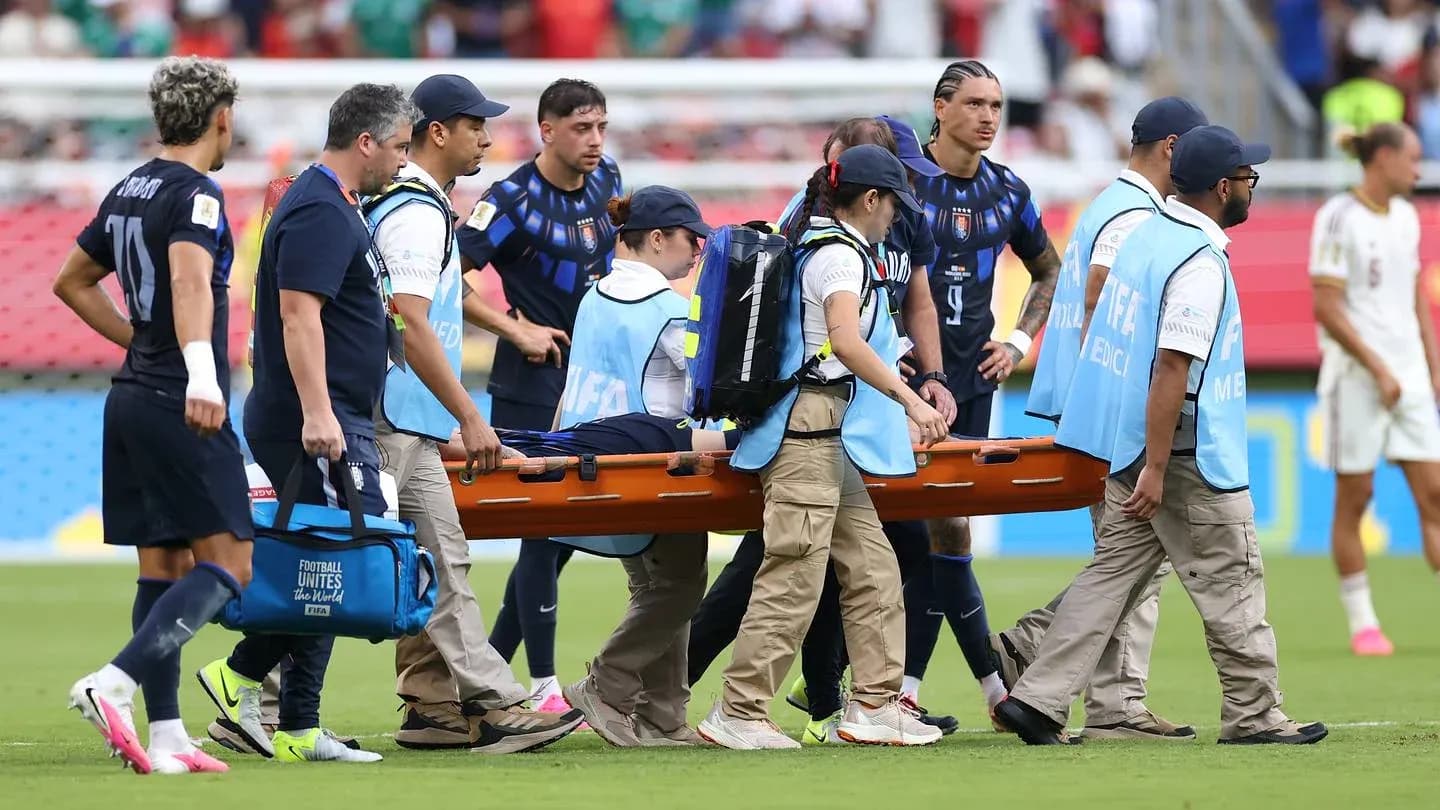
The Uruguay midfielder didn’t even make it to the interval of the group-stage decider against Spain, leaving the pitch on a stretcher after a grim, self-inflicted-looking injury that silenced a stadium used to noise and needle.
For 40-odd minutes, this was Ugarte at full throttle. His third start of the tournament, another shift spent harrying and hounding from the base of midfield, snapping into duels, covering ground, doing the unglamorous work that has long been his calling card. Spain, as they do, kept the ball, recycling it in front of Uruguay’s compact block, red shirts probing, navy ones shuttling.
Then came the moment everything turned.
As Pedri drifted between the lines, Ugarte surged in to join Mathías Olivera and Rodrigo Bentancur, a three-man press converging on the Barcelona playmaker. It looked, for a split second, like the perfect trap. Instead, Ugarte never made contact with man or ball. His studs bit into the turf, his leg jarred awkwardly, and he crumpled.
Play went on. He stayed down.
Spain, ruthless and unbothered by the chaos behind them, continued the move and scored from the same passage of play. While red shirts wheeled away in celebration, Ugarte was still receiving lengthy treatment on the grass, his World Cup unravelling in real time.
When he was finally lifted onto the stretcher and carried off, the expression said enough. Pain, yes. But also the dawning realisation of what this might mean beyond one game, beyond one tournament.
Flesh, blood, and a stalled rebuild
The immediate concern is obvious: the player’s health. Sir Alex Ferguson used to rail against the tendency to treat footballers as chess pieces, reminding anyone who would listen that the sport is played by “creatures of flesh and blood and feeling.” Ugarte, in that moment, was exactly that—no transfer value, no tactical role, just a 25-year-old in clear distress.
Once the scans are done and the diagnosis lands, the conversation at Old Trafford will inevitably shift. Because for Manchester United, Ugarte is also an asset, and a complicated one.
His first full season at the club never caught fire. Signed for around $66 million (£50 million) in 2024, he arrived with a reputation as a destroyer, a midfield enforcer built for Premier League battles. The reality was brutal. He started only eight league matches all campaign, and just one after Michael Carrick stepped into the dugout in January.
He didn’t just lose his place. He lost his footing in the project.
By the spring, his name featured less on team sheets and more in transfer gossip. Various Serie A clubs circled, sensing an opportunity, and United were widely expected to listen. An exit felt logical for everyone: Ugarte needed a reset, United needed funds and space for a midfield reshuffle, and nobody at Old Trafford believed they would see that original £50 million fee again.
Now? The entire equation has changed.
No club will commit serious money to a player whose last competitive action ended with him being stretchered off in a World Cup. Even if he has dodged the nightmare of an ACL tear, any significant lay-off dents both his market value and his immediate usefulness. Medical reports will dictate interest. Caution will dictate offers.
United, who had quietly prepared to move him on, suddenly face the prospect of being stuck.
A midfield plan ripped up
This comes at the worst possible time for a club bracing for a major midfield overhaul.
Casemiro still needs a long-term replacement. The balance around Kobbie Mainoo has to be managed carefully, with the teenager expected to shoulder a far heavier workload in 2026–27 than he did last season. Depth, energy, and reliability in the centre of the pitch are non-negotiable if United are to drag themselves back towards the top.
The working assumption had been that Ugarte would go, his departure opening both a squad slot and some room on the wage bill for another signing. One out, one in. Simple on paper.
That plan is now on ice.
If the injury proves serious, Ugarte becomes almost impossible to sell at a sensible price. Even a moderate problem complicates any deal. United may be forced to carry him into next season, unsure when he will be fully fit or how he fits into Carrick’s evolving midfield structure.
Do they still push ahead with another defensive midfielder, effectively writing Ugarte out of the story? Or do they gamble on his recovery and risk going light again in a department that has already cost them so many points?
One awkward landing in a World Cup group game has created a fault line running straight through United’s summer.
For Ugarte, the priority is simple: get healthy, get back. For Manchester United, the question is harsher: can a club trying to rebuild afford to wait on a player whose future was already in doubt before his knee slammed into the turf?