.svg&w=384&q=75 "GoalGist logo")
Manchester United Appoints Eva Olid as New Women’s Team Head Coach
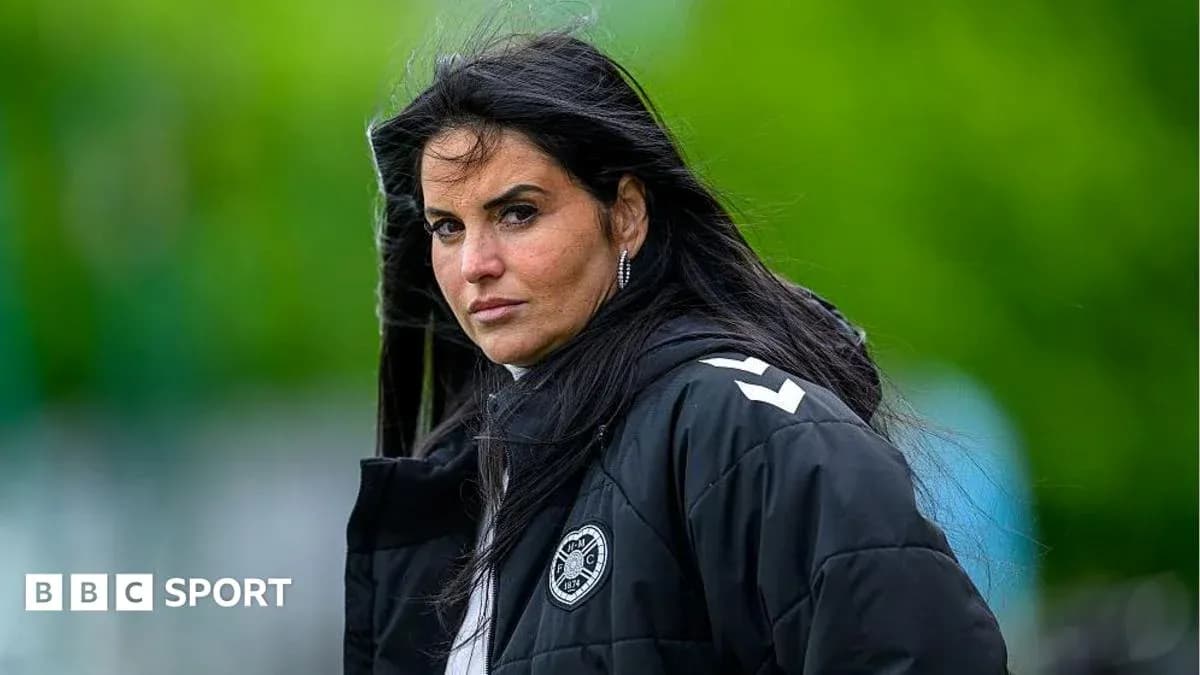
Manchester United have handed the keys to their women’s team to Eva Olid, a coach whose reputation has been built far from the glare of the Women’s Super League, but whose work in Scotland has turned heads across the game.
The 40-year-old Spaniard has signed a two-year deal, with an option for a further 12 months, replacing Marc Skinner, who left by mutual consent on Monday – just a month before the new WSL season.
For Olid, this is not just a promotion. It is a leap into the spotlight.
“The opportunity to become head coach of Manchester United Women is a dream come true,” she said. “There is already so much talent within our squad and I am excited to work with the players to support them to fulfil their immense potential.”
United wanted a developer, not just a tactician. Their internal brief was clear: a coach with a proven history of improving players, especially young ones. Olid ticks that box emphatically.
From virtual unknown to title contender
When Olid arrived at Hearts, she did so as a virtual unknown. She leaves as the architect of one of the most striking transformations in Scottish women’s football.
Hearts have never been one of the traditional heavyweights in Scotland. By the time she walked away in May, they were top of the pile.
Last season, she led the club to their first Scottish Women’s Premier League title and their first major silverware. She also took them to a first domestic final, losing the 2024 Scottish Cup to Rangers, but confirming their emergence as a genuine force.
Her impact went beyond trophies. Hearts became the SWPL’s great entertainers. Built around an aggressive 3-4-3, Olid’s side attacked relentlessly, with the goalkeeper acting almost as a fourth defender, stepping high to launch moves and compress the pitch.
The numbers told the story. Hearts finished as top scorers in the SWPL with 85 goals. Only Rangers, with 80, came remotely close.
For United’s forwards – Ella Toone, Lea Schuller and Elisabeth Terland – that statistic will sound like a promise. Under Olid, chances tend to flow.
A coach with a Plan B
Olid is not just a romantic attacking ideologue. When the moment demanded pragmatism, she showed she could pivot.
Across her first four seasons, Hearts could not find a way past Glasgow City. In April, with the title race on the line, she changed tack. Out went the full-throttle approach; in came a more conservative, defensive set-up. Hearts won 1-0 and went top.
That match did more than tilt a title race. It became a personal landmark. Olid revealed her intention to leave after that game, saying she could not have walked away without finally beating City at least once.
Her players felt the full weight of that journey. Former Hearts captain Georgia Hunter, who moved to Ipswich this summer, did not hold back when asked about her old manager.
“She’s a great manager, very, very good,” she told BBC Sport. “I learnt so much. The transition with all the players and [where] she took the club to is absolutely amazing.”
Builder of teams, shaper of careers
United’s hierarchy have made no secret of their desire to lean harder into youth development. Olid’s record in that area is central to her appointment.
At Hearts, she trusted teenagers in high-pressure situations. Erin and Jess Husband both made their debuts at 15 under her watch, part of a broader pattern of nurturing young talent and giving them responsibility early.
“Eva is the perfect coach to lead us into an exciting new era – she shares our commitment to developing exciting homegrown and young players,” said Matt Johnson, United’s director of women’s football.
Her work has not been confined to club football. Time spent with the Scotland women’s national team added another layer to her profile and, for those watching closely, made this kind of move feel inevitable.
“We were convinced she had somewhere special to go,” said BBC Sport Scotland’s Amy Canavan. “She 100% deserves this chance and is ready for it.”
Unknown quantity, clear identity
One of the most intriguing aspects of this appointment is how little the WSL actually knows about Olid.
She has never managed in England. She has not yet tested herself in European competition. The weekly grind of the WSL, with its tactical variety and relentless scrutiny, will be a step up from the Scottish game.
United, though, believe the direction is right. They wanted a coach who could improve individuals session by session, who could shape a clear style and bring through the next wave of talent. They see all of that in Olid, and expect a brand of football coloured by her Spanish roots – possession with purpose, high-intensity pressing, brave use of the ball.
Her arrival was rapid. Skinner’s departure on Monday came with United already well advanced in their search, and Olid’s contract was signed within 24 hours. That speed underlines how firmly she sat at the top of their shortlist.
Pressure from day one
Speed of appointment will not soften the spotlight. If anything, it sharpens it.
Skinner’s exit reopened long-standing questions about United’s ambition for their women’s team. Investment, recruitment, and the club’s broader strategy have all been under the microscope. The new manager steps into that debate whether she likes it or not.
Scrutiny will be immediate. So will expectation.
She inherits a squad that has been depleted over the summer and a fanbase that has grown increasingly impatient, demanding not just progress but proof of a genuine commitment to competing at the top.
Her first task is brutally simple and enormously complex: galvanise what she has, integrate youthful talent, and embed a new way of playing in time for the WSL opener at London City Lionesses on 4 September – four weeks from Friday.
That match will not decide a season. It will, though, offer an early, unforgiving measure of where Manchester United stand under Eva Olid, and how quickly her revolution can take hold.