.svg&w=384&q=75 "GoalGist logo")
Mallorca vs Villarreal: Tactical Stalemate in La Liga
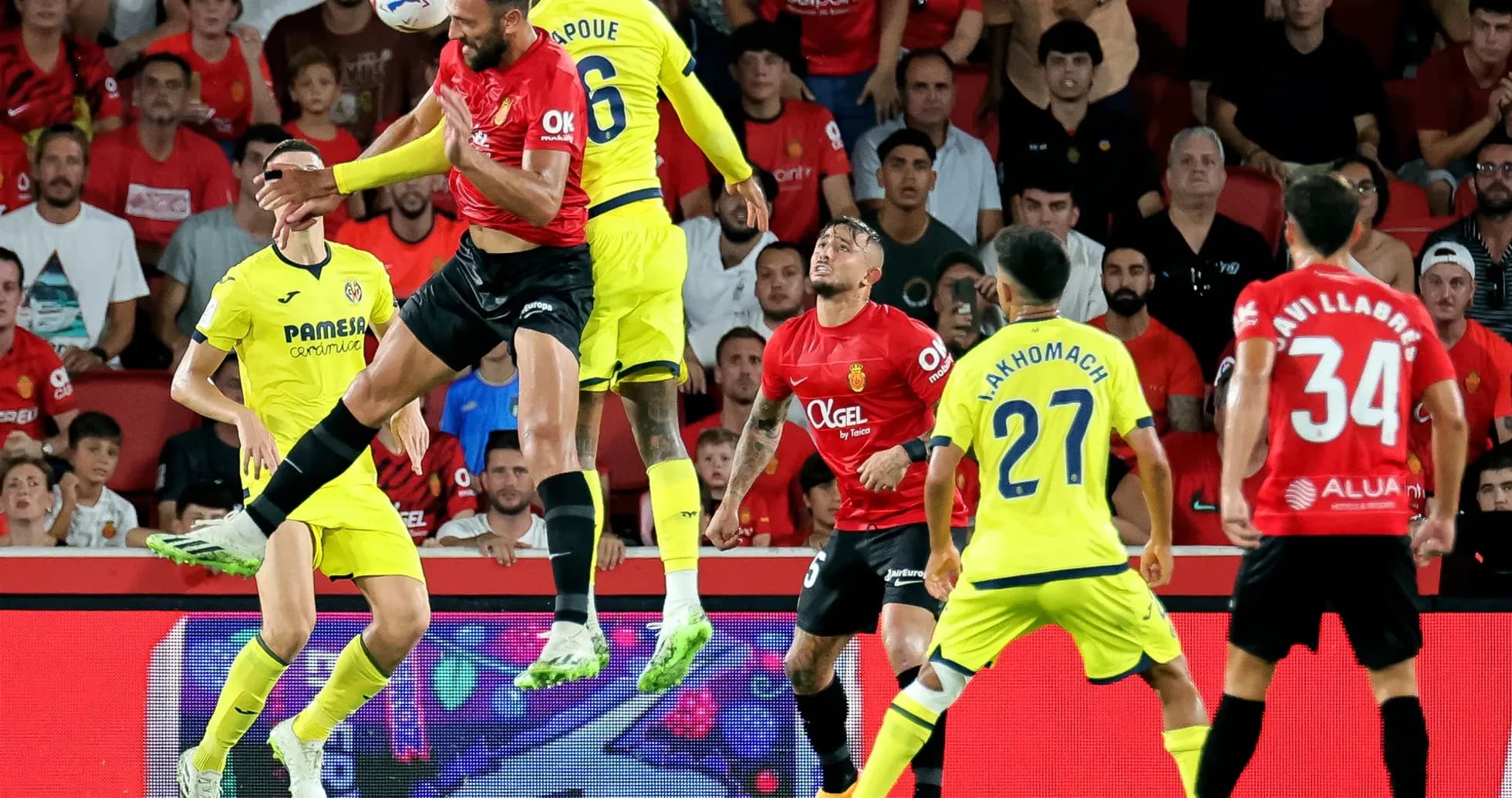
Under the midday glare at Estadi Mallorca Son Moix, a Mallorca side clinging to mid-table safety met a Villarreal team chasing the Champions League places – and over 90 tense minutes they cancelled each other out, 1-1, in a draw that told a rich tactical story.
I. The Big Picture – Clash of Identities
Following this result, Mallorca sit 15th in La Liga with 39 points from 35 matches, their overall goal difference at -9 (43 scored, 52 conceded). It is the record of a team that survives through pragmatism: compact at home, fragile on their travels. At home this season they have taken 8 wins and 6 draws from 18, scoring 28 and conceding 21 – a clear home-field identity built on resilience and direct, vertical attacks.
Villarreal, by contrast, arrive as one of the league’s heavyweights. They are 3rd with 69 points from 35 games, boasting an overall goal difference of +25 (65 for, 40 against). Their season has been defined by attacking fluency: in total they average 1.9 goals per game, rising to 2.4 at home and a still-healthy 1.3 on their travels. They are a side that expects to dominate, even away from home, but whose away defensive record (25 conceded in 18) leaves the door ajar.
The 1-1 scoreline mirrored the interval: Mallorca struck once in the first half and Villarreal replied before the break, the second period turning into a chess match between a deep-lying home block and a technically superior visiting midfield.
II. Tactical Voids – Who Was Missing and What It Meant
Mallorca’s team sheet was shaped as much by absences as by choices. A cluster of defensive injuries – L. Bergstrom, M. Joseph, J. Kalumba, M. Kumbulla, A. Raillo and J. Salas – stripped Martin Demichelis of depth and leadership at the back. The suspension of Pablo Maffeo for yellow cards removed one of La Liga’s most combative full-backs; his 10 yellows and 22 committed fouls this season underline how central his aggression is to Mallorca’s edge in duels and transitions.
In response, Demichelis leaned on a 4-3-1-2, with L. Roman behind a back four of M. Morey Bauza, M. Valjent, O. Mascarell and J. Mojica. Mascarell dropping into the defensive line was a telling adaptation: a midfielder by trade, he offered composure in build-up but inevitably reduced the unit’s aerial and pure defensive dominance compared to a natural centre-back like Raillo.
Ahead of them, Samu Costa anchored a hard-running midfield trio with S. Darder and M. Morlanes, while P. Torre operated as the link behind the strike pair of Z. Luvumbo and V. Muriqi. With Mallorca’s overall scoring average at 1.2 goals per game – but 1.6 at home – the plan was clear: protect the box, then funnel attacks quickly into Muriqi’s frame and Luvumbo’s channels.
Villarreal’s only listed absentee was J. Foyth, out with an Achilles tendon injury. Marcelino could still roll out his preferred 4-4-2: A. Tenas in goal; a back four of S. Mourino, R. Marin, R. Veiga and S. Cardona; a midfield line of T. Buchanan, S. Comesana, T. Partey and A. Gonzalez; with A. Perez and T. Oluwaseyi up front.
The disciplinary subtext loomed large. Samu Costa entered as one of the league’s leading yellow-card collectors (10 yellows, 61 fouls committed), while S. Mourino – 9 yellows and a yellow-red – patrolled Villarreal’s right side. In a match where both teams often live on the edge of the tackle, the risk of momentum-swinging cautions was ever-present, especially given Villarreal’s tendency to pick up late yellows: 25.00% of their yellows arrive between 76-90 minutes, a period where Mallorca also show a notable spike in their own bookings.
III. Key Matchups – Hunter vs Shield, Engine Room vs Enforcer
Hunter vs Shield centered on V. Muriqi against a Villarreal defence that, on their travels, concedes 1.4 goals per game. Muriqi’s season has been monstrous: 22 league goals in total, from 85 shots (47 on target), underpinned by a bruising duel profile – 416 duels contested, 214 won. He is not just a finisher but a reference point, drawing 59 fouls and occupying entire back lines.
Here, his battle with S. Mourino and R. Marin was the game’s gravitational core. Mourino, one of the league’s most active defenders, has amassed 98 tackles, 9 blocked shots and 28 interceptions, plus 179 duels won from 319. His willingness to step in front of Muriqi, to anticipate rather than merely react, was Villarreal’s primary shield. R. Marin’s positioning allowed Mourino to be aggressive; when Muriqi drifted to the far post, the responsibility often fell on the second centre-back to win the aerial duel or at least contest the second ball.
The “Engine Room” duel pitted Samu Costa against S. Comesana and T. Partey. Costa’s profile – 62 tackles, 13 blocked shots, 25 interceptions and 400 duels contested – speaks of a midfielder who thrives in chaos. His role was to disrupt Villarreal’s rhythm, protect the improvised back line and spark transitions. Against him, Comesana brought control and vertical passing: 1,169 passes at 82% accuracy, with 26 key passes and 45 tackles of his own. Partey’s presence beside him offered ballast and progression, allowing Villarreal to push their full-backs and wingers higher to pin Mallorca back.
On the flanks, Buchanan and A. Gonzalez tried to stretch Mallorca’s narrow 4-3-1-2, dragging full-backs out and opening pockets for the forwards. Yet without Foyth’s overlaps or the creative punch of bench option N. Pepe from the start, Villarreal’s width was more functional than devastating until changes arrived.
Further up, the spectre of G. Mikautadze and Alberto Moleiro on the Villarreal bench added a latent threat. Mikautadze’s 11 goals and 5 assists, plus 64 dribble attempts, make him a chaos agent between the lines; Moleiro’s 10 goals and 4 assists, with 35 key passes, give Villarreal a different creative profile. Once introduced, either could tilt the attacking balance against a tiring Mallorca block.
IV. Statistical Prognosis – What the Numbers Say About the Draw
Following this result, the numbers reaffirm the broader trends. Mallorca remain a home-leaning side: 8 home wins from 18, scoring 1.6 and conceding 1.2 per game at Son Moix. Villarreal, meanwhile, continue to look more vulnerable away, with 7 wins, 5 draws and 6 defeats on their travels, scoring 1.3 and conceding 1.4 per match.
Both teams are flawless from the spot this season – Mallorca have scored all 5 of their penalties in total, Villarreal all 6 – but Muriqi’s individual record (5 scored, 2 missed) is a reminder that his personal penalty conversion is not perfect, even if his club’s campaign tally is.
In xG terms – though not explicitly provided – the shot profiles implied by these season-long trends suggest a marginal Villarreal edge in chance volume, countered by Mallorca’s high-quality, direct looks through Muriqi and Luvumbo. Villarreal’s overall defensive record (1.1 goals conceded per game in total) points to a side usually capable of absorbing pressure, but their away concession rate aligned more closely with the single goal they gave up here.
The draw feels, tactically and statistically, like equilibrium: Mallorca’s compact, injury-hit structure maximised their home strengths and star striker; Villarreal’s deeper squad and superior technical level controlled long stretches but could not fully escape their away defensive frailty. In the end, 1-1 is a result that preserves Villarreal’s top-four momentum while nudging Mallorca a little closer to safety – a stalemate rich in subplots, shaped as much by the missing pieces as by the protagonists on the pitch.