.svg&w=384&q=75 "GoalGist logo")
Lucas Herrington's Heartbreaking Penalty Miss in World Cup
Lucas Herrington did not deserve this ending. Not this weight. Not at 18.
He walked into the night in Arlington as the youngest starter the Socceroos have ever fielded at a World Cup, a symbol of what might come next. He walked off as the face of one of Australian football’s cruellest defeats.
His penalty, a calm side-foot that had looked assured on the run-up, climbed too high and smacked the crossbar. The sound echoed. So will the moment. Before the ball had even bounced away, Awer Mabil was sprinting towards him, an arm around the teenager in a gesture that understood the kind of scar this leaves.
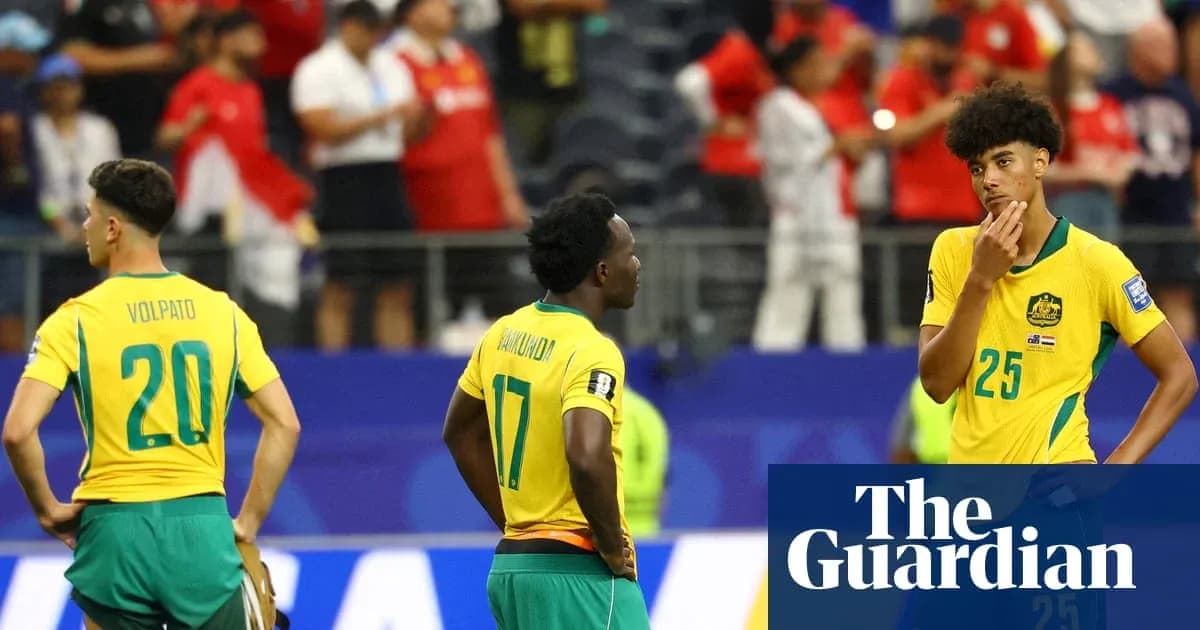
When Egypt finished the job a few kicks later, Herrington turned his back on the crossbar that had betrayed him and reached for his mop of curly hair, as if to steady himself. He bent over, hiding his face. Jackson Irvine came first, then Nestory Irakunda, a foot shorter but wrapping him in an embrace that said more than any words. Two players who should be the future of Australian football, trapped in a present they would rather forget.
Australia’s wait for a first World Cup knockout win now stretches on. Four more years at least. And the nagging thought will follow them home: they may not see a better opportunity than this for a long time.
Herrington was not alone in his regret. Harry Souttar, the defensive colossus who had emptied the tank across 120 bruising minutes, stepped up first in the shootout. His penalty sailed over the bar, a tired scoop rather than a strike, and instantly handed Egypt the upper hand.
Tony Popovic played his final card late, sending on captain Maty Ryan in the dying stages as a specialist for the shootout. It changed nothing. Egypt were ruthless from the spot, converting all four of their penalties and ending the contest before Australia could even reach their fifth.
By then, the Socceroos had already spent three hours in this tournament without scoring from open play. They trailed 1-0 at half-time, their morale low, their football even lower. When Jordy Bos tested his left knee after a heavy challenge and discovered it was too painful to walk, the mood sank further. Subterranean.
The first half had been a tactical arm wrestle, more about avoiding the press than breaking lines. Half chances flickered and died. The early Australian optimism – Cristian Volpato’s swerving effort that grazed the crossbar, Bos rampaging into the box – vanished with the opening goal.
Australia’s press faltered down their right, Egypt sliced into the space, and in a scrappy duel on the edge of the box Irvine was caught out by Ziko and conceded a foul. Emam Ashour took the free-kick, Irvine blocked the initial effort, but the danger never truly cleared. The ball was recycled, floated back in, and Egypt’s No 8, left untracked at the back post, nodded in. One lapse, one punishment. The Socceroos trailed.
The stadium around them – a vast, roofed arena in Arlington, ringed by 24,000 parking spaces and built as a cathedral for American sport – did not get the spectacle it deserved. This was attritional, stop-start football, punctured by delays that would have made room for a few extra ad breaks without much complaint. After 100 minutes, the two sides had managed just four shots on target between them.
For those in green and gold and red and white, though, it was unbearable tension. At 1-1, every cross felt decisive, every clearance a small act of survival. Patrick Beach punched and clawed at high balls, the Egyptian defence, lacking height but not courage, threw themselves in front of everything.
Bos’s injury forced Popovic into a reshuffle after the break. Kai Trewin came on for his World Cup debut at right-back and, within 10 seconds, his direct opponent almost scored. The second half threatened to run away from Australia before it had even settled.
They clung on, then finally struck back. For the first time this tournament, the Socceroos scored while behind. Officially, the equaliser went down as an own goal to Mohamed Hany, but the credit belonged to Aiden O’Neill. From the left side of the box he shaped a gorgeous, looping delivery that arced menacingly across the six-yard area, begging for a touch. Hany obliged, the ball glancing in and dragging Australia level.
The game opened up, but only slightly. Nerves tightened. Legs tired. The clock dragged.
Then Mo Salah arrived.
For most of the night, the Egypt captain had been a background presence, marked, managed, contained. In the final minutes of normal time he suddenly took control, whipping in a cross that found Ramy Rabia, who seemed certain to score until Beach flung up a hand and tipped the header over. Salah then drove a shot of his own, before engineering one last chance that Souttar blocked, the defender’s intervention the only thing between Egypt and the corner of the net.
Any doubts about Salah’s fitness evaporated in that spell, and in the grin he flashed at Souttar during the coin toss for extra time. Even he proved human, though, when a ricochet dropped to him on the bounce early in the additional 30 minutes and he lashed over the bar.
Egypt grew stronger as extra time wore on, laying siege to the Australian box. Crosses rained in, second balls bobbled dangerously, and clearances became more desperate. Neither side, though, could find the moment that would spare them the cruelty of penalties.
Both were chasing the same piece of history: a first World Cup knockout victory. Ninety minutes hadn’t separated them. Neither had 120. The shootout would grant that milestone to one and break the other.
It chose Egypt. And left a teenager, and a nation, to live with the crossbar.

