.svg&w=384&q=75 "GoalGist logo")
Liverpool Faces Defender Dilemma After Konaté Departure
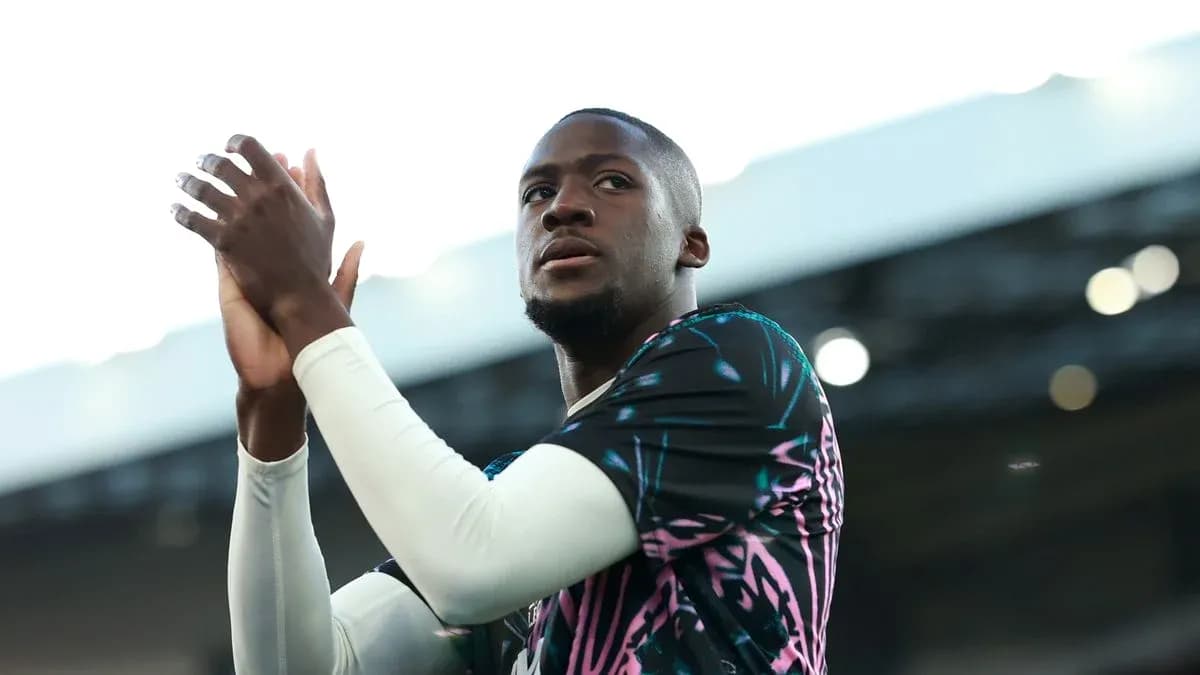
Ibrahima Konaté is on his way out of Liverpool. No dramatic bust-up, no late twist, just a hard line: no agreement on a new deal, contract running down, and a key defender walking away for nothing.
For a club that once prided itself on ruthless trading, the numbers now look stark. Trent Alexander-Arnold sold to Real Madrid for £10 million. Andy Robertson gone. Mohamed Salah gone. Konaté next. Four pillars of an era, a combined fee that barely buys you a squad player in today’s market.
Now Arne Slot and new sporting director Richard Hughes must find a starting centre-back in a window where top-level defenders are priced like elite forwards.
They do not have the luxury of time.
Jan Paul van Hecke – Familiar Face, Familiar Partner
One name fits the current Liverpool blueprint almost too neatly: Jan Paul van Hecke.
Brighton’s Dutch defender has already been linked from back home, and the logic is obvious. He’s played in a back three and a back four, is comfortable in a possession-heavy side, and knows what it means to defend high with space at his back. That’s Liverpool’s world.
On the ball, van Hecke is calm and constructive. Three goals and three assists in the Premier League this season speak to more than just safe sideways passing. He can step in, he can hurt you.
Under pressure, he doesn’t wilt. His knack for drawing fouls – 1.21 per 90 minutes in the league – mirrors one of Konaté’s underrated strengths (1.19). He invites contact, rides the press, and buys his team a breath when the game tightens.
Off the ball, he defends on the front foot. He sits in the 72nd percentile for interceptions per 90 (1.32) among Premier League centre-backs, reading danger early rather than waiting to react.
He is not the same aerial force as Konaté, despite standing 6'3". Yet alongside Virgil van Dijk, and with imposing youngster Jeremy Jacquet arriving for pre-season, Liverpool could lean on collective strength rather than a single dominant presence.
There’s another layer. Van Hecke already shares a dressing room with Van Dijk in the Netherlands squad and has gone to the World Cup ahead of heavyweight rivals Matthijs de Ligt and Stefan de Vrij. He is not just a prospect; he is trusted at the highest level and expected to play a real part in North America.
That familiarity with Liverpool’s captain is powerful. It makes him an obvious candidate. It also complicates the timing. A World Cup summer means Liverpool either move quickly before the tournament inflates his price and profile, or they wait and risk being dragged into an auction.
His contract situation at Brighton adds more intrigue. Van Hecke enters the final year of his deal, a classic pressure point. Brighton will listen at the right number – thought to be around £50 million – but they will not be alone in the conversation. Tottenham like him. Chelsea like him. Roberto De Zerbi’s rebuild only sharpens the sense that Brighton are ready to cash in, but not cheaply.
If Liverpool want him, they will have to act like the predators they once were in this market, not the bystanders they’ve occasionally become.
Joachim Andersen – The Grown-Up in the Room
If van Hecke is the long-term alignment pick, Joachim Andersen is the plug-and-play solution.
The Dane, once an unlikely FPL darling at Crystal Palace, now anchoring Fulham’s defence, offers something different: size, experience, and a taste for aerial combat. He ranks high for interceptions and clearances, and while he’s not as progressive as van Hecke on the ball, he is still comfortable enough to function in a side that wants to build.
Liverpool would not be buying a project here. They’d be buying certainty.
Just a centimetre shorter than van Hecke, Andersen brings six seasons of Premier League know-how and 49 caps for Denmark. He lives in the top 10% of Premier League centre-backs for touches and aerial duels won. In a league that is getting more physical and more direct at the top and bottom, that matters.
His profile also offers something Liverpool badly need: genuine cover for Van Dijk. Andersen can step into that role, win the same types of duels, dominate the same areas, and give a 34-year-old captain – who has played more minutes than any other player his age this season – the rest he has been denied.
Fulham paid £30 million two years ago. He would be the cheapest option on this list, and at 29, he would not block the pathway for Jacquet or fellow youngster Giovanni Leoni.
That point is key. Jacquet’s underlying data already mirrors Konaté’s closely. Liverpool might decide the true “replacement” is already in-house and that what they actually need is a stabiliser, not a star.
If that’s the route they take, there are few more qualified than Andersen to hold the fort while the next generation grows into the shirt.
Jarell Quansah – The One That Got Away?
Then comes the wild card. Or perhaps, the mistake waiting to be corrected.
Jarell Quansah left Liverpool for Bayer Leverkusen last summer in a £35 million deal that always felt slightly uneasy. A homegrown centre-back, composed beyond his years, sold at a time when Liverpool’s defensive future was already uncertain.
Slot’s first season did not help. Quansah’s confidence took a hit after being hooked at half-time in the Dutchman’s first game in charge. A year on, that decision looks even harsher in the rear-view mirror.
Because in Germany, Quansah has exploded.
At Leverkusen, he has re-established himself as one of Europe’s outstanding young defenders and earned a call-up to England’s World Cup squad. Those who watched him beside Van Dijk in Jürgen Klopp’s farewell season saw the raw material. Now, the polish is coming.
He was dribbled past just twice across the entire Bundesliga campaign. His passing is crisp and reliable – a 90.3% completion rate – and he’s added confidence driving forward, with 0.55 successful dribbles per 90. He looks like a modern, all-round defender, not just a stopper.
The problem? Price.
Liverpool built a multi-tiered buy-back clause into the Leverkusen deal, with pre-negotiated contract terms. They can bring him back this summer for £69.4 million. That figure drops to £52 million next year, according to BILD.
So the question is brutal: pay a premium now to correct a decision that already looks bizarre, or wait a year, let him develop further in Germany, and risk another club forcing the issue?
For a club that has just allowed arguably its best academy defensive prospect since Jamie Carragher to leave, only to watch him flourish elsewhere, the optics are sharp. The football argument, though, might be sharper still.
Alessandro Bastoni – The Dream Move with a Twist
Then there is the glamour name: Alessandro Bastoni.
On paper, it’s a headline signing. Inter’s left-footed centre-back, capable of playing centrally or at left-back, a ball-playing defender of the highest class. He would soothe the loss of Robertson, ease the uncertainty around Kostas Tsimikas, and buy time for Milos Kerkez to grow into the role.
In reality, he is not a Konaté replacement. He is more of a long-term Van Dijk heir.
Bastoni’s numbers in Serie A are elite. He sits in the top 10% of centre-backs for assists, successful passes, and accurate long balls. He lives in the top 5% for big chances created, overall touches, and xG conceded while on the pitch. He controls games, not just defends them.
His status, though, brings complications. Bastoni would not arrive to rotate. He would expect to start centrally, which likely forces Van Dijk to the right side of the pairing. That is a structural shift, not a like-for-like swap.
There was a moment this year when a move felt more plausible. Abuse after his red card against Bosnia and Herzegovina, which triggered Italy’s collapse and elimination from World Cup qualification, created tension and noise around his future.
Barcelona were linked. The door seemed to creak open.
Inter president Giuseppe Marotta has since tried to slam it shut, telling DAZN that Bastoni “has absolutely not expressed his desire to leave.” For now, he looks set to stay in Milan, the club he joined nine years ago.
Still, if there is even the faintest chance of prising him away, Liverpool have to be in the room. Players of his profile and age do not appear on the market often, and when they do, the clubs that hesitate tend to watch them lift trophies elsewhere.
Liverpool now stand at a crossroads of their own making. Konaté will walk, joining a list of modern greats who have left Anfield for a fraction of their worth or nothing at all. The squad is lighter, the margin for error smaller, the market harsher.
Van Hecke, Andersen, Quansah, Bastoni: four very different answers to the same question.
Which version of Liverpool shows up in this window – the bold, decisive operator of old, or the club that keeps discovering too late what it had in its own hands?

