.svg&w=384&q=75 "GoalGist logo")
Lionel Messi Shines Again in World Cup Knockout
Lionel Messi, again. Of course.
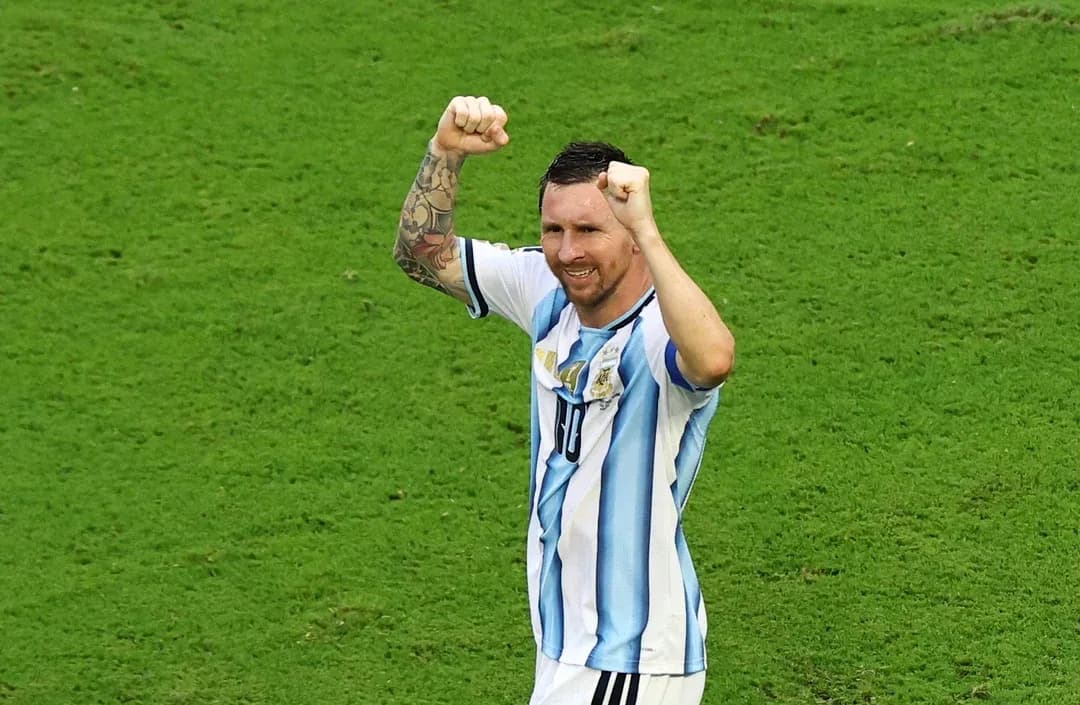
On a humid Miami night, in a World Cup knock-out game that threatened to drift, the 39‑year‑old stepped forward and ripped the script back into his own hands, as he has done for nearly two decades.
A switch, a feint, a finish
The moment came in the 29th minute of Argentina’s Round of 32 clash with Cape Verde at Miami Stadium. Lisandro Martínez, head up and unhurried, sprayed a superb diagonal switch that cut through Cape Verde’s shape and found Messi moving into space.
Starting wide on the right, the Inter Miami forward glided inside the box, the way he’s done a thousand times and yet never quite the same way twice. One touch to set, another to shift the angle. Cape Verde goalkeeper Vozinha, a cult figure of this World Cup and known to many as “El Abuelo,” squared himself, reading the body, trying to read the mind.
He never stood a chance.
Messi opened his body as if to curl across goal, then drilled his left-footed shot high and vicious at the near post, flashing it into the top corner on the left side. Power, precision, and the cold certainty of a man who still decides games on his own terms.
Miami rose. Argentina led. The World Cup, once more, revolved around No. 10.
History, again, bends his way
That strike did more than break Cape Verde’s resistance. It rewrote another page of the record book.
This was Messi’s seventh goal of the 2026 tournament, making him the first player ever to score seven or more goals at two different World Cups, having hit the same mark at Qatar 2022. Others have had great tournaments. Nobody has stacked them like this, across eras, across continents, across generations of teammates and opponents.
Cristiano Ronaldo has finally ended his own long wait for a World Cup knockout goal in this edition, but Messi continues to live on a different statistical plane. He now stands as the only player to have scored in five separate World Cup knockout stages, and he has done it in five consecutive editions.
From the tension of early knockout rounds to the suffocating weight of finals, he has found the net at every step: Round of 16, quarterfinals, semifinals, final. And now, in 2026, he has added the newly introduced Round of 32 to that personal map of decisive moments.
Back in Qatar, he struck against Australia in the Round of 16, the Netherlands in the quarterfinals, Croatia in the semifinals, and France in that unforgettable final. Each goal carried its own story, its own pressure. This one in Miami slots neatly into that lineage, another knockout game bent to his will.
A new stage, the same star
The World Cup has expanded, formats have shifted, and the calendar has stretched. Yet the central image remains stubbornly familiar: Messi, left foot drawn back, defenders frozen, a goalkeeper grasping at air.
This Round of 32 goal, his first at this new stage, underlines a simple truth. Even as the tournament grows and the cast widens, the man at the heart of it refuses to step away from the spotlight.
At some point, this will end. The legs will slow, the stage will belong to others. But not tonight in Miami, not against Cape Verde, not with “El Abuelo” beaten at his near post and another World Cup record sliding under Messi’s name.
For now, the question isn’t whether he can still do it.
It’s how much more he intends to take from this tournament before he finally lets it go.