.svg&w=384&q=75 "GoalGist logo")
Kubo Takefusa's Injury: Japan's Challenge Against Brazil
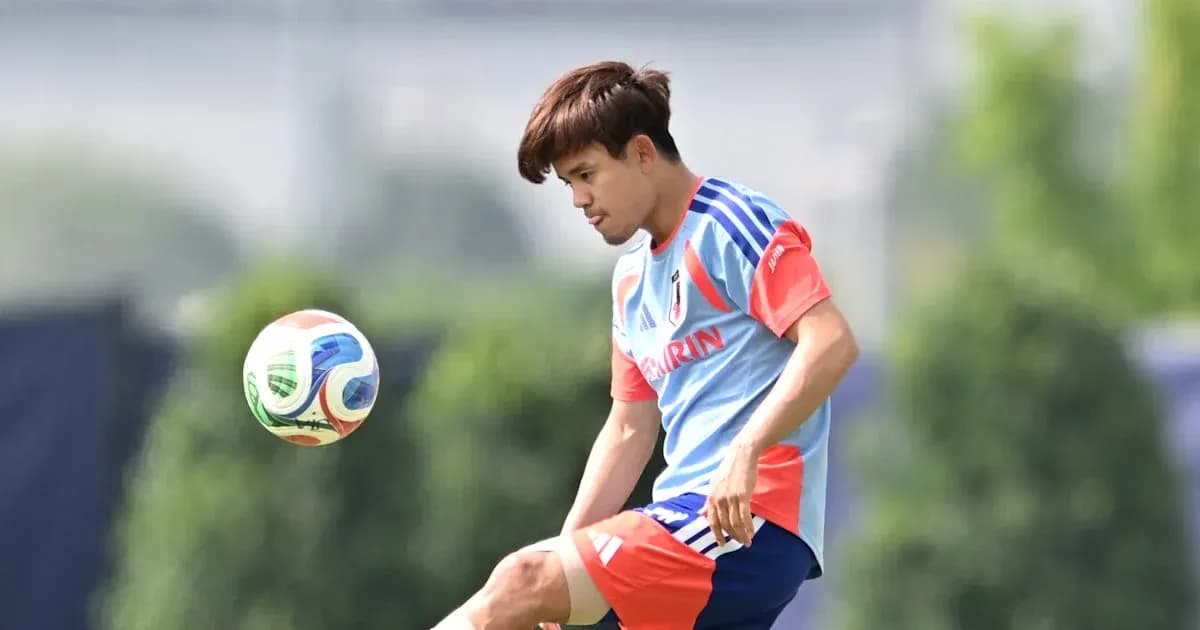
On the eve of Japan’s World Cup round-of-32 showdown with Brazil, Kubo Takefusa offered the briefest of medical bulletins on his damaged left knee.
“I’m good.”
The words were light. The reality is not. Since crumpling in the tournament-opening draw with the Netherlands, Kubo has barely touched a ball in anger. His days have been reduced to rehab sessions, solitary runs, and a knee strapped so heavily it looks more like a precautionary cast than a support.
On Sunday, coach Moriyasu Hajime removed any lingering doubt. The Real Sociedad playmaker will not face Brazil. A nation prepared to stay awake until 1am now has to add a familiar thought to its late-night ritual: what if?
“I’m hoping for a speedy recovery and he’s doing everything he can to pick up his conditioning,” Moriyasu said at the pre-match press conference.
Kubo’s absence is not a mere tactical footnote. At 25, he has become the team’s creative reference point, the one player with a touch of left-footed sorcery that no one else in the squad quite replicates. With Mitoma Kaoru, captain Endo Wataru and Minamino Takumi already sidelined, he had begun to step into a leadership void, his voice and presence growing louder around the camp as the stakes rose.
Now Japan must walk into a meeting with Brazil without him. On paper, that sounds like a fatal blow to a team that has not only talked about beating the five-time world champions, but has gone further and stated openly that it is in this tournament to win the whole thing.
The thing is, this Japan side has been built for exactly this kind of crisis.
Moriyasu has leaned hard into depth and versatility. Across the group stage and into the knockouts, he has used all but three of his 26-man squad; the only outfielders not to feature are the two backup goalkeepers. The “next man up” mantra that often feels like a sporting cliché has become something else entirely in this group: an operating system.
Take one piece out, another slots in. The quality does not collapse. The identity does not waver.
That belief runs through the squad and shapes the way they talk about Brazil. There is no reverence, no genuflecting before the yellow shirt.
Asked which teams he considered the strongest at this World Cup, Wolfsburg striker Shiogai Kento named France and Argentina. Brazil did not make his list.
“You don’t really hear about Brazil lately,” he said.
The line hung in the air. This is Neymar’s Brazil, after all, the same Neymar who has scored nine goals in five previous games against Japan. The old scars are still fresh in the record books, if not in the minds of this younger generation.
Asked specifically about the Brazilian No. 10, Shiogai did not blink.
“That’s Neymar of the old. I think we’re OK right now.”
Three decades ago, such words would have bordered on sacrilege in Japanese football. When the J.League launched 33 years ago, Brazil were not just the benchmark; they were the dream. Brazilian imports lit up the fledgling competition, and the national side looked at the Selecao and Joga Bonito with something close to awe.
Those early years were defined by a one-way flow of admiration. Japanese players watched, learned, and copied. The idea of speaking about Brazil in anything other than hushed tones would have been unthinkable in 1993.
The landscape has shifted. Japan now exports talent to Europe’s major leagues, competes with the world’s best, and arrives at a World Cup with a clear, unapologetic ambition. The gap in reputation has shrunk, even if the gap in honours remains yawning.
That is the context in which Kubo’s injury lands. Yes, Japan are a better side with him drifting between the lines, slipping passes into channels that did not seem to exist a second earlier. Yes, his absence strips away a layer of unpredictability that could have unnerved a Brazilian back line not as untouchable as its predecessors.
But this team has chosen not to pin its hopes on a single star. It has chosen depth over dependency, structure over superstition.
So the script changes. The responsibility spreads. Another midfielder must take the ball in tight spaces. Another wide player must dare to beat a man. Another leader must speak in the dressing room before they walk out to face the yellow shirts that once towered over Japanese football dreams.
The fear has gone. The respect remains. And as Brazil loom once more on the World Cup stage, the question is no longer whether Japan belong here.
It is whether this generation can turn defiance into the result their predecessors could only imagine.