.svg&w=384&q=75 "GoalGist logo")
Jurgen Klopp Appointed Germany Head Coach Until 2030
Jurgen Klopp strides back into the firing line, and this time he is taking on the biggest job his country can offer.
Germany have appointed the former Liverpool manager as their new head coach on a contract running until the end of the 2030 World Cup, handing the 59-year-old the role he has long been linked with but never previously taken. For Klopp, who walked away from Anfield in 2024 saying he was “running out of energy” after nine thunderous years and six major trophies, this is the last great climb.
This is the pinnacle
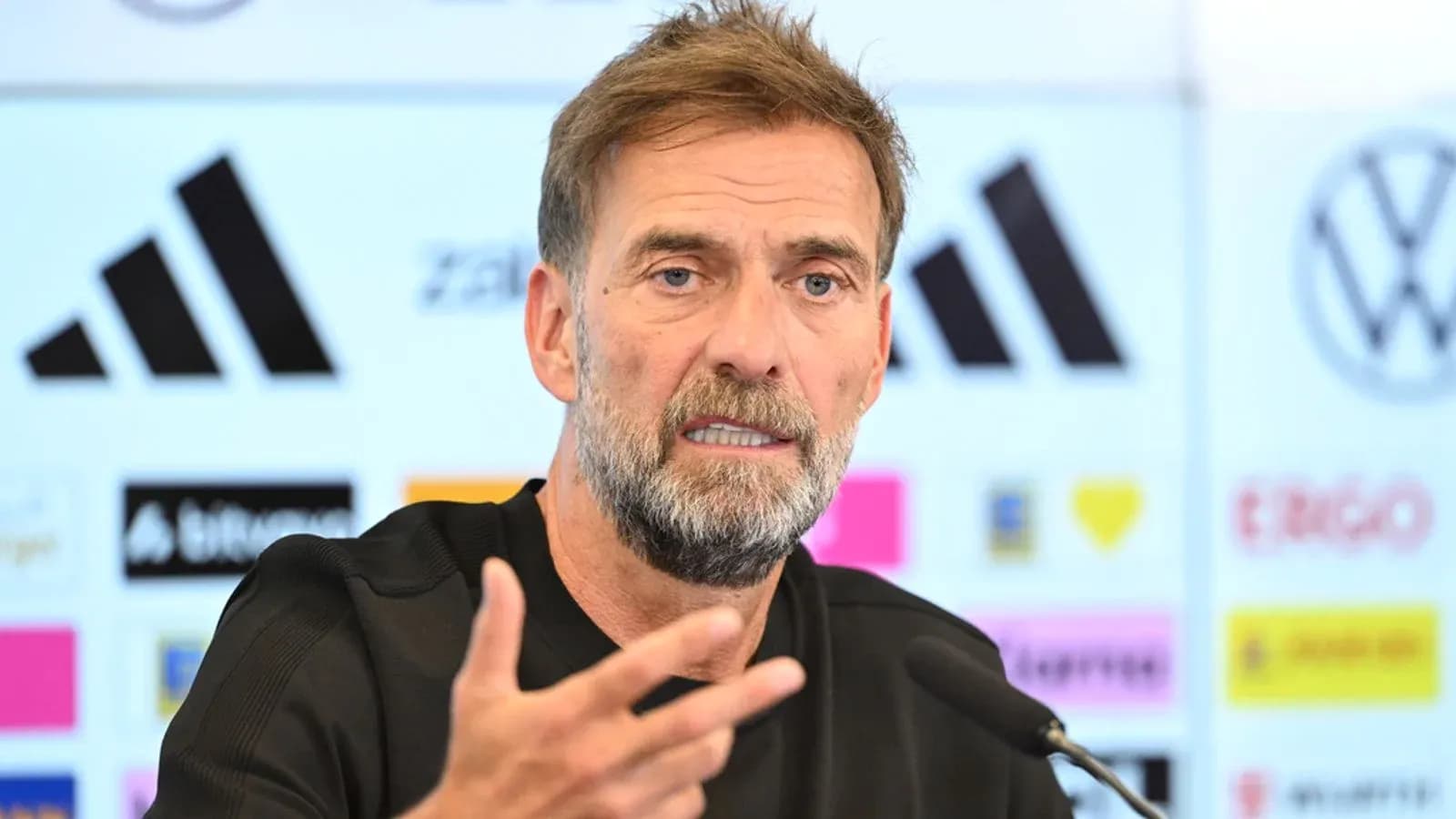
Unveiled on Friday, Klopp cut through the ceremony with the kind of blunt honesty that defined his club career. He called the national team job “the pinnacle, the high point of my footballing career as a coach” and promised to “give everything I've got” with what he described as “the best possible assistant coaching team.”
Yet he also made it clear that this will be done on his terms. In a pointed message to critics and media alike, Klopp warned he would not hesitate to walk away if the job spills over into his private life.
“I will be remunerated very graciously and if tomorrow Jurgen Klopp is s***, I will be gone,” he said. “But if the DFB says let us discontinue the job, then that's it. And if you behave badly and don't let my family in peace, I'll be gone. I'll just turn away. I know there are other countries where national team head coaches are treated even worse. I love this job but I am also ready to call it quits if needs be.”
No half-measures. No long goodbye. Germany have hired Klopp, but he has drawn the lines.
He stressed there will be no encore after this. “Jurgen Klopp is not going to have any ‘career’ after the national team,” he said. This is the last stop.
A different kind of return
After leaving Liverpool, Klopp stepped away from the dugout for six months before resurfacing as Red Bull's head of global soccer. From there he insisted he had no desire to return to club management. The national team, though, is a different proposition, and when the DFB came calling after Julian Nagelsmann’s resignation following a World Cup last‑32 exit to Paraguay on penalties, they went straight to one man.
Klopp was the first person they turned to. He said yes.
His first game in charge will come quickly enough: the Netherlands in the Nations League on September 24. A rivalry, a benchmark, and a stage to show what “Germany, the German way but very intense” actually looks like under him.
No guarantees, no illusions
The noise around Klopp’s appointment was inevitable. So was the talk of instant transformation. He moved to cool that idea immediately.
“Jurgen Klopp being in the job doesn't automatically mean we're going to be world champions,” he said. “Success is performance vs expectations. We need a new set of expectations.”
He went straight to the comparison that has stalked Germany for years.
“Many people have asked themselves, are we as good as France? If the answer is no, then that is not necessarily true. If the question is, do we have players like Dembele, Barcola, Mbappe? Then the answer is no, we don't, but we can still beat them.”
That is the Klopp pitch in a sentence: accept reality, then attack it. He does not want Germany to imitate anyone.
“We don't want to play like Argentina, Spain, England or France. We want to play like Germany, do it the German way but very intense. Are we the number one team at the moment? No, we aren't; I accept that. Would we be happy to be the number two team? Then people would say we aren't number one.
“At the moment, we have 11 teams ahead of us. Yes, we can beat them, but for this to happen, you need to play very good, intense football.”
Expectation management, yes. Lowering standards, no.
Building his inner circle
If the job is the pinnacle, the staff around him look like a statement too. Former Liverpool lieutenants Pep Lijnders and Peter Krawietz will join him with Germany, reuniting the core of the coaching team that delivered the Champions League, Premier League, Club World Cup, FA Cup and two League Cups at Anfield.
Lijnders arrives after a short spell at Manchester City following Pep Guardiola's departure, while Krawietz, long known as Klopp’s trusted analyst and strategist, returns to his side once more. Sven Bender, who played under Klopp at Borussia Dortmund, also joins the staff, adding another familiar face and a link back to the high‑pressing, high‑emotion Dortmund teams that first carried Klopp into the European elite.
Off the pitch, there is another significant move. Per Mertesacker, who stepped down as Arsenal's academy manager at the end of last season after eight years in the role, will become Germany's sporting director in January, replacing Andreas Rettig. A World Cup winner moving into the boardroom as Klopp takes charge on the touchline: the DFB are reshaping the entire axis of their national setup.
A nation’s project, on a clock
Klopp was clear about his mission.
“It is my mission to make the national team squad a better team and hope the pool for me to choose from will be bigger, but it is not something I am doing against you, I am doing it for you. It is an honour,” he said.
The task is brutal in its simplicity: restore Germany as a force at major tournaments by 2030. Between now and then lie Nations League campaigns, a European Championship cycle, and a World Cup that now doubles as the end point of Klopp’s coaching life.
He has his staff. He has his power. He has his warning.
Germany have handed Jurgen Klopp the job he always seemed destined to take. The question now is whether his final act in management can drag a fallen giant back to the top, or whether his greatest challenge has arrived just a little too late.