.svg&w=384&q=75 "GoalGist logo")
José Mourinho's Calmer Return to Real Madrid
José Mourinho says he is calmer now. The touchline suggested he might be right.
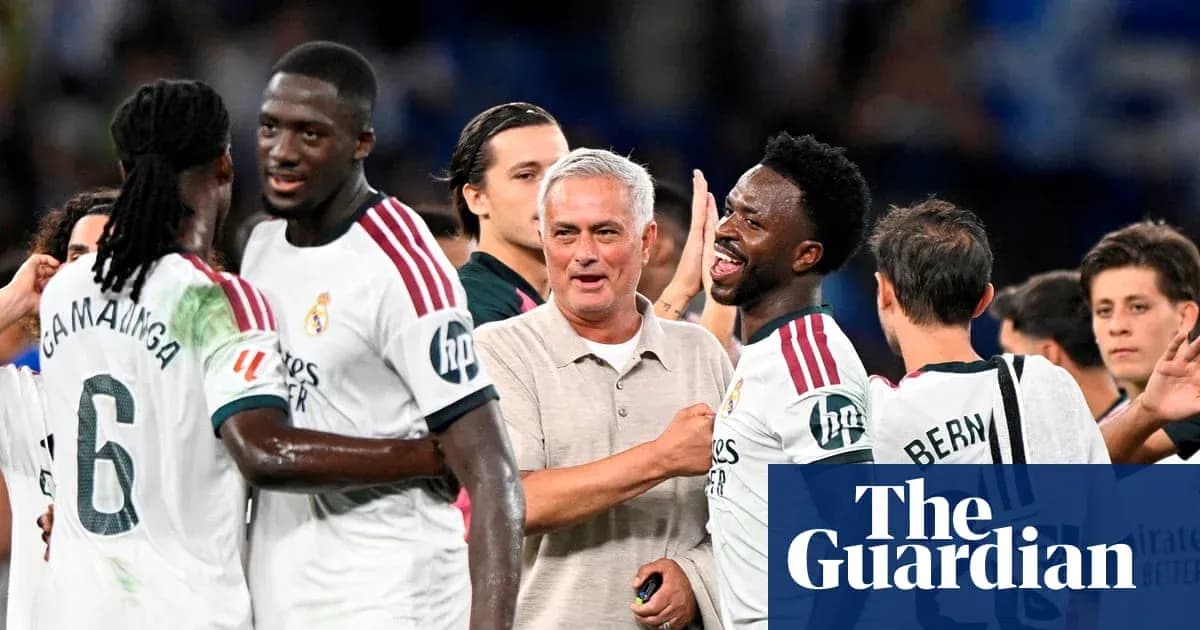
When the Real Madrid bench exploded in the 90th minute, substitutes and staff sprinting towards the corner to engulf Carlos Espí, Mourinho stayed where he was. No charge, no knee slide, no iconic sprint. He rose slowly, fists clenched, and walked down the touchline behind them, shouting but measured, eyes fixed on the chaos ahead. As the pile-on grew in the corner, he tugged Fede Valverde aside for a quiet word.
It might as well have been: phew.
A first game back after 4,380 days, a new era with Kylian Mbappé, Vinícius Júnior and Jude Bellingham together at last, a record signing in Yan Diomande on the bench – and yet the night belonged to a 21-year-old who barely registered on Madrid’s radar six months ago.
Carlos Espí, plucked from Levante after dragging them clear of relegation with his goals, was signed to be something different. An old-school No 9. Penalty-box weight. A body in the area when the beautiful patterns broke down. He is still living at Valdebebas, like his coach, sharing breakfast with Mourinho every morning. This is why they brought him.
And this was exactly the moment he was bought for.
With the move disintegrating in the area and the ball running away from Mbappé, Espí was there, alive to the rebound, forcing it over the line. Ugly, decisive, priceless. A goal that not only rescued Mourinho’s first night back, but also raised a question: does this profile of striker belong in the team, not just as a late option?
For now, it had done its job.
Mourinho’s return to Madrid’s bench began with the usual theatre. Photographers abandoned their spots behind the goal to swarm around him before kick-off. This was the show. It ended with him embracing Espanyol coach Manolo González, high-fiving the referee and disappearing down the tunnel, three points in his pocket but plenty to think about.
Between those two handshakes lay the reality he always knew would come. The badge and the noise do not solve everything. It is early, solutions take time, and Espanyol, he had warned, are a good side. They proved him right. Madrid had more chances, more of the ball, more of the stars – but Manolo’s team largely succeeded in making them suffer.
Old flaws flickered back into view. The defensive looseness. The drops in intensity. The spells where control simply vanished. Doubts remain, as they should on opening day. But the late winner at least pushed them back a little, if only for a night. There will be tougher games than this. There will certainly be tougher nights for Mourinho’s temper.
In the spring, when Madrid faced Benfica, Mourinho had described his first spell at the club as “three hard, intense, sometimes violent years”. Time sands down the edges. The rows, the fractures, the exhaustion fade; the trophies and the defiance remain. Mourinho insists he is “not the kind of man who misses anything”, that he is not someone who “has regrets”. But plenty at Madrid missed him. Florentino Pérez most of all.
In Pérez’s world, managers are a necessary evil. Except this one. Mourinho is as close as the president has ever come to a coach he genuinely likes. For some around the club, the longing had never really gone away. They wanted that intensity back, even the violence of it. A hard man to lead them, an iron surgeon to cut away bad habits and go to war with their rivals. A personality big enough to impose himself on a dressing room that has seen it all.
For all that the end of his first spell had been unsustainable, Pérez never quite let go of the idea that Mourinho had laid the foundations for what followed. Six Champions League titles in 11 years. He clung to the notion that those triumphs were, in some way, his. Mourinho told a story on the eve of this game: after every trophy Madrid lifted, Pérez called him.
“I always said no, no, no, it was nothing to do with me,” Mourinho recalled. Which, of course, was a neat way of saying: it had something to do with me.
Pérez had said much the same in public. It took 13 years to finally give in to the urge, but here they were again, back together.
And why not? The last great returnees – Zinedine Zidane, Carlo Ancelotti – had delivered. The others had failed. At the end of that anecdote, Mourinho pointed out that the trophies belonged to Zidane and Ancelotti, then paused and checked, almost innocently, that they were the only men to have won anything. The implication was clear enough: the diagnosis of Madrid’s current malaise, the surgery they now need, is his domain too.
Just as in 2010, Madrid trail Barcelona. They have gone two years without a major title. That gap is about more than tactics or transfers. It is about culture.
Effort alone will not fix that, but Mourinho is starting there. “We have to try not to negotiate things that are non-negotiable,” he said. “Commitment can’t be missing.” He has the authority, or at least the reputation, to demand that. The club will grant him the power to impose it. Habits have already shifted. Training sessions have sharpened, or at least the players’ approach to them has. Diomande declared he was ready to “die” for Mourinho. The coach dismissed it as just a phrase, but he did not hide that it pleased him.
There are football reasons for optimism too. Vinícius’s future is finally resolved. No contract shadows, no status arguments. The World Cup is done, no distractions looming on the calendar. Mourinho pointed out that Brazil, France and England have all found a way to maximise Vinícius, Mbappé and Bellingham individually. Doing it with all three in the same XI is another problem entirely.
“I don’t think they’re incompatible,” he insisted. Last season, it often looked like they were. Bellingham himself admitted they sometimes drift into the same spaces.
Here, all three started. Bellingham as a classic No 10, Vinícius glued to the touchline. “For me this is his [Jude’s] position,” Mourinho said. “The connection with the forwards, he can score goals. He has to play close to the goal. Playing at 6 or 8 we’re losing his closeness to the goal.”
Bellingham wasted no time justifying that faith. The first goal of the new Mourinho era came after nine minutes, from a set piece. Vinícius was fouled on the left – a pattern already emerging, Alex Calatrava having given him a kick in the back earlier that drew Mourinho’s arms aloft in protest. Arda Guler swung in a superb cross, and Bellingham climbed highest to power his header past Marko Dmitrovic.
Mourinho barely reacted. Sat at the far left of the bench, he rose, slipped his hands into his pockets and strolled down the touchline to where the overflow of his sizeable staff sat in the stand. There he shook hands with Sami Khedira, the in-house assistant Madrid have assigned him, and analyst Roberto Merella. Businesslike. Contained.
For a while, it looked like that might be that. The gulf between the sides felt enormous. Madrid pressed high, suffocating Espanyol’s attempts to play out. The ball kept coming back. This, they might have thought, is the future.
Then the intensity dropped. Just a notch, but enough. Espanyol sensed it and edged forward.
When Dean Huijsen needed treatment for a cut, Madrid’s players drifted towards Mourinho for instructions. The game, though, drifted away from them. Espanyol stepped up and were rewarded. Thibaut Courtois saved from Riedel, Roberto Fernández failed to keep his follow-up down, and suddenly the visitors were wobbling.
A lovely move then carved them open. Tuy Dolan and Javi Hernández combined neatly, Calatrava arriving to finish and level the game. Mourinho stayed almost motionless on the bench.
Mbappé responded. Twice he escaped, once on each side of the area, twice forcing smart saves from Dmitrovic. Yet Espanyol should have gone in ahead. Again they pieced together a sharp attack, Omar El Hilali whipping in a superb cross from the right. Dolan stretched but could not reach it inside the six-yard box, and Fernández headed the loose ball straight at his own feet when the goal seemed to open.
After the break, the chances kept coming. From a Guler corner, Bellingham rose again, his header tipped on to the bar by Dmitrovic. The rebound dropped perfectly to Mbappé at the back post. Somehow, from almost on the line, he put it wide. Valverde then thumped a shot against the post. Mbappé drove another effort just past the upright. The clock ran, the frustration grew, the story of Mourinho’s return threatened to turn sour.
So he turned to the bench.
Marc Cucurella. Diomande. Eduardo Camavinga. Trent Alexander-Arnold. And, crucially, Espí. Fresh legs, fresh profiles, a reminder that this Madrid squad is both deep and still oddly incomplete.
The pressure finally told. In the 90th minute, as the move broke down and the ball seemed to have escaped Mbappé, Espí reacted faster than anyone. One jab, one scruffy finish, one roar from the corner flag. Behind him, his coach walked rather than ran, watching his players celebrate the reprieve he so badly needed.
“I think we deserved to win, but Espanyol didn’t deserve to lose,” Mourinho said afterwards, ending the night with a touch of humility that contrasted sharply with the ferocity of his first spell.
Calmer, yes. But with nights like this ahead, how long will that last?