.svg&w=384&q=75 "GoalGist logo")
José Mourinho Returns to Real Madrid: A Stormy Homecoming
Thirteen years after walking out of a divided Real Madrid dressing room, José Mourinho is on his way back into another one.
The 63-year-old is set to be confirmed as Madrid’s new manager after Benfica finish their Liga Portugal campaign this weekend, with Mourinho on the brink of completing an invincible domestic season. From Lisbon to the Bernabéu, from control to chaos. He returns to a club once again at war with itself, and once again under the absolute command of Florentino Pérez.
This is not a gentle homecoming. It’s a rescue mission.
A fractured giant, Barcelona on top
Madrid’s season has been dominated less by football and more by feuds. Barcelona have taken control of LaLiga again, while the capital has seethed.
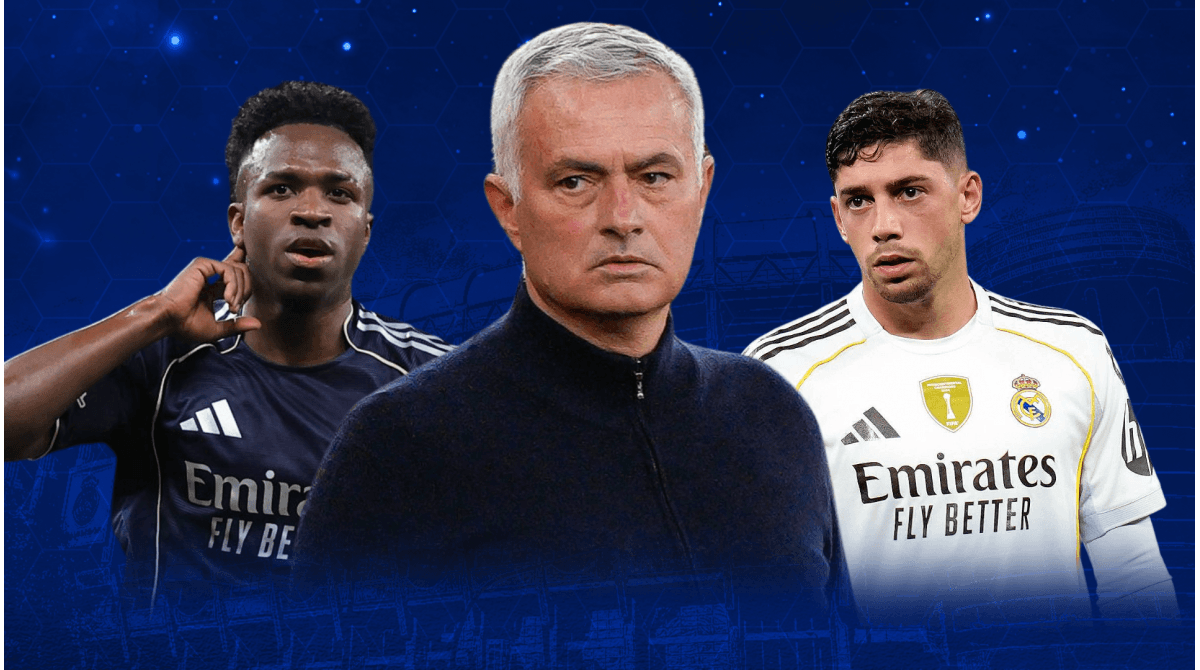
Vinícius Júnior’s relationship with caretaker boss Xabi Alonso broke down. Kylian Mbappé, the superstar signing, is reportedly unpopular in the dressing room. Álvaro Arbeloa, drafted in to steady the ship, never managed to restore calm.
The tension finally boiled over when Federico Valverde and Aurélien Tchouaméni clashed in a heated argument that ended with both players fined. It was a flashpoint that summed up the wider problem: a squad full of talent, short on harmony.
Into that environment walks Mourinho, a man whose own confrontational style has divided dressing rooms throughout his career. Some inside and outside the club have already questioned the wisdom of dropping the “Special One” into such a volatile mix.
Pérez, though, never really looked elsewhere. In an extraordinary press conference on Wednesday, the Madrid president even leaned on Transfermarkt’s market values as he spoke about the squad’s construction, a revealing glimpse into how he sees players: as assets to be balanced as much as footballers to be coached.
Now he wants Mourinho to both repair a broken group and reshape an unbalanced squad. The to-do list on arrival at the Santiago Bernabéu will be long. At the top of it sit several big names whose futures suddenly look anything but secure.
Vinícius Jr: extend or exit
On the pitch, Vinícius Jr has been electric in 2026. Across Europe’s top five leagues, only Harry Kane has scored more goals in all competitions. He has carried Madrid at times, a constant threat and one of the few bright spots in a turbulent campaign.
Off the pitch, his situation is far less clear.
Vinícius is about to enter the final 12 months of his contract this summer and has yet to sign a new deal. For a club that prides itself on ruthless squad management, the equation is brutally simple: he renews, or he is sold. Letting one of their most valuable assets walk away for nothing is not an option.
Reports have consistently suggested the 25-year-old wants wage parity with Mbappé. That demand cuts to the heart of Madrid’s internal hierarchy. Matching Mbappé’s salary would be a powerful statement; refusing it would be another.
Mourinho’s view will carry serious weight. Is Vinícius the attacking spearhead of his second Madrid project, or the sacrifice that funds a broader rebuild? The answer will shape not only the summer, but the identity of this team for years.
Federico Valverde: leader or lightning rod?
Few players have embodied Madrid’s modern era like Federico Valverde. Relentless, versatile, and increasingly a leader, he has often captained the side and set the tone with his work rate and intensity.
Yet his bust-up with Tchouaméni has cast a shadow over that status. Publicly, Pérez backed Valverde in that same press conference, but several reports suggest the president is privately angered, believing the Uruguayan instigated the confrontation.
Speculation in England has already linked Manchester United with a move, hinting that rivals sense an opportunity if Madrid’s resolve wavers.
For Mourinho, Valverde looks like an ideal lieutenant: aggressive, disciplined, tactically flexible, and emotionally invested. The kind of player he traditionally builds midfields around. The question is whether the club hierarchy sees him the same way after this season’s flashpoints.
If Mourinho chooses to stand firmly behind Valverde, it could become an early test of his authority in the corridors of power.
Eduardo Camavinga: valuable, but expendable?
Madrid’s financial reality lurks behind all of this. The redevelopment of the Bernabéu has strained the budget, and the club cannot simply spend their way out of trouble. To build Mourinho’s squad, others will almost certainly have to leave.
Eduardo Camavinga looks the likeliest high-value departure.
The Frenchman is tied down until 2029, a contract that usually signals a long-term pillar. Yet he has started only 15 LaLiga matches this season, a modest return for a player of his pedigree and potential. In the cold arithmetic of the market, he represents a chance to bank a significant fee, close to his €50m valuation.
Camavinga’s versatility, which once seemed like a blessing, may have worked against him. Used in multiple roles, he has struggled to nail down one. Under Mourinho, a coach who prefers clearly defined responsibilities, that ambiguity could count even more.
If Madrid need a major sale to unlock their summer, Camavinga’s name will be near the top of the list.
Dani Ceballos: the obvious cut
Some decisions are easier.
Dani Ceballos has long hovered on the fringes of the Madrid squad: a technically sound midfielder, useful in rotation, but never truly central to the project. At 29, he is no longer a prospect. He is a senior player on a substantial wage who rarely starts.
For a club trying to trim costs and sharpen the squad, that profile is unsustainable.
Ceballos will not command a huge transfer fee, but freeing up his salary opens space for players Mourinho trusts more. Ajax, Fenerbahçe, Real Betis and Juventus have all been linked, and there is no shortage of clubs who would see him as a smart addition.
For Madrid, his exit feels less like a dilemma and more like an inevitability.
A familiar face, a very different club
When Mourinho last left Madrid, he did so amid acrimony, exhausted by internal battles with powerful players and external wars with Barcelona. Now he returns to a club transformed by a stadium rebuild, weighed down by financial constraints, and unsettled by internal disputes.
He still brings the same aura, the same edge, the same willingness to confront problems head-on. This time, though, the problems are as much structural as they are tactical.
Vinícius Jr’s contract, Valverde’s status, Camavinga’s value, Ceballos’ future – these are not just names on a squad list. They are decisions that will define Mourinho’s second era before a ball is even kicked.
He arrives to fix a fractured dressing room and reshape a squad under pressure, with Barcelona on top and Madrid’s identity in question.
For a man who thrives on conflict and reinvention, it is the perfect stage.
But in a club that now treats players like balance-sheet entries as much as icons, how much power will the Special One really have?