.svg&w=384&q=75 "GoalGist logo")
Inter Dominates Monza in Serie A Opener
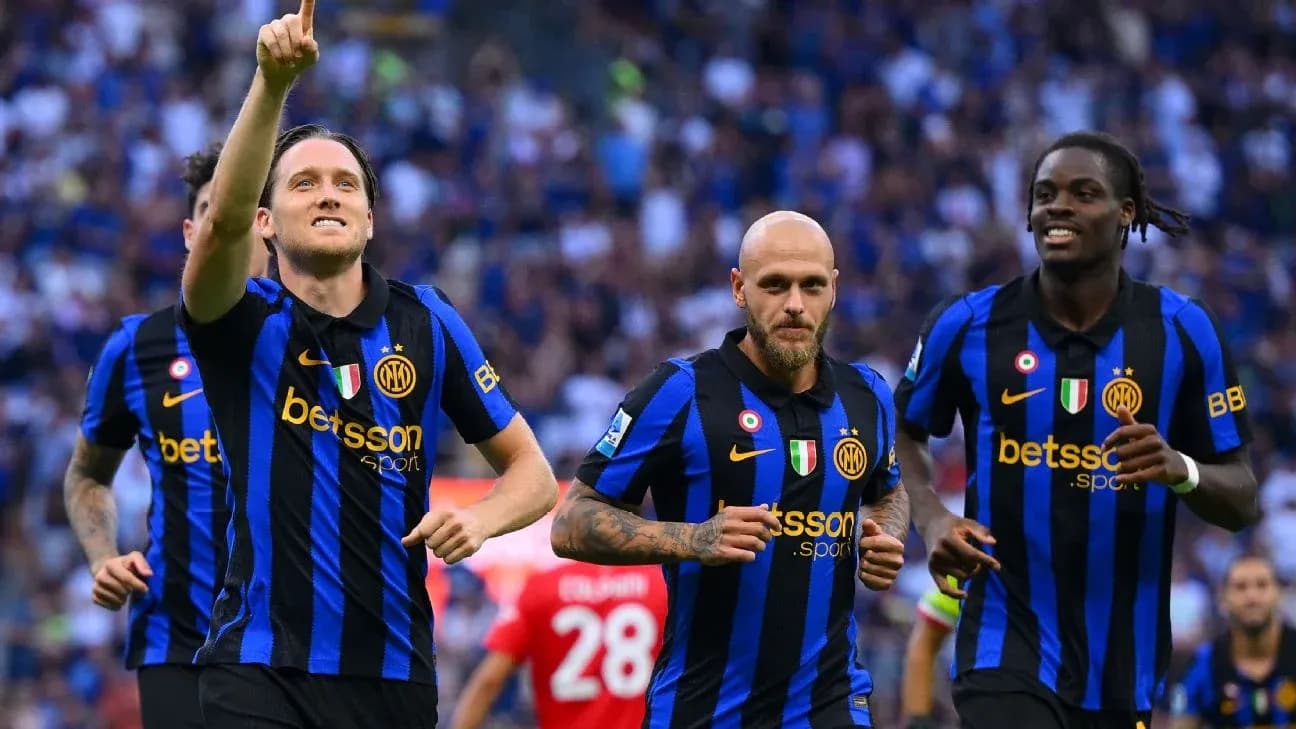
The San Siro eased back into Serie A life with a familiar picture: Inter on the front foot, dictating tempo and territory, and ultimately overpowering Monza 4-1 in the opening round of the 2026 campaign. Following this result, Inter sit 1st with 3 points and a goal difference of +3 (4 goals for, 1 against), while Monza are 20th with 0 points and a goal difference of -3 (1 goal for, 4 against). It is early, but the structural contrast between the sides was already stark.
Cristian Chivu stayed loyal to Inter’s institutional DNA with a 3-5-2 that looked more like a 3-2-4-1 in possession. J. Martinez anchored the back, shielded by a trio of Y. Bisseck on the right, M. Akanji centrally and A. Bastoni on the left. Ahead of them, H. Calhanoglu operated as the metronome at the base of midfield, flanked by N. Barella and P. Zielinski, with F. Dimarco and A. Diouf as aggressive wing‑backs/half‑spaces raiders. Up front, the pairing of F. Esposito and L. Martinez gave Inter both penalty-box presence and vertical threat.
Ivan Juric’s Monza, on their travels, lined up in a 3-4-3 that was meant to be combative and transitional. S. Pizzignacco started in goal behind E. Kouadio, L. Lucchesi and A. Carboni. The wing lanes were patrolled by S. Birindelli and A. Bakoune, with F. Ondoa and M. Mout inside. The front three of A. Colpani, Gustavo Varela and R. Mangas promised mobility more than aerial dominance.
Both coaches were forced into significant re‑wiring before a ball was kicked. Inter were without H. Mkhitaryan (suspended), D. Spence (inactive) and M. Spinacce (injury), trimming Chivu’s midfield options and making Calhanoglu’s availability even more central to their build-up. Monza’s absentees were more severe: E. Akinsanmiro (muscle injury), P. Ciurria (inactive), L. Colombo (injury), D. Mota (suspended), M. Pessina (knee injury), D. Thiam (yellow‑card suspension) and I. Toure (knee injury) stripped Juric of experience, leadership and a proven goal source. The result was a young, brave but exposed side at San Siro.
Inter’s season statistics, even from a single match, already sketch their intent. At home they have played 1, won 1, scoring 4.0 goals on average and conceding 1.0. There is no clean sheet yet, but the attacking output is emphatic. Monza, away, mirror that story in reverse: 1 match, 1 defeat, 1.0 goal scored and 4.0 conceded. The goal difference in total for each side aligns with the standings: Inter’s +3 (4 for, 1 against), Monza’s -3 (1 for, 4 against).
Within that framework, certain individual performances defined the tactical story. At the back, Bisseck was quietly dominant. In his 90 minutes he completed 66 passes at 95% accuracy, won 2 of his 3 duels and made 2 interceptions. Those numbers illustrate why Inter’s back three could hold an aggressive line: Bisseck not only defended space but also acted as a secure outlet to recycle possession and pin Monza deeper.
Ahead of him, Calhanoglu was the conductor. In just 54 minutes he completed 60 passes at 93% accuracy, scored once from his only shot on target and added 1 key pass. He also tackled once, blocked 1 shot and made 1 interception, underlining that his influence was two‑way. His single yellow card places him already among Serie A’s early disciplinary leaders, but his control of rhythm outweighed the risk.
If Calhanoglu set the tempo, Diouf and Zielinski injected the verticality. Diouf’s 35 passes at 94% accuracy, 3 key passes and 2 assists tell the story of an interior who constantly broke lines and linked with the forwards. Zielinski, with 64 passes at 87% accuracy and 1 goal, occupied those classic half‑spaces, arriving late and unmarked to finish moves that began deep in Inter’s structure. Together, they explain why Inter’s midfield, even without Mkhitaryan, looked layered and difficult to contain.
Up front, Esposito was the headline. In his 90 minutes he scored once, assisted once, took 3 shots (1 on target) and won 6 of 9 duels. Drawing 4 fouls, he continually forced Monza’s back line to retreat, creating the very pockets that Diouf and Zielinski exploited. This is the “Hunter vs Shield” matchup in microcosm: Inter’s primary “hunter” in Esposito against a Monza defence that, across their away record so far, concedes 4.0 goals per game. It was a mismatch, and it played out as such.
On the other side, Gustavo Varela was Monza’s lone spark. In 83 minutes he scored their only goal, took 3 shots (1 on target) and completed 11 passes at 90% accuracy. He won just 1 of 9 duels, which underlines how often he was isolated against a numerically superior Inter back line. M. Mout, meanwhile, quietly stitched what he could: 35 passes at 71% accuracy, 1 assist, 3 tackles and 2 interceptions show a young midfielder trying to hold together a stretched block.
Discipline shaped the game’s tone. Inter’s season card profile shows yellow cards clustered between 31‑45 minutes (50.00%) and 46‑60 minutes (50.00%), mirroring Calhanoglu’s caution in the first half and the side’s willingness to foul to prevent transitions after the break. Monza’s yellows arrive later, split evenly between 61‑75 minutes (50.00%) and 76‑90 minutes (50.00%), embodied by Lucchesi and Kouadio. Both defenders, under constant strain, resorted to fouls: Lucchesi committed 4 fouls and saw yellow; Kouadio committed 2 fouls and was also booked. There were no red cards for either side despite the “Top Red Cards” table listing only players with yellows so far.
From a structural perspective, the “Engine Room” duel was decisive. Inter’s midfield triangle of Calhanoglu, Barella and Zielinski, with Diouf stepping inside from the left, overwhelmed the central pairing of Ondoa and Mout. Inter’s preferred 3‑2 base in build‑up (Bisseck–Akanji–Bastoni with Calhanoglu plus one of Barella/Diouf) created a free man almost every time they played through Monza’s first line. That superiority translated into sustained pressure and allowed the wing‑backs to pin Birindelli and Bakoune deep, blunting Monza’s counter‑attacking outlets.
Statistically, both sides are still blank on penalties: neither has taken nor missed one this season, so there is no psychological baggage from the spot. The defensive solidity, however, is already divergent. Inter concede 1.0 goal on average at home; Monza concede 4.0 away. With no clean sheets and no failures to score for either side yet, the pattern suggests that Inter matches may lean towards high‑scoring, but with the champions‑elect profile of a team that simply outguns opponents.
The prognosis, even this early, is clear. Inter’s squad is deep enough that absences like Mkhitaryan’s can be absorbed by the emergence of Diouf and Esposito, while the defensive base led by Bisseck and Bastoni looks stable. Monza, ravaged by injuries and suspensions to key figures like Mota and Pessina, are being asked to learn on the job in one of the league’s most hostile environments.
Following this result, Inter’s 4.0 goals scored per home game and 1.0 conceded set a benchmark that few visitors will match. Monza’s 1.0 scored and 4.0 conceded away underline a side that can threaten sporadically but cannot yet protect its own box. Unless Juric can quickly restore some of his missing spine and tighten the defensive distances, Monza’s season risks becoming a long chase from the bottom, while Inter’s looks set to be another campaign played from the summit.