.svg&w=384&q=75 "GoalGist logo")
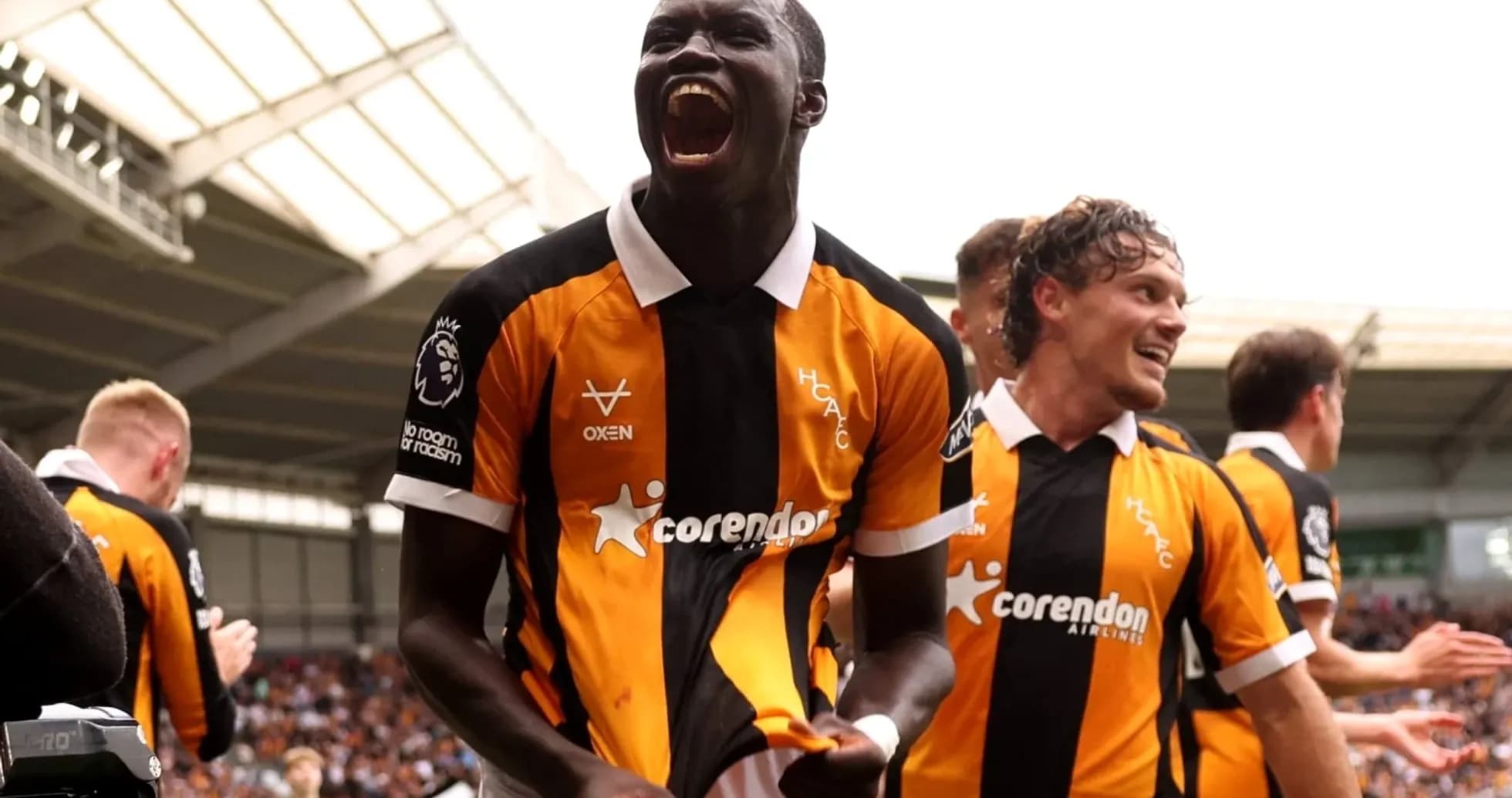
Hull City's Premier League Statement Win Over Manchester United
Under grey August skies at the MKM Stadium, Hull City opened their Premier League return with a statement win that felt bigger than the 2–0 scoreline over Manchester United. Following this result, the table says fifth against sixteenth, but the football told a deeper story: a newly promoted side with a clear identity, and a giant still trying to remember what it wants to be.
I. The Big Picture – Structure, Scoreline, Statement
Sergej Jakirovic set Hull up in a 5-4-1 that was anything but conservative. The back five of L. Coyle, S. Ajayi, J. Egan, N. Mendy and R. Giles formed a tight, aggressive shell in front of K. Tzolakis, but the wing-backs and wide midfielders were licensed to break with purpose. With O. McBurnie as the lone forward, Hull’s shape flexed between a low block and a direct, vertical countering system.
The numbers underpin the narrative. Overall this campaign, Hull have played 1 match, winning it 2–0. At home, that is 1 played, 1 win, 2 goals for and 0 against. The goal difference overall is +2, exactly mirroring their home record. They sit on 3 points, with a clean sheet and no failure to score. For a side earmarked for survival battles, this is the statistical profile of a team that believes it belongs.
Manchester United, under Michael Carrick, arrived in a familiar 4-2-3-1, but left with familiar questions. On their travels, they have played 1, lost 1, scored 0 and conceded 2. Overall, they too have 1 match played, 0 points, 0 goals for and 2 against, a goal difference of -2. The raw data is stark: United have yet to score, have failed to keep a clean sheet, and their only “biggest” result so far is a 2–0 away defeat.
II. Tactical Voids – Absences and Discipline
Both managers had to navigate significant absences. Hull’s list of missing players – J. Butland, J. Gelhardt, D. Gyabi, C. Hughes, M. Jacob, E. Matazo, H. Morita and O. Zambrano – stripped depth from every line. Yet Jakirovic leaned into continuity: his only recorded formation this season is that 5-4-1, used in this match, and it delivered immediate clarity.
United’s problems were more structural than numerical, but the injuries to T. Heaton, M. Mount, M. Ugarte and M. de Ligt quietly reshaped the spine. Without Mount’s connective play or Ugarte’s defensive ballast in midfield, Carrick turned to Y. Tielemans and Andrey Santos as a double pivot, asking them to both build and protect. Without de Ligt, H. Maguire was again the reference point in defence, partnered by A. Heaven.
Discipline added another layer. Hull’s season card profile shows two yellow cards, split evenly across time: 50.00% in the 31–45 minute window and 50.00% in the 91–105 window. That suggests a side that tackles aggressively as halves close, when fatigue and game management collide. On the individual level, M. Crooks and L. Millar both carry early yellow cards, with Crooks’ physical edge (4 tackles, 2 blocks) walking the line between control and risk.
For United, the story is more concentrated. Their only yellow card so far has come between minutes 31–45 – 100.00% of their cautions in that late-first-half zone. The culprit, P. Dorgu, committed 4 fouls, picked up a booking, and was withdrawn at half-time. It hints at a wider structural issue: United’s left side, with Dorgu ahead of L. Shaw, was repeatedly stressed by Hull’s transitions.
III. Key Matchups – Hunter vs Shield, Engine Room Battles
The defining narrative of this fixture was Hull’s defensive line turning into unexpected hunters. S. Ajayi and N. Mendy are already among the league’s early headline-makers. Both have 1 goal each from 1 appearance, both scored with their only shots on target, and both exited after 64 minutes having tilted the match.
Ajayi, rated 7.7, won all 3 of his duels, completed 16 passes at 87% accuracy and added 2 interceptions. Mendy, rated 8.0, completed 19 passes at 94% accuracy, blocked 1 shot and won 2 of 5 duels. These are centre-backs not only defending but actively deciding the game in both boxes. Against a United attack that includes M. Cunha as the nominal striker and B. Fernandes as the creative axis, Hull’s “shield” became the “spear.”
On United’s side, the Hunter vs Shield dynamic never really materialised. M. Cunha led the line, supported by B. Mbeumo, Fernandes and Dorgu, but United’s season statistics are damning: overall, they average 0.0 goals for, with 0.0 at home and 0.0 on their travels. Hull, by contrast, have conceded 0.0 goals overall, 0.0 at home, and have a total clean sheet count of 1. The matchup between United’s misfiring frontline and Hull’s watertight back five was decided emphatically in the Tigers’ favour.
In the engine room, M. Crooks and R. Slater quietly dictated the game’s rhythm. Slater, who already sits among the league’s top assist providers, delivered 1 assist from 21 passes at 90% accuracy, adding a key pass and working tirelessly across 90 minutes. Crooks, also on 90 minutes, produced 19 passes, 4 tackles and 2 blocks, picking up a yellow card but embodying Hull’s combative midfield identity.
They faced Tielemans and Andrey Santos, a technically gifted but unbalanced pair. With no true destroyer behind them – especially in the absence of M. Ugarte – they were repeatedly exposed when Hull broke lines quickly. The data on United’s cards (only 1 yellow, all in that 31–45 window) suggests less controlled aggression and more reactive fouling, epitomised by Dorgu’s struggles.
IV. Statistical Prognosis – What This Game Tells Us
With only one round played, xG figures are not provided, but the scaffolding is already visible. Hull’s attacking output – 2.0 goals per game overall and at home – is matched by perfect defensive numbers: 0.0 goals conceded overall, 1 clean sheet from 1 match, and no failures to score. Their “biggest win” so far is the very 2–0 against United, and their most used formation is the one that delivered it.
United’s early-season profile is the mirror image: 0.0 goals scored overall, 2.0 conceded on their travels, no clean sheets, and 1 failure to score from 1 match. Their only recorded formation is the 4-2-3-1 that just misfired at Hull. Carrick’s side are not yet structurally broken, but they are statistically fragile.
The disciplinary trends add a final nuance. Hull’s late-half yellow card spikes underline a team that defends fiercely as the whistle approaches, willing to take bookings to protect game-state. United’s lone card, concentrated in that same 31–45 band, speaks more to being dragged into duels they were not set up to win.
Taken together, this match reads less like an opening-day anomaly and more like a blueprint. Hull City, despite a long injury list, have a clear tactical identity, a productive set-piece threat from their defenders, and a midfield that understands its roles. Manchester United, stripped of a few key pieces, still look like a side caught between possession ideals and the harsh realities of Premier League away days.
Following this result, the numbers are simple: Hull are a top-five side on merit, United sit in the bottom half with a negative goal difference. The deeper analytics suggest that, unless United find balance in midfield and sharper coordination in the final third, more afternoons like this on their travels may follow – while Hull’s 5-4-1, anchored by Ajayi, Mendy, Crooks and Slater, already looks built to survive and, occasionally, to dominate.