.svg&w=384&q=75 "GoalGist logo")
Hannibal Mejbri: Tunisia's Rising Star at the 2026 FIFA World Cup
The boy named for a general is now leading an army of his own.
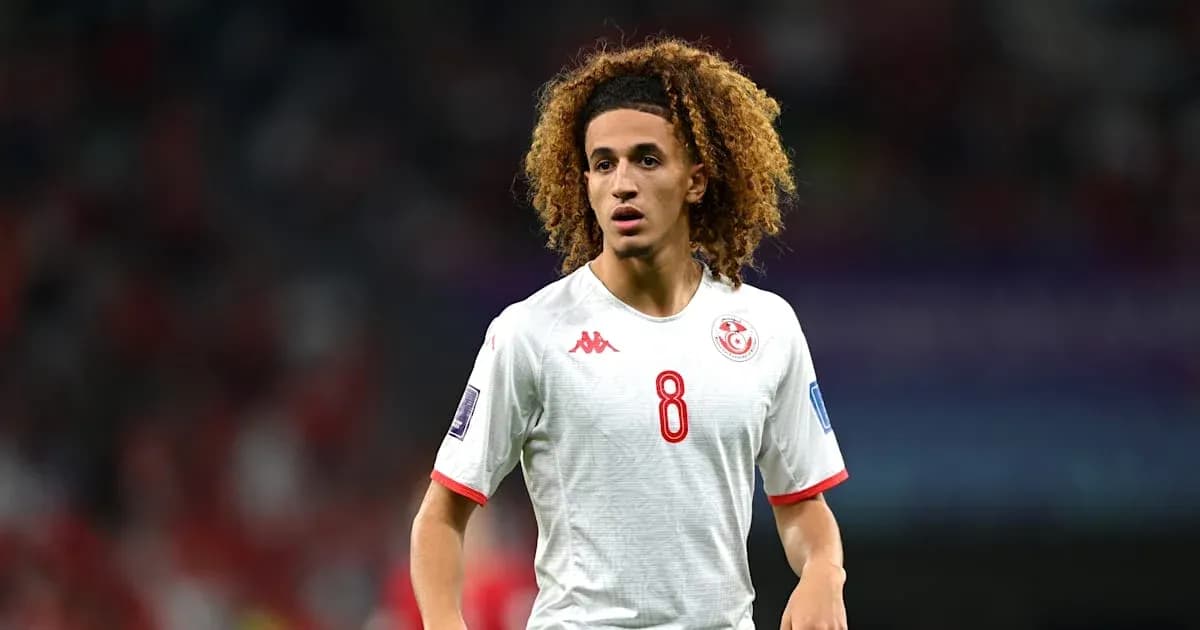
Hannibal Mejbri, 23 and already the beating heart of Tunisia’s midfield, carries one of football’s great nicknames on his back. The Eagles of Carthage. A team that nods to an empire, and a player whose first name recalls its most famous commander: Hannibal Barca, the man who dragged war elephants over the Alps and stared down Rome from within sight of its walls.
Two thousand years on, another Hannibal is chasing a different kind of breakthrough. His battlefield is the 2026 FIFA World Cup. His mission is simpler to describe, harder to achieve: take Tunisia somewhere they have never been. Out of the group. Over their own mountains.
From La Banane to the world
The story begins far from Carthage, in the 20th arrondissement of Paris. Dense, noisy, working-class. A place where the buildings lean in on you and the streets never really sleep.
Mejbri was born there to Tunisian parents, in a neighbourhood where football was the quickest way to belong. He remembers the mix: “many Tunisians, many Algerians, many Moroccans, lots of Senegalese, Malians as well.” Different flags, same game. If you had a ball, you had a language.
One block of flats dominates the local skyline. Curved, looming, and known to everyone as La Banane – the Banana. Its concrete arc framed his childhood and quietly shaped a professional footballer.
“Instead of going straight up to my house, I used to stay out and play football until night fell,” Mejbri recalls in the series *World at Their Feet*, which tracks emerging talent on the road to the 2026 World Cup. No elite plan, no private coaches, no long-term blueprint. “I was a normal boy, there was no master plan. I had my friends, I was focused on my life as a kid.”
But the “normal boy” was impossible to miss.
Childhood friend Hubert Mbuyi remembers the first impression: not just the touch, the vision, the swagger with the ball, but the look. “He had a unique style, with big hair, big blonde hair. So everyone knew him and had a lot of expectations for him.” On any scrap of tarmac or patch of dust, the equation was simple. “Where you could find a pitch and a ball, you will find Hannibal.”
Paris, Monaco, Manchester: a fast climb
The talent didn’t stay local for long. At six, Mejbri joined the academy at Paris FC, the club that combs the capital for rough diamonds. Seven years there gave him a foundation. A short spell at Boulogne-Billancourt followed, a familiar stepping stone in the Parisian talent pipeline.
Then came the first major leap.
In 2018, Monaco moved. The Ligue 1 club, renowned for spotting youth before anyone else, paid €1 million to bring a 15-year-old Mejbri into their academy. The teenager from La Banane suddenly found himself in a very different world.
“I could feel the richness of Monaco,” he says. The cars, the marina, the money. “So yeah, it was a little bit of a shift, a little dream, and I learned a lot there.” The experience wasn’t perfect, and by his own admission, not always enjoyable. But it showcased his raw edge to a wider audience.
Scouts from Europe’s giants began circling. Bayern Munich. Paris Saint-Germain. Barcelona. The shortlist alone told its own story. Yet in August 2019, at just 16, Mejbri chose a different path and a different shade of red. He signed for Manchester United, three-time Champions League winners and a club that still sells the dream of turning prodigies into legends.
Old Trafford can swallow young players whole. Mejbri climbed.
By 2021, he had his Premier League debut. Two years later, in September 2023, came the moment every academy graduate craves: a first top-flight goal for United, in a 3–1 home defeat to Brighton.
The scoreline dulled nothing. “I still get chills,” he says of that strike. The celebration told its own story. United were 3–0 down, the game gone, yet he roared into the moment, unable to hold back. “I don't know why I started to celebrate when we were losing 3–0, and you can see in my celebration that I had a certain rage in me and that I let go of everything when I scored.”
For a player built on emotion, it felt like a snapshot of his entire journey.
Choosing Tunisia with his heart
On the international stage, Mejbri could have taken a different route. He represented France at under-16 and under-17 level, a familiar path for gifted kids from the Parisian banlieues. The French system knew him, liked him, invested in him.
He turned the other way.
In 2021, when Tunisia called, he answered. No hesitation, no drawn-out saga. “I joined Tunisia because I chose with my heart,” he says. He makes a point of stressing the balance. “Even though I lived in France, it doesn't take away the love I have for France. But I find that the love I have for Tunisia is greater.”
The decision has already defined his career. Mejbri is 44 caps into his life with the Eagles of Carthage and has twice been named African Revelation of the Year at the Africa d'Or awards. For Tunisia, he is no longer a promise. He is a pillar.
Yet every time he pulls on the red shirt, his mind travels back to that curved block in Paris.
“When I represent my country, I also represent my neighbourhood,” he says. “Because I know that I will represent them, and so all of that, it's a bit related to pride.”
For those back home, the feeling is mutual. “All Tunisians are proud of him,” says Mbuyi. The pride is layered: national, yes, but also fiercely local. “Because in the end, he's a kid from the neighbourhood. When he plays matches, everyone focuses on the match. We're all watching Hannibal's hair on the pitch. We try to spot him every time.”
You don’t just watch Tunisia. You look for the blonde curls in midfield and know someone from La Banane is out there on the game’s biggest stage.
Giving back to La Banane
Fame has not severed the connection. Every summer, when the season’s noise dies down, Mejbri goes back. Same streets, same block, same faces – with a few more kids now wearing his name.
He organises a football tournament in the neighbourhood, a grassroots festival that mirrors his own beginnings. Last year, he handed out around 100 shirts. Not marketing. Not a stunt. Just a tangible link between the professional and the place that made him.
“You can just walk around here and find two or three people wearing his shirt,” Mbuyi says. For the next generation, the message is clear. One of their own made it out without ever really leaving.
“Hannibal is a great example of what the people look for in this area,” Mbuyi adds. The sentence hangs in the air. Ambition, identity, loyalty. “Because of him, the young kids can dream.”
Now those dreams stretch all the way to the World Cup. The Eagles of Carthage have flown to football’s summit before, but always stalled at the same point. Group stages, brave performances, early exits.
With a 23-year-old from La Banane driving them on, Tunisia are daring to believe that this time, like their namesake general once tried, they might finally push beyond the old limits and conquer new ground.