.svg&w=384&q=75 "GoalGist logo")
England’s Defensive Dilemma: Can Tuchel Find the Right Back Line?
England’s front line lit up Dallas. The back line told a very different story.
For all the swagger of that second-half surge against Croatia, the World Cup opener left a nagging question hanging over Thomas Tuchel’s team: can this defence really carry England through a month of the most ruthless football on earth?
Konsa–Stones under the microscope
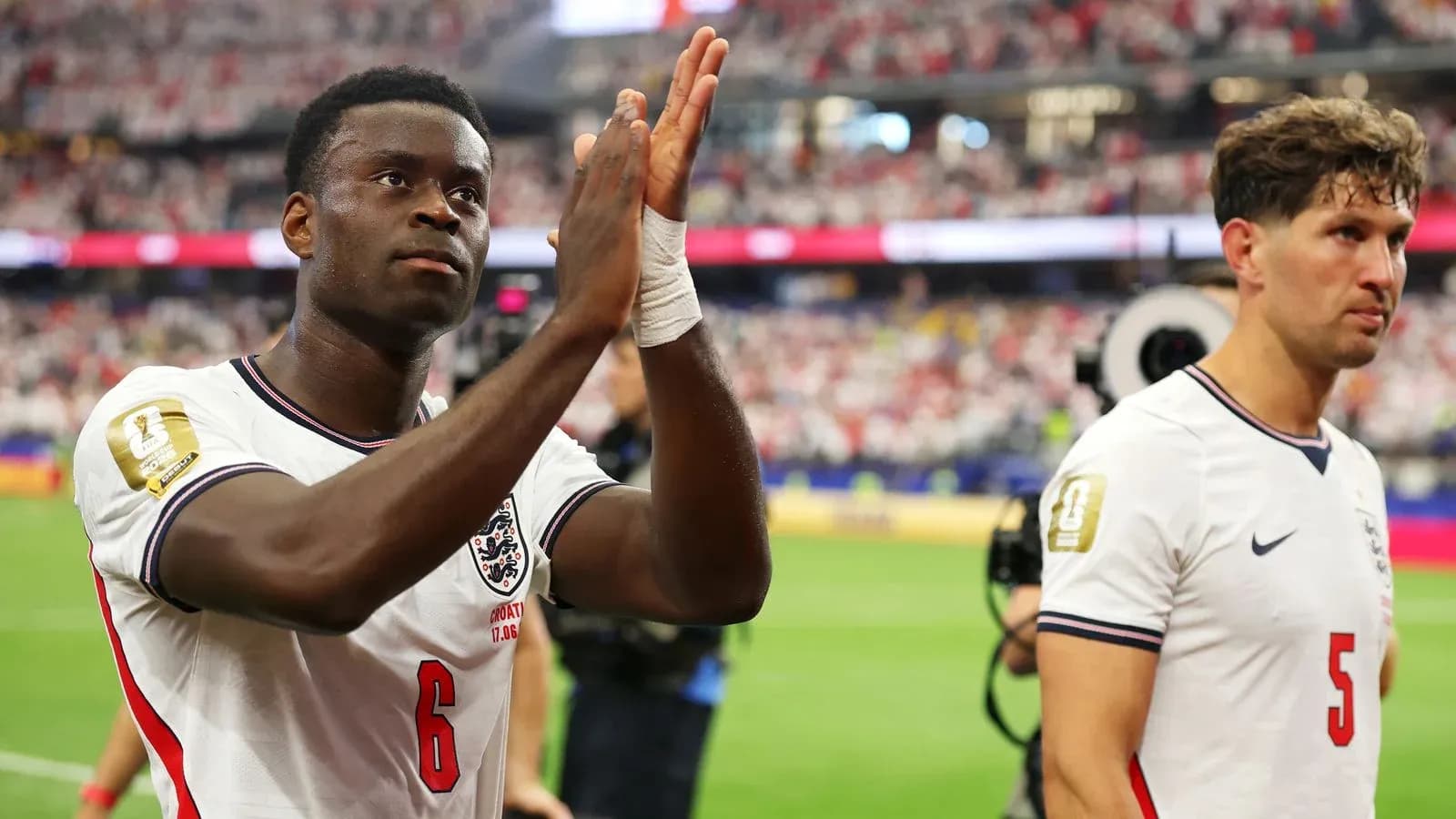
The surprise came an hour before kick-off. Ezri Konsa and John Stones named as the centre-back pairing, Marc Guehi on the bench. Eyebrows went up. By half-time, they were joined by fingers pointing.
Croatia’s first goal exposed the risk. Stones went to ground too early, the kind of decision that looks worse every time you watch it back. The second came from Konsa misjudging a simple chipped ball. Two lapses, two punishments, and suddenly the pre-match debate around that partnership felt less theoretical.
On the ball, both centre-backs had shaky moments in the opening exchanges. Croatia pressed high, aggressively, and England’s attempts to build from deep wobbled. Stones and Konsa each surrendered possession under pressure, inviting trouble in areas where tournament football is rarely forgiving.
By the end, the passing stats looked tidy enough. The defensive numbers did not.
Stones produced one tackle – unsuccessful – and one clearance in 87 minutes. He won four of seven duels. Konsa’s return was even less convincing: three wins from eight duels, just one of five in the air, no tackles, no interceptions. For a side with ambitions of going the distance, those are red flags, not footnotes.
Little wonder the conversation around England’s back line has turned quickly.
Guehi waiting in the wings
Jamie Carragher’s verdict the following morning was blunt: England probably lack enough defensive steel to go all the way. The caveat is that Tuchel has a potential solution sitting in plain sight.
Marc Guehi changed clubs and changed level this year. Since arriving at Manchester City from Crystal Palace in January, the 25-year-old has looked like he has been playing at that speed his whole life. Another FA Cup winners’ medal in May underlined his rise, but the numbers behind it show why he now looms so large over England’s selection.
From his Premier League debut for City in January, Guehi ranked among the division’s best for both defensive output and composure on the ball. He sat 10th for possession won in the defensive third, fourth for interceptions, sixth for forward passes and fifth for passes completed in that spell. That is a defender who doesn’t just survive games; he shapes them.
Crucially, his emergence has come at Stones’ expense. The City defender, a first-choice pick for Gareth Southgate at the Euros two summers ago, found himself on the outside looking in as Pep Guardiola built his defence around Guehi.
Stones has been adamant he was fit and available during City’s run-in. Guardiola still chose Guehi. That reality now confronts Tuchel. If City’s manager trusted Guehi over Stones in the season’s defining moments, should England’s head coach be braver in this World Cup?
The recent club record does Stones no favours. He played just five times for City in 2026, starting only five league games in the past year. City lost four of those. Tuchel values Stones’ experience, leadership and quality in possession enough to bring him anyway. The question is how, and where, to use him.
The left-side problem
Tuchel’s decision to start Stones on the left of the centre-back pairing against Croatia, shifting him away from his natural side to accommodate Konsa on the right, feels increasingly like the wrong experiment at the wrong time.
The warning signs were there. Tuchel had tested that configuration in the final warm-up game against Costa Rica. Modern defending lives on detail and repetition, and Stones has barely lived on that side of the pitch for City.
Over the past three seasons he has logged just 371 minutes at left centre-back, compared with 1,151 on the right. That imbalance matters. Body shape, angles, passing lanes – they all change when you cross the pitch.
Guehi, by contrast, has spent much of his career operating on the left despite being right-footed. At Palace he often played on the left of a back three, and at City he has looked equally comfortable stepping into that channel. Like Stones, he can switch sides when required, but unlike Stones, the left is his familiar home.
He knows it, too. “When you have been playing on one side for a long time and you switch to the other side it can throw you off a little bit,” he said back in December. It was a casual remark at the time. It now reads like a quiet warning.
Reuniting Stones with his natural right-sided role and dropping Guehi in on the left would give England a pairing with balance, clarity and recent club form behind it. It is also the combination Tuchel chose for the first World Cup warm-up game against New Zealand. That felt then like the blueprint. It may yet become the reset.
The Konsa conundrum
There is, though, a human cost to every tactical tweak. Konsa has been one of Tuchel’s most trusted lieutenants. Only Jordan Pickford and Harry Kane have played more minutes for England under this manager. Guehi has actually started more often alongside Konsa than with Stones in Tuchel’s tenure.
Dropping Konsa after one World Cup game – a game England still won – would be ruthless in the extreme. It would also cut across the continuity Tuchel has tried to build in qualifying and into this tournament.
So the alternative emerges: find a way to keep all three on the pitch.
Tuchel has already trialled that idea. Against Wales in October, Konsa started at right-back with Stones and Guehi as the centre-back pair. The logic is clear. Tuchel has leaned towards physically robust defenders in the full-back roles, bypassing the more creative, risk-taking profile of someone like Trent Alexander-Arnold in favour of players who can defend one-on-one, win duels and cover big spaces.
Konsa fits that mould. As a right-back tucked into a back three in possession, he offers security and an extra centre-half’s instincts without sacrificing too much athleticism in wide areas.
The trade-off is brutal. Reece James would be the man to miss out.
Managing James, managing risk
James impressed against Croatia, especially when he stepped into midfield late on and helped tilt the game further in England’s favour. Tuchel has leaned towards him as his first-choice right-back, starting him five times in that role – more than any other player in this era.
But James arrives at this World Cup with an injury record that cannot be ignored. Before starting the recent Costa Rica and Croatia fixtures, he had not begun back-to-back games for Chelsea since March. Every extra minute carries a calculation.
There is a strong argument for managing his load early in the tournament. The temptation will be to rest him against a weaker Panama side in the final group game. The complication is that England’s qualification and final position in Group L may still be on the line when they face Ghana next.
Can Tuchel really afford to rotate heavily in a match that could shape the entire knockout path? Or does he take the bolder route now, trust Konsa at right-back, and lock in what might be his most secure central pairing in Stones and Guehi?
A decision that defines a campaign
Tuchel’s task is not simply to pick his best defenders on paper. It is to find a combination that allows England’s thrilling attack to flourish without leaving the back door wide open.
The Croatia game showed both extremes: a front line capable of ripping teams apart, and a defence that looked one mistake away from panic. The margins at a World Cup are too fine to carry that contradiction for long.
Guehi offers form, balance and a natural solution on the left. Stones offers experience and authority on the right. Konsa offers reliability and versatility, whether centrally or at full-back. James offers dynamism and a different kind of threat.
Only two – or at most three – can start against Ghana.
Tuchel has the pieces to build a back line that can carry England deep into this tournament. The real test now is whether he has the nerve to put them together in time.

