.svg&w=384&q=75 "GoalGist logo")
Egypt Makes World Cup History with Penalty Win Over Australia
ARLINGTON, Texas — Mohamed Salah limped into this World Cup wondering how many more of these he had left. He walked out of AT&T Stadium on Friday night having led Egypt somewhere it had never been.
Into the knockout rounds. And now, into history.
Egypt beat Australia 4-2 on penalties after a 1-1 draw, winning a World Cup elimination game for the first time. It took 120 minutes of strain, a brutal own-goal, a goalkeeper switch, and a defender with no international goals on his résumé stepping up to decide it all.
Hossam Abdelmaguid, 25 years old, 15 caps, zero goals — until the moment that will follow him for the rest of his life.
Abdelmaguid’s moment, Salah’s night
Harry Souttar skied Australia’s first penalty. Lucas Herrington smashed their fourth against the crossbar. The door was open, but someone still had to walk through it.
Abdelmaguid did not flinch.
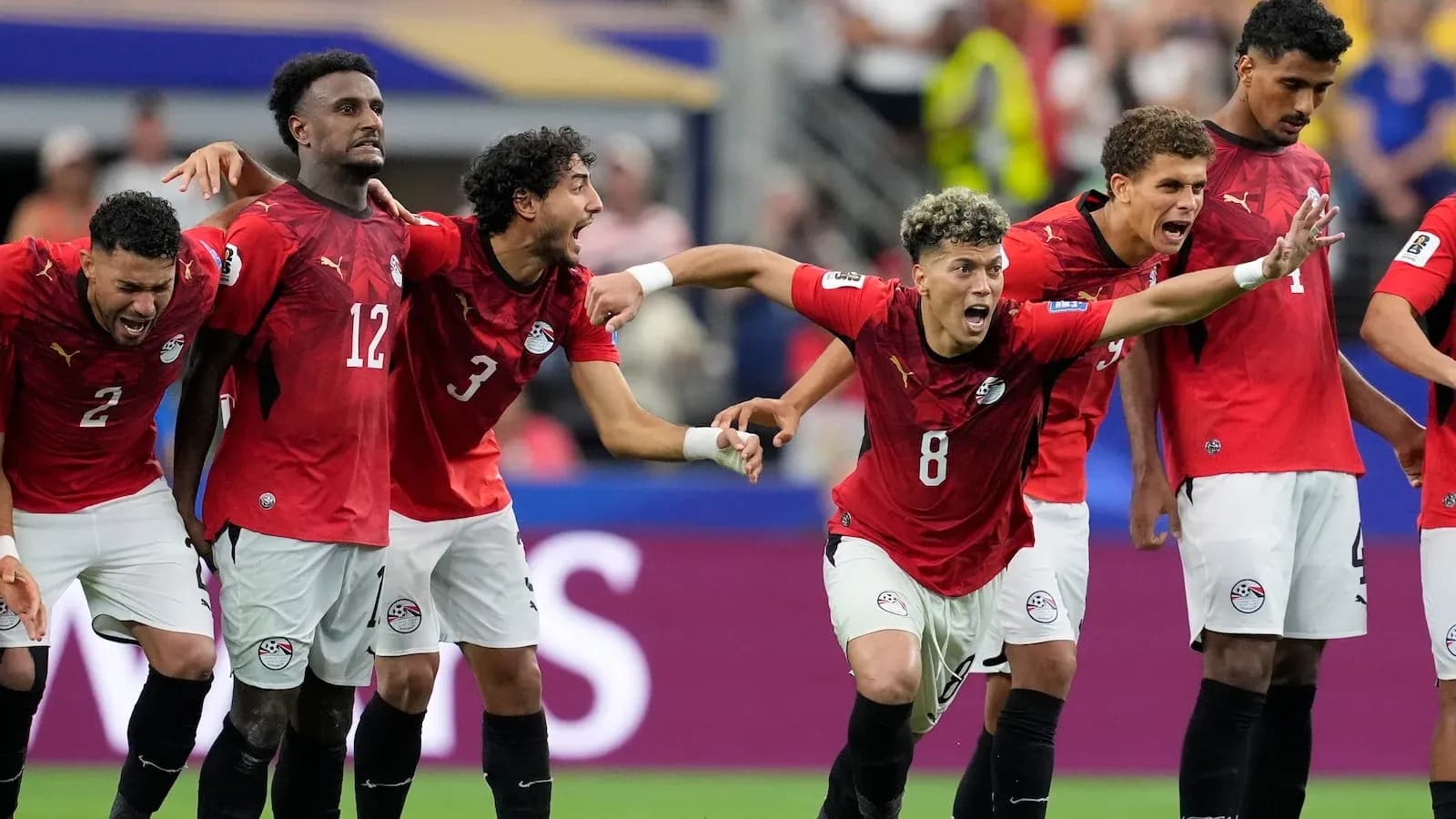
He went low to the left, Mathew Ryan guessed wrong and dived right, and 70,244 people inside the home of the Dallas Cowboys erupted as if the roof might come off. Red shirts swarmed toward the corner flag. Egypt’s bench emptied. A country that had never before won a World Cup game until this tournament now had a place in the last 16.
Salah, 34, played every second of regulation and extra time despite a hamstring injury from the group finale. He converted his penalty in the shootout and then watched, arms aloft, as Abdelmaguid finished the job.
“Me feeling today is that it's incredible,” Salah said. “I always like seeing the boys happy and enjoying the moment. Nothing can match that. So today was one of the best days of my life.”
For a player sitting one goal behind coach Hossam Hassan’s national record of 69, this was about something else. Legacy, yes. But also release.
Hassan’s prayer, Egypt’s breakthrough
Egypt arrived at this expanded 48-team World Cup with a modest record: three previous tournaments, no wins. That changed less than two weeks ago with a 3-1 victory over New Zealand in the group stage.
This was the next barrier.
On the touchline, Hassan lived every second. The former star striker, now 57 and chasing history as a coach, cut a restless figure, barking instructions, urging calm, and, by his own admission, praying.
“I was only thinking about the Egyptian fans,” he said through a translator. “During the entire time and during the penalty shootout, I was just praying, ‘God, please make the Egyptian people happy.’ Even before the penalty shootout, to be honest.”
His players held their nerve. Mahmoud Saber, Ramy Rabia and Salah all scored from the spot. Jackson Irvine and Awer Mabil converted for Australia, but the two misses were fatal.
When Abdelmaguid’s shot hit the net, Hassan finally allowed himself to explode into celebration. Egypt’s debut in the knockout rounds had become a statement.
Next up: either defending champion Argentina or Cape Verde in Atlanta on Tuesday.
A fast start, then a cruel twist
Egypt had started the night like a team determined to avoid the lottery of penalties.
In the 13th minute, Emam Ashour ghosted into the box and met a cross with a sharp header that beat Patrick Beach at the near post. It was a clean, decisive finish, and it settled Egyptian nerves early.
The chance to kill the tie arrived seconds after halftime. Omar Marmoush broke free, the angle opening up for him, but he dragged his shot wide. It felt like a small miss at the time. It grew larger with every minute.
Because the game’s next goal would belong to World Cup infamy.
In the 55th minute, Aiden O’Neill stood over a free kick just left of the penalty area and whipped it into a crowded box. Mohamed Hany, already the unwanted owner of an own-goal from the group-stage draw with Belgium, rose to meet it.
His header flew past his own goalkeeper, Mostafa Shoubir.
Two own-goals. Same tournament. Same defender. A grim record, and a brutal twist in a match Egypt had largely controlled.
Hany had been down less than 10 minutes earlier in almost the same spot, colliding with Connor Metcalfe on a header attempt. Medical staff rushed on with a stretcher at the ready, but after checks he stayed on. Soon after, his name was etched into the wrong kind of World Cup history.
Australia, who have now seen both of their World Cup knockout goals come via opposition own-goals, suddenly had life again.
Australia’s gamble in goal
For long stretches, the Socceroos had their 22-year-old goalkeeper to thank for that.
Beach, making just his sixth international appearance, produced several big moments. Late in regulation he flung himself to his right to claw away a powerful header from Rabia. Seconds later, he smothered a shot from Salah that seemed destined to sneak through bodies.
He had earned his night.
Then came the switch.
With extra time draining away and penalties looming, coach Tony Popovic turned to experience. Ryan, 34 years old and on his 105th cap, replaced Beach for the shootout.
It was a cold, ruthless decision designed for this exact scenario. Ryan has seen it all at international level. Beach has barely begun.
But the script betrayed Australia.
Ryan never got close to any of Egypt’s four penalties. He dived left as Abdelmaguid rolled the ball right. The gamble, so often justified in tournament football, failed.
“It hurts when you get that close,” Popovic said. “Unfortunately, we bow out in a penalty shootout, so it’s difficult to take right now.”
Australia’s World Cup knockout record now reads 0-3: a 1-0 defeat to Italy in 2006, a 2-1 loss to Argentina in Qatar four years ago — that lone goal an own-goal — and this.
A different Egypt steps forward
This is a different Egypt to the one that flickered and faded at previous World Cups.
They have a global superstar in Salah, still chasing Hassan’s scoring record but now captaining a side that is finally winning on this stage. They have a coach whose touchline energy mirrors the urgency of a generation tired of near-misses. They have role players like Abdelmaguid, Saber, Rabia and Ashour stepping out from the shadows when it matters.
They also have scars. Hany’s pair of own-goals will follow him, unfairly, long after this tournament ends. Yet his teammates’ response — tightening up, digging in, surviving — said something about the group’s resilience.
Egypt had one more big chance before penalties, Haissem Hassan driving into the box only to see his effort blocked by Souttar’s knee. After that, it was about nerve.
Egypt had more of it.
The Pharaohs now head to Atlanta with belief, a knockout win in their pocket, and Salah still driving them on through pain and history.
Argentina or Cape Verde await.
Who dares underestimate them now?