.svg&w=384&q=75 "GoalGist logo")
Egypt's Historic World Cup Knockout Win Against Australia
In the end, it came down to a teenager, a crossbar and a superstar who finally found his nerve.
Under a wall of whistles and a bank of Egypt fans, Australia’s World Cup dream died in a penalty shootout, and Egypt – with Mohamed Salah in tears of joy – walked into history.
A shootout under fire
Tony Popovic played his last card before the spot-kicks, hauling off his goalkeeper and sending on Mathew Ryan for the shootout. It was a bold, late gamble from a coach who knew exactly what was at stake: neither Egypt nor Australia had ever won a knockout match at a men’s World Cup.
The noise was vicious. The penalties, even more so.
Harry Souttar stepped up first for the Socceroos and thrashed his kick over the bar, the ball flying into the night and Australia immediately onto the back foot. The next five takers found the net, each one ratcheting up the tension. Salah, largely muted in open play, walked forward with the weight of a nation and rolled in the coolest of penalties.
Then came 18-year-old Lucas Herrington. One stride, one swing, one cruel thud off the bar.
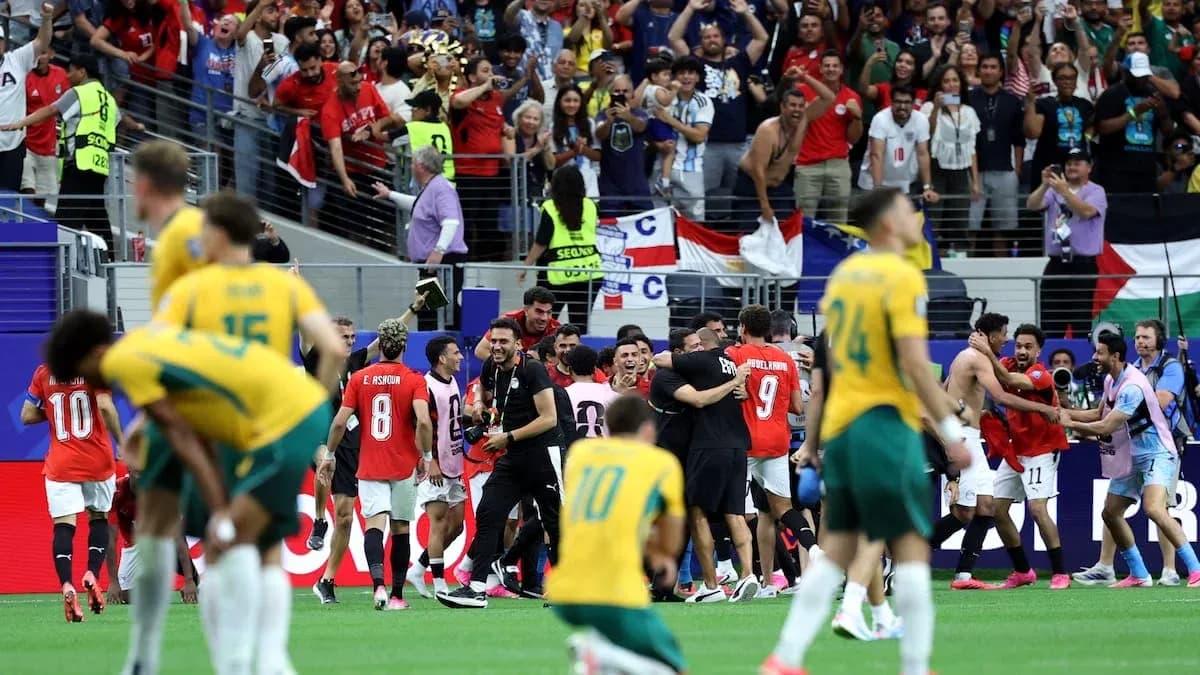
Abdelmaguid followed, calm where others had cracked, and buried his kick to send Egypt through. Salah dropped to the turf in tears; Australian players sank to their knees. The margins could not have been finer.
Egypt strike first
The drama had been building long before the shootout.
Inside the air-conditioned home of the Dallas Cowboys, with 70,000 watching, Emam Ashour rose after 13 minutes and changed the entire tone of the night. Karim Hafez swung in a cross, Nestory Irankunda lost his man at the back post, and Ashour powered home a header for his second goal of the tournament.
It was slightly against the run of play. Cristian Volpato, the late convert from Italy to Australia, had already rattled the top of the crossbar with less than five minutes gone, a warning shot that had Egypt’s back line twitching. Egypt, who had only just tasted their first World Cup win in the group stage against New Zealand, looked edgy at the back.
But one lapse in concentration, one untracked run, and the seven-time African champions had the lead.
For an Australia side that had scored just twice in the group phase, the equation was brutal: chase the game, or go home.
A bruising contest
The first half became a grind. Salah, 34 years old and coming in off a hamstring strain, hovered on the fringes, more decoy than destroyer. He made little impact in an attritional opening 45 minutes, with Australia content to lean into their physical edge and Egypt wary of over-committing.
Aziz Behich finally forced Mostafa Shoubir into a save 10 minutes before the break, but the full-back’s low effort was tame and straight at the goalkeeper. In the stands, another layer of tension settled.
There was a flashpoint before the interval. Jordan Bos, one of the quickest players at the tournament, flew down the flank and met an equally forceful challenge from Rabia. Bos hit the turf hard, stayed there, and Australia’s medical staff soon signalled the inevitable. He did not reappear after the break, replaced by Kai Trewin, a significant blow to Popovic’s plans on the left.
Australia drag themselves back
Egypt should have killed it seconds after half-time. Omar Marmoush, the Manchester City attacker, slid in at close range and somehow dragged his effort wide. It felt like a let-off at the time. It looked monumental later.
The miss jolted Australia. They pushed higher, pressed harder, and when a dangerous in-swinging free-kick whipped into the Egypt box, the pressure finally told. Mohamed Hany, wrestling with bodies around him, could only glance a header past his own goalkeeper and into the net.
Hany had already scored an own goal earlier in the tournament. This one cut even deeper.
Suddenly, the Socceroos had a lifeline. Egypt’s coach had warned about Australia’s physical approach; now he was watching it turn the game. Every aerial ball became a test. Every set-piece, a threat.
Extra time and the weight of history
Normal time ended with Egypt surging again. Salah, still searching for a defining touch, linked play neatly in the build-up as Ramy forced Patrick Beach into an athletic, stretching save deep in added time. It was the kind of stop that usually swings a tie. This one only postponed the reckoning.
Egypt finished the 90 the stronger side. Early in extra time, Salah finally found space on his weaker right foot and lashed a shot high over the bar. The chance came and went, and with each passing minute penalties loomed larger.
Both teams knew the stakes. Neither had ever stepped beyond this stage at a men’s World Cup. Every tackle, every clearance, every sprint in those final minutes carried that history on its back.
But there was no separating them.
Salah’s final word
So it came to the spot-kicks, to Ryan’s late entrance, to Souttar’s miss, to Herrington’s heartbreak. To Salah, standing on the edge of the box, watching, waiting.
He had been a peripheral figure for long stretches, almost a passenger at times. The game had been defined by Ashour’s header, by Hany’s misfortune, by Volpato’s early warning shot, by Bos’s injury and Beach’s late save.
Yet when the moment of truth arrived, Salah did what the greats so often do. He shut out the noise, stepped up, and delivered.
Egypt, at last, have a World Cup knockout win to call their own. Australia, so close and so combative, are left to wonder how far this run might have gone if a bar had been an inch lower, or a first penalty had stayed down.