.svg&w=384&q=75 "GoalGist logo")
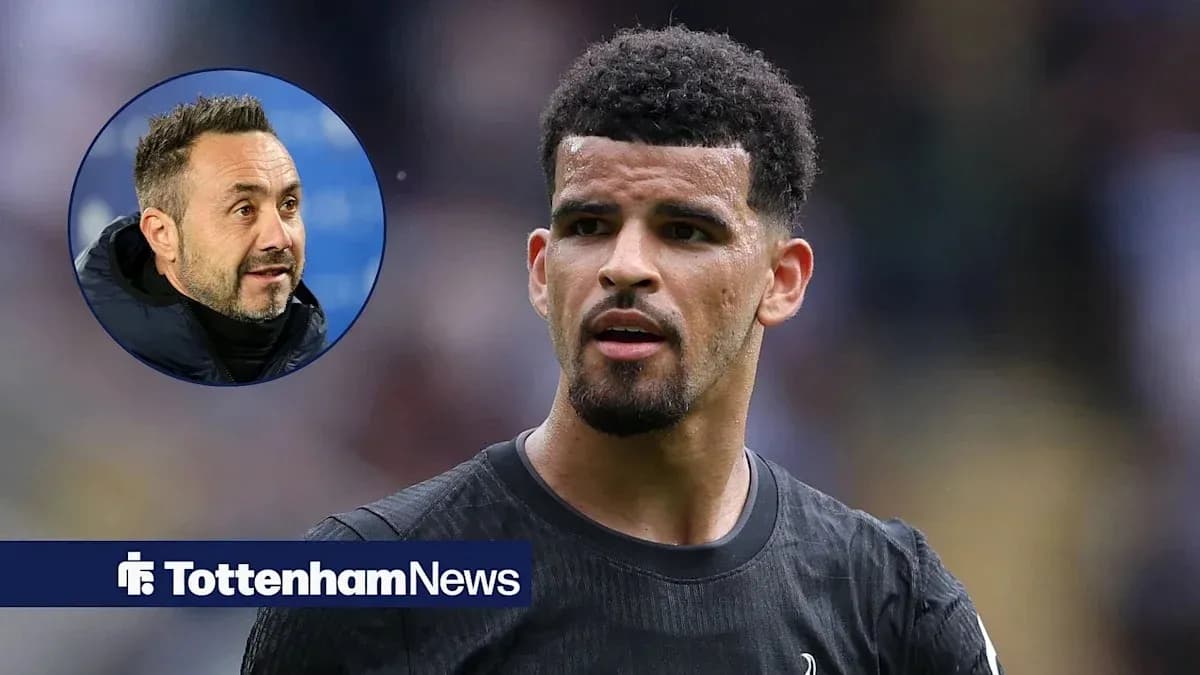
Dominic Solanke: A Controversial Figure at Tottenham
Dominic Solanke has never been a straightforward conversation at Tottenham Hotspur. He’s an argument. A split room. A shrug from some, a staunch defence from others.
He arrived in 2024 carrying the glow of a breakout season at Bournemouth, where 19 Premier League goals suggested a striker finally ready to live up to his early billing. Spurs thought they were buying a forward on the rise. What they have had since is a stop-start story of promise, frustration and, crucially, interruption.
Injuries have bitten hard. The numbers are blunt. Across two league campaigns in north London, Solanke has scored just 12 Premier League goals. For a 28-year-old signed to be a leading forward at a club with Champions League ambitions, that return keeps the debate alive every weekend he plays – and every weekend he doesn’t.
Now Roberto De Zerbi has walked straight into the middle of that debate and lit a flare.
De Zerbi’s big call
The new Tottenham head coach will open his first Premier League campaign with a clear decision to make: Richarlison or Solanke at the tip of his attack. On recent evidence, it sounds like his mind is already made up.
Speaking to Football London, De Zerbi did not just back Solanke. He elevated him. The Italian described the England international as one of the best strikers in the Premier League, insisting there are “not many better.”
He framed Solanke as a player who lives and dies by his confidence. “I think he changes the quality of performances depending on the confidence he feels,” De Zerbi said, underlining the mental side of the striker’s game as much as the technical.
Then came the detail. De Zerbi called him a “complete” centre-forward. A striker who can run in behind, protect the ball, link play, and – in the manager’s own words – is “able to score 15-20 goals in Premier League.”
It is a bold prediction. Solanke has only reached double figures in England’s top flight once. For a fanbase still waiting to see the Bournemouth version in a Spurs shirt over a full season, those words land as both a promise and a challenge.
Chaos, injuries and context
To judge Solanke’s time at Tottenham purely on goals is to ignore the chaos swirling around him since he arrived.
Under Ange Postecoglou, Spurs were ravaged by injuries and lost their early-season rhythm. The campaign drifted towards a pragmatic tilt at European qualification rather than a sustained title or top-four charge. Stability was in short supply.
Then came further upheaval. Thomas Frank, Igor Tudor and eventually De Zerbi all had turns in the technical area. Solanke’s own body refused to cooperate through that churn. He suffered multiple injuries, never stringing together the kind of run any striker needs to find rhythm and instinct.
Last season he played just 15 Premier League matches. For a supposed first-choice No 9, that figure tells its own story.
And yet, beneath the surface, the data paints a more generous picture.
The numbers behind the narrative
According to Data.MB, Solanke quietly posted some of the strongest underlying metrics among Premier League strikers last season.
Per 90 minutes, he ranked third for shots on target percentage at 58.82 per cent. When he did get chances, he hit the target more often than almost anyone else in his position. That suggests composure, technique and decision-making are not the issue; volume of chances is.
On the ball, he also impressed. His passing accuracy of 78.85 per cent placed him third among strikers, a figure that supports De Zerbi’s belief in his ability to knit attacks together and act as a focal point rather than a pure poacher.
Out of possession, the numbers are just as striking. Solanke ranked sixth for interceptions per 90 (2.23) and seventh for possessions won (4.23). Those are the returns of a forward who presses with intent, reads the game and contributes heavily to the first line of defence.
Put simply, there is a modern, all-round centre-forward in there. One who links, presses, disrupts and, when given the opportunity, hits the target.
What there has not been, yet, is the avalanche of goals that turns good data into a feared reputation.
Praise, pressure and a gauntlet thrown down
That is where De Zerbi’s comments cut both ways.
On one hand, they are a clear show of faith. A manager publicly aligning himself with a player, backing his talent and insisting that, in the right environment, Solanke belongs among the division’s elite. For a striker whose performances swing with confidence, that kind of endorsement matters.
On the other, they pile on expectation. “Not many better” is a phrase that will be thrown back at Solanke every time a chance goes begging. Fifteen to twenty league goals is not a casual estimate; it is a benchmark. Anything significantly below that will be judged against the manager’s own words.
And right now, the reality is inescapable. Until Solanke starts scoring regularly, De Zerbi’s claim cannot be fully defended. Underlying numbers and tactical usefulness are important, but strikers at clubs like Tottenham are ultimately measured by the scoreboard.
The encouraging part for Spurs is that the raw materials are there: high shot accuracy, strong link play, aggressive pressing, and a manager who clearly believes he can build a system around those strengths.
The risk is just as clear. If the goals do not come, the narrative around Solanke hardens, and De Zerbi’s first big attacking bet starts to look like a misstep.
The Premier League season is almost here. The choice up front appears made. Now Dominic Solanke has to turn faith and figures into what Tottenham have been waiting for: a season where the argument ends, and the goals speak for themselves.

