.svg&w=384&q=75 "GoalGist logo")
Curaçao vs Germany: Joshua Brenet's Redemption Arc
On Sunday night in Germany, a small Caribbean island will stare down a football giant. And on the right flank for Curaçao, the most turbulent figure in their squad will run straight into his past.
An island’s footprint on a European powerhouse
Curaçao remains part of the Kingdom of the Netherlands, but on the pitch the relationship has flipped. For years, Curaçaoans and their descendants have streamed to Dutch cities, and now those families form the spine of the Netherlands’ own national team. FIFA only recognised Curaçao in 2010; the island has wasted little time in carving out a football identity of its own.
Of the 26 players in Curaçao’s World Cup squad, just one was actually born on the island: Tahith Chong. The winger, once a bright hope at Manchester United, played 16 competitive games for the club before a flat six‑month loan at Werder Bremen in 2021. He is now at Sheffield United and stands as Curaçao’s most recognisable export.
He is not alone in carrying Bundesliga scars. Six members of this squad have passed through German football. Gervane Kastaneer at 1. FC Kaiserslautern, Riechedly Bazoer at VfL Wolfsburg, Roshon van Eijma at Preußen Münster, and the forward pair Jürgen Locadia and Joshua Brenet at TSG Hoffenheim. Each had a different story. None is as combustible as Brenet’s.
Brenet and Nagelsmann: from big move to cold exile
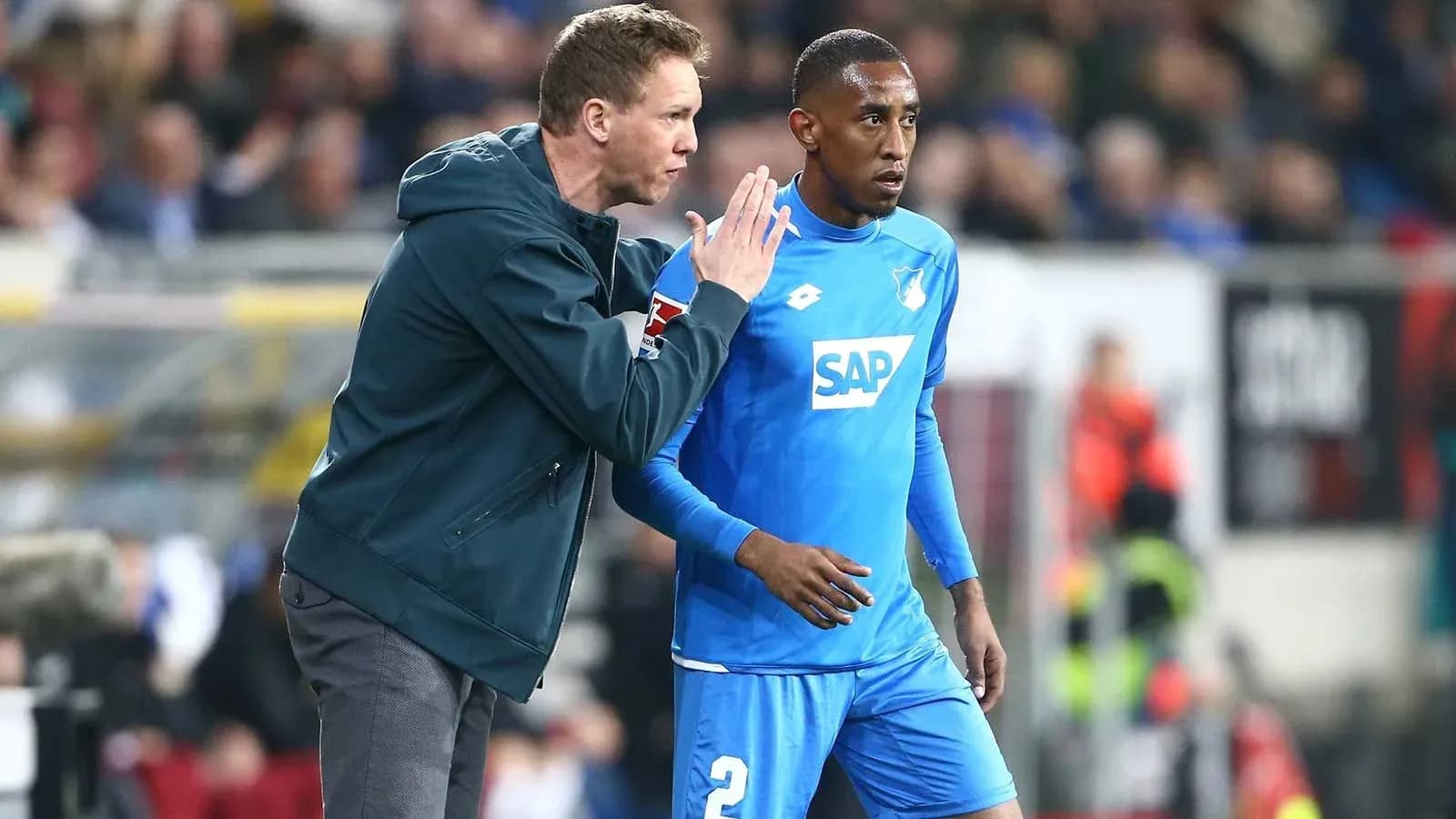
In 2018, Hoffenheim paid €3.5 million to prise Joshua Brenet from PSV Eindhoven. He arrived as a three-time Eredivisie champion, a modern right-back with two senior caps for the Netherlands and the backing of a rising coach: Julian Nagelsmann, now in charge of Germany.
The move looked like a smart step up. It quickly unravelled.
Brenet began life in the Bundesliga on the bench. Then came Hoffenheim’s first-ever Champions League match, against Shakhtar Donetsk. On the eve of that historic night, he skipped a video session. Nagelsmann responded by cutting him from the squad.
The door was not slammed shut entirely. Nagelsmann later brought him back into the fold, but only on the fringes. Brenet’s minutes stayed sporadic, his influence minimal. When Nagelsmann left, the situation worsened. His successor Alfred Schreuder, now Nagelsmann’s assistant with the DFB, did not use him at all. Under Sebastian Hoeneß, Brenet was pushed down to the reserves in the fourth-tier Regionalliga Südwest.
By then, it was not just form. Repeated disciplinary issues, including chronic lateness, stained his reputation. Hoffenheim searched for a buyer and found none. Only in 2022, when his contract ran down, did he finally move on, joining Twente Enschede on a free transfer.
Revival on the pitch, chaos off it
Back in the Netherlands, Brenet’s football began to speak for him again. At Twente he impressed, rediscovering the thrust and aggression that had once made him a Dutch international.
Off the field, he imploded.
In January 2023, he was caught driving without a licence twice in two weeks. He had already lost that licence in 2020 after a drink‑driving offence. This time, the courts came down hard. In 2024, a judge sentenced him to one month in prison.
“He clearly has no regard for authority. It seems to me as though he is continuing to play football after receiving a red card,” the presiding judge said in court.
It was not his first brush with the law. Back in 2021 he had received a suspended sentence, including a fine and community service, for domestic violence. The prison term for driving without a licence was later converted to community service on appeal, but Twente had seen enough. They terminated his contract.
The next chapter took him far from the European spotlight. He signed for Al‑Rayyan in Qatar and managed just six appearances in the 2024/25 season. Then came a short spell at Livingston FC in Scotland, followed by a move to Kayserispor in Turkey for the second half of the campaign. A career that once looked settled at the top level now lurched from stop to stop.
A new flag, a familiar stage
On the international scene, Brenet had long seemed tied to Oranje. He had represented the Netherlands at various youth levels and made his senior debut in the 2016 World Cup qualifiers. Yet FIFA granted him permission to switch allegiance to Curaçao, the country of his parents.
The change has given him something that had slipped away in Europe: a central role.
Since debuting for Curaçao in 2024, Brenet has scored six goals in 17 appearances. He started at right-back in the team’s final warm‑up match against Aruba and found the net again, underlining his importance in both directions.
Now 32, he walks into a World Cup opener that feels almost scripted. On Sunday at 7 pm, Curaçao will begin their campaign against Germany. On the opposite bench: Julian Nagelsmann and Alfred Schreuder, the two men who once froze him out at Hoffenheim.
For Curaçao, this is a shot at the global stage, a chance for a small island to leave a mark against a four-time world champion. For Brenet, it is something sharper. Ninety minutes to show, in front of former employers and old judges, that the story of his career is not just a catalogue of wasted chances.

