.svg&w=384&q=75 "GoalGist logo")
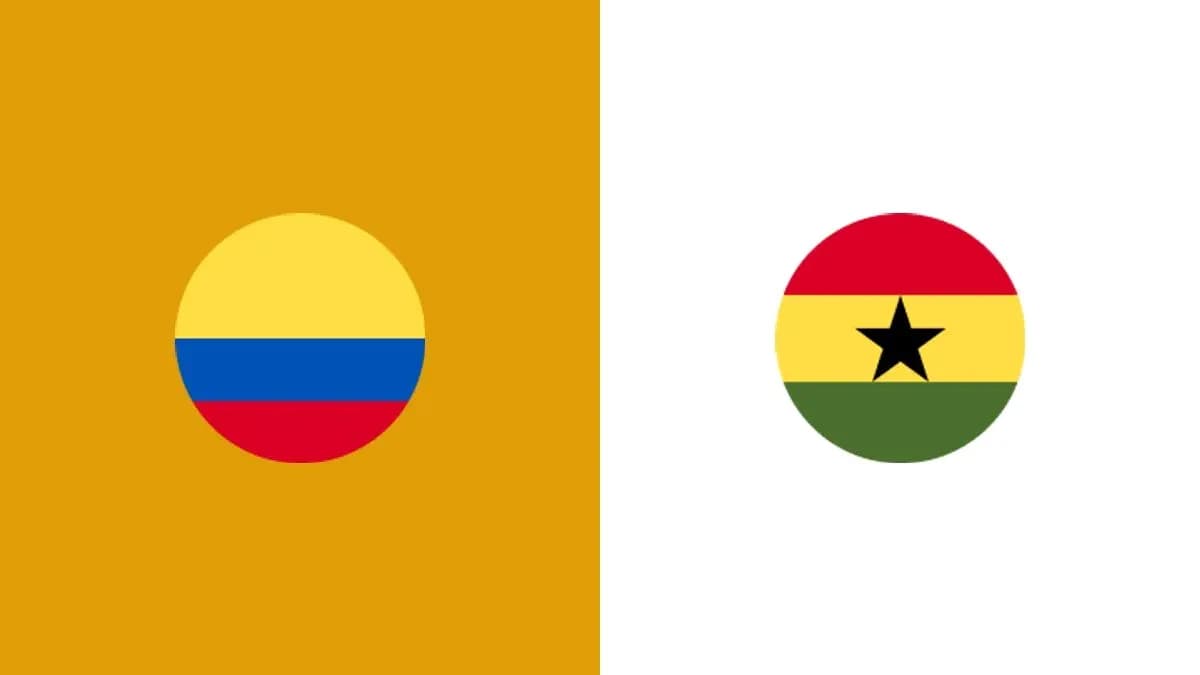
Colombia vs Ghana: A Clash of Eras in Kansas City
The Round of 32 winds towards its conclusion with a meeting that feels like a clash of eras as much as continents. Colombia arrive in Kansas City humming with rhythm and certainty, a side that has glided through the group stage with the swagger of a team that expects to be here deep into July. Ghana turn up with something very different: a sense of history already made, and the dangerous freedom of underdogs who have nothing to protect and everything to chase.
Kick-off is set for 4 July 2026 at 01:30 GMT, 20:30 EST on 3 July. Under the lights, the contrast in storylines could hardly be sharper.
Colombia’s quiet storm
Néstor Lorenzo has built a Colombian team that doesn’t need to shout to impose itself. The numbers do that for them. Top of Group K with seven points, unbeaten, and with just a single goal conceded in three matches. They handled Uzbekistan and DR Congo with authority, then went toe to toe with Portugal in a goalless draw that felt more like a chess match than a group game.
The impression is of a side that has grown used to control. From Jordan and Costa Rica in pre-tournament friendlies to the World Cup itself, Colombia have strung together five matches without conceding. Six scored, none allowed. That kind of defensive record doesn’t happen by accident.
It starts at the back with Camilo Vargas, calm and unflappable, and stretches through a back four that understands spacing and timing. Davinson Sánchez and Jhon Lucumí give Colombia a rugged, aerially dominant centre, while Daniel Muñoz and Johan Mojica offer the width and aggression that define Lorenzo’s blueprint.
Then there is the heartbeat. Richard Ríos and Jefferson Lerma bring balance and bite in midfield, Gustavo Puerta and Jhon Arias add energy and angles, but everything still seems to bend towards one man.
James Rodríguez, 34 now, no longer sprints away from defenders. He doesn’t need to. His game has been distilled to its essence: vision, weight of pass, the ability to see a gap before it opens. When Colombia begin to tilt the pitch, it is usually James who finds the seam that no one else noticed.
Ahead of him, Luis Díaz stretches the left flank with his usual relentlessness, while Luis Suárez – now declared fully fit after a minor issue limited him against Portugal – returns to lead the line. The likely XI reads like a statement of continuity: Vargas; Muñoz, Lucumí, Sánchez, Mojica; Puerta, Lerma, Arias; Rodríguez, Suárez, Díaz. A settled core, a clear idea, and a sense that this is only the start.
Ghana’s new chapter
Ghana come from a very different place, but no less compelling. The Black Stars have already crossed a threshold: for the first time in the modern era, they have pushed beyond the group stage at a World Cup. That alone carries emotional weight.
Their route out of Group L was anything but smooth. A narrow 1-0 win over Panama, a stubborn 0-0 against co-hosts England, and a 2-1 defeat to Croatia that snapped an unbeaten run but didn’t derail the campaign. Four points, enough to slip through as one of the best third-placed teams.
The broader form line tells of a team still under construction. Across their last five games – including friendlies against Wales and Mexico – Ghana have gone W-D-L-D-L, scoring three and conceding four. Not spectacular, not disastrous, but always competitive.
Carlos Queiroz has leaned on experience to steady the project. Thomas Partey, the midfield general, remains the anchor around which everything else orbits. Jordan Ayew continues to carry the burden of goals and leadership in the forward line. Around them, a younger supporting cast has begun to find its voice.
There was concern when Antoine Semenyo, the Manchester City midfielder, picked up an ankle problem. Ghana’s medical staff have managed it well; he is expected to start, and his ability to knit transitions together will be crucial against Colombia’s press.
The likely XI – even if some listings have been muddled on paper – looks something like this: Asare; Senaya, Adjetey, Luckassen, Mensah; Sulemana, Partey, Owusu, Sibo, Semenyo; Ayew. It is a side built to suffer without the ball and then bite on the counter.
Where the game will be won
Tactically, the fault line is obvious. Colombia live on their right flank. Daniel Muñoz has already scored twice at this tournament, and he doesn’t just overlap; he invades. When he surges forward and links with the midfield trio and James drifting over, Colombia create overloads that can suffocate a back line.
Ghana know this. Their entire plan hinges on discipline in the middle third and a defensive block that moves as one. The key duel sits at the heart of it all: Richard Ríos against Thomas Partey.
If Ríos is allowed to step forward, receive on the half-turn and feed Díaz and Rodríguez between the lines, Ghana will spend the night chasing shadows. If Partey can disrupt that rhythm – cut off passing lanes, force play sideways, win second balls – the dynamic changes. Suddenly Colombia’s full-backs are higher than their comfort zone, and the spaces behind them begin to look inviting.
That is where Kamaldeen Sulemana and Semenyo come into play. Ghana won’t flood numbers forward, but when they do break, they will do it with speed and intent. Vertical, direct, ruthless. Colombia’s warning is clear: probe, but don’t over-commit. One careless turnover and a game they think they control can flip in a heartbeat.
At the back, Ghana face a brutal examination. Keeping a clean sheet against a frontline that can attack from all angles requires more than bravery. It demands flawless communication. Centre-backs Derrick Luckassen and Jonas Adjetey must track Suárez’s movement while constantly checking shoulders for Díaz cutting inside and Muñoz arriving late. One misstep, one missed rotation, and James will slide a pass into the gap.
Mindset and margins
The mental side may be as decisive as any tactical tweak. Colombia walk into this tie in full flow: W-W-W-D-W across their last five, their last three World Cup games defined by control rather than chaos. They know what they are, and they play like it.
Ghana arrive with scars and belief in equal measure. They have been stretched by Mexico, frustrated by Wales, lifted by Panama, and hardened by England and Croatia. Each match has added a layer of resilience.
There is also the novelty of it all. These two nations rarely meet at this level; no recent head-to-head record exists to lean on. No familiar grudges, no old blueprints. Just a blank page on a World Cup night.
Colombia, first in Group K, carry the weight of expectation. Ghana, third in Group L, carry the weight of possibility. One side is chasing a deep run they feel overdue. The other is already living in uncharted territory, with the chance to turn a breakthrough into a full-blown shock.
Under knockout pressure, those roles can twist quickly. If Colombia’s patience turns to anxiety, if Ghana’s defensive resolve turns into belief with each minute the score stays level, the atmosphere in Kansas City will change.
The stage is set: a South American power with a clean sheet streak, an African side that has already ripped up its own ceiling. Now the question hangs over Kansas City Stadium: will this be another step in Colombia’s calculated march, or the night the Black Stars write the next great World Cup upset into their story?