.svg&w=384&q=75 "GoalGist logo")
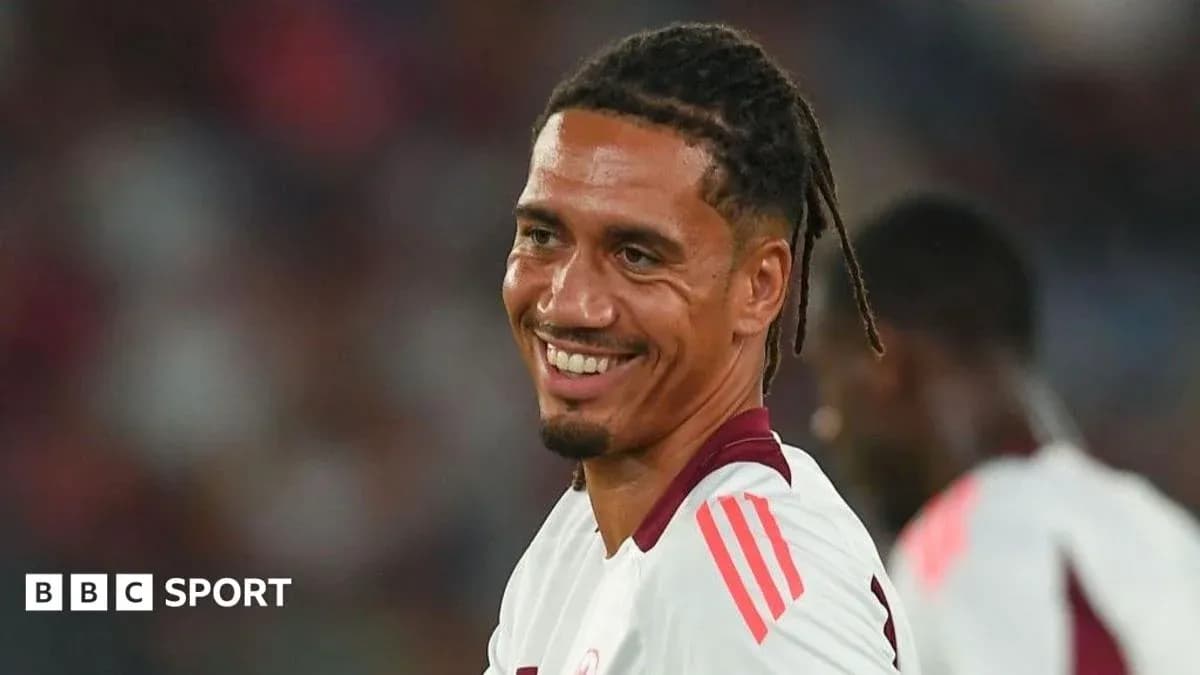
Chris Smalling: From Maidstone to Elite Football
Chris Smalling never really fitted the template.
You hear it in the first few sentences of a 45‑minute conversation. The language is precise, the thinking clear. This is not a footballer drifting towards retirement, clinging to old stories. This is a 36-year-old centre-back, fresh from an ever-present season with Al-Fayha in Saudi Arabia, back in the north west of England and calmly plotting his next move.
His playing days are not done. Not yet. Not for someone who has dragged a career from non-league Maidstone to a Champions League final in just three years, amassed 580 club appearances across three countries, worked under Sir Alex Ferguson and Jose Mourinho, collected 31 England caps and lifted trophies with Manchester United and Roma.
But Smalling has always thought beyond the next game.
The body, the science, the extra mile
"I know my body now better than when I was 26 and that's shown in the games I'm playing," he says.
When he was young at United, he watched Sir Alex nudge veterans like Ryan Giggs towards yoga and new recovery methods. Back then, it felt like an add-on. Now, it is the core of his existence.
"When you get beyond 30, each year is precious in terms of enjoying playing and being passionate about football.
"Actual training is a very short time. The longevity and recovery starts very early in terms of what I'm eating and doing between sessions, even down to my supplements now."
Most players accept the pre-season blood tests, listen to the club nutritionist and move on. Smalling went further.
"In pre-season we have blood tests and the clubs make recommendations. I went one step further and kind of had genetics testing, which goes deep into everything. A lot of my supplements were changed because of that."
The result? An ever-present campaign in the Saudi Pro League with Al-Fayha, a point of genuine pride for a player whose game has always leaned on athleticism and intensity.
From Maidstone to Manchester United
Wind back 18 years and none of this seemed remotely likely.
"It wasn't even plan D," he says, almost laughing at the thought.
He was playing for Maidstone, preparing to study financial economics at university. A-levels done, life mapped out. He was even looking at non-league clubs near Leicester so he could keep playing while studying.
Then, very late in the summer, Fulham called.
"It was very late in the summer when the opportunity came around. I knew it was a slim chance even to be offered but I needed to do everything I could."
Roy Hodgson watched one practice game, pulled him into his office and offered him a contract.
"It wasn't even a full week. I didn't have any time to get my head around it. I was just in total shock."
That sudden jolt into a different world would become a theme.
The knock on the hotel door
Fast forward to January 2010. Smalling is 20, part of the Fulham squad travelling to Blackburn for a Premier League game. He does not play in the 2-0 defeat. The real drama has already happened.
"There had been a lot of talk about other clubs but not Manchester United," he recalls.
On the eve of the game, Hodgson pulls him off the team coach. Fulham have accepted a bid. Sir Alex Ferguson is coming to the hotel. In 45 minutes.
"I called my mum first but then I was sitting in the room thinking it was going to be a bit awkward and what questions could I ask him?
"Literally, we were there for about at least a couple of hours. He was so calming and reassuring."
Smalling admits he doubted the move. United were stacked with centre-backs. Where would he fit? How would he develop?
"He told me I would get a chance and he believed in me.
"To be able to share the dressing room and the pitch and have conversations with him, is just incredible."
That personal connection, the ability to make a player feel seen and trusted, is what he believes separates the truly elite managers from the rest.
Mourinho, broken toes and belief
To many on the outside, his relationship with Jose Mourinho is remembered for one thing: the public criticism in November 2016 when the Portuguese questioned his willingness to play through injury.
Smalling tells a different story.
"For United or Roma, Jose picked me for most games because we had a good relationship and he trusted me.
"It's very easy to influence younger players but the beauty of Sir Alex and Jose is that they were able to create that belief in senior players. A lot of managers can give good team talks but if you look at some eye-to-eye, see the passion and real belief that 'it's going to happen' senior players follow and the rest lock in. That's the beauty of top-class manager."
The broken toe episode underlines it. He was pushing his body to the limit.
"In that situation, I was having injections in broken toe because he had created that mentality in me that I could do anything, even if, maybe, I shouldn't. I had reached the limit of the amount I could have, had to stop in a warm-up and he was disappointed.
"It gave me even more belief because it was easy to choose another centre-back but he wanted me."
They remain in contact. Smalling messaged Mourinho to wish him good luck when he took over at Real Madrid this summer. The respect runs both ways.
Coaching, though, is not a path he intends to follow.
"I don't think it will be my route. I'm quite comfortable with the next stage."
Building the next chapter
That next stage is already taking shape.
"I'm working on an education programme for young players partnering with the Global Institute of Sport that's going to be coming out shortly. I've got three or four of these types of projects.
"Once my football career comes to an end, I can put more time to them but at the minute it's all focused on playing because I have that passion and drive and physically my stats are good."
Whoever signs him now will not just be getting a defender.
At Al-Fayha, he pushed standards off the pitch, helping ensure the gym met the demands of a modern elite professional. He talks with satisfaction about the way he is remembered at his previous clubs, not only for performances but for his influence around the place.
He has always been mindful of the road not taken.
"It would have been the safer route," he says of the university offer he turned down.
"In that first year, I was not earning a lot of money. I was playing for the reserves and the 19th man for the first team, travelling around but not quite on the bench. There was no guarantee I was going to earn more money."
Then came United. A four-year contract. Then a renewal after the first year. Another a year later. Another 18 months after that.
"There was always this carrot. I never took anything for granted."
From Maidstone to Manchester, Rome to Riyadh and back to the north west, the pattern is clear. Every step has come with risk, with doubt, with a decision to push on rather than settle.
Now, as he waits for the next club to call, Smalling stands as something rare in the modern game: a veteran centre-back whose body is tuned by science, whose mind is already on the future, and whose story still has another chapter to write.