.svg&w=384&q=75 "GoalGist logo")
Chelsea's Pursuit of Dominance in Women's Football
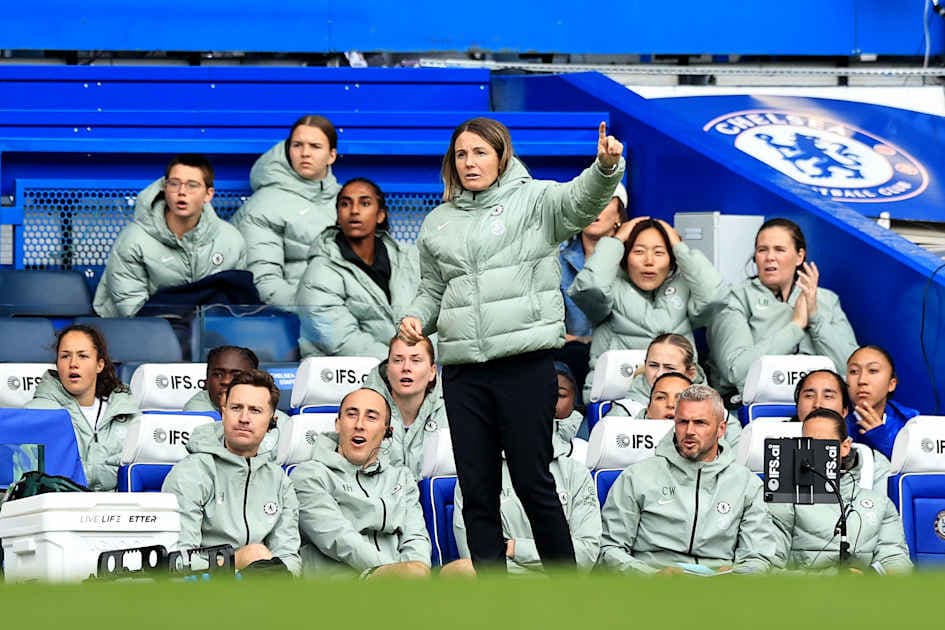
Chelsea know what dominance looks like. Sonia Bompastor walked through the doors in the summer of 2024 and promptly delivered a domestic Treble in her first season. That kind of start rewrites expectations. It also sharpens the glare when the next campaign brings something less than a clean sweep.
This season, Chelsea still collected the Women’s League Cup, secured a third-place finish in the WSL to book a return to the Women’s Champions League, and pushed into the Women’s FA Cup semi-finals. For most clubs, that would be a banner year. At Chelsea, it triggered introspection.
“If you reflect in terms of results, for sure, we have been so used to winning so many games, trophies, and titles,” Bompastor admitted. “But this season we couldn't achieve as much as we did previously.”
That line lands differently at a club that has set the standard in the women’s game for the best part of a decade. Chelsea have been the reference point: the model of investment, structure and relentlessness. Now the chasing pack is no longer just chasing.
“The competition is becoming bigger and bigger,” she said. The gap is shrinking, not only in England but across Europe. Clubs are pouring more resources into their women’s teams, recruiting aggressively, building deeper squads, and designing projects specifically to knock Chelsea off their perch.
Chelsea, Bompastor insists, have long “been showing the pathway.” The problem with blazing a trail is that others eventually follow it. “Right now, most of the clubs are catching up and making sure they can compete against us,” she noted. The conversation at Cobham has shifted: how do you stay ahead when everyone else is finally running at your speed?
“So, it’s for us as a club to have a vision around, ‘okay, how can we maintain the success in the long term at a club like Chelsea?’ That's the question we need to ask ourselves.”
Those reflections are already under way. Bompastor describes both of her seasons in charge as transitional, even if one ended in a Treble and the other with a more modest haul. The first year felt like lift-off. The second has been a reminder of how quickly the landscape can change.
New competition rules will change it again. Chelsea’s qualification for next season’s Champions League means they will not take part in the League Cup in 2026/27. One domestic front disappears, but the demands will not ease.
“We have been competing in four competitions, and going into next season, there will be three competitions,” Bompastor explained. The squad was built with four fronts in mind, with the depth to rotate, to absorb injuries, to carry international players through relentless calendars. Now the challenge is different: sharpen that depth, don’t just spread it.
Her comparison with her previous job at Lyon is revealing. In France, she could win 80 per cent of games at 60 per cent intensity. She could blood academy players and still collect three points. England is a different kind of grind.
“When I was at Lyon, 80 per cent of the games, we could play at 60 per cent, and it was enough for us to win. I could play some of the games with players coming from the academy and still win games. That's not the case here,” she said.
Here, every league fixture bites. The badge across from you might belong to a traditional giant or a newer force, but the pattern is the same: physical tests, tactical puzzles, emotional swings. “Here, you have to compete in every league game because every match brings you a challenge in different ways. Sometimes it's a physical challenge. Sometimes it's a tough game because they are big clubs. Sometimes it's a tactical challenge.”
Drop your level, even briefly, and you feel it on the table. “There is no space for you to drop a little bit because when you do that, you lose or you drop points.”
That reality is driving Chelsea’s internal audit. They are not tearing anything up; they are refining, re-arming, planning for a WSL that no longer allows passengers and a Champions League that punishes any hesitation.
“Our job is to reflect and to make sure we make the right decisions for the future,” Bompastor said.
The Treble proved how high Chelsea can climb. The past season showed how hard it will be to stay there. Now comes the part that defines great eras: not the trophies already won, but the decisions made to win the next ones.