.svg&w=384&q=75 "GoalGist logo")
Chaos in the Riviera: Nice Faces Relegation Playoff After Ineos Collapse
The final whistle went. The anger finally spilled.
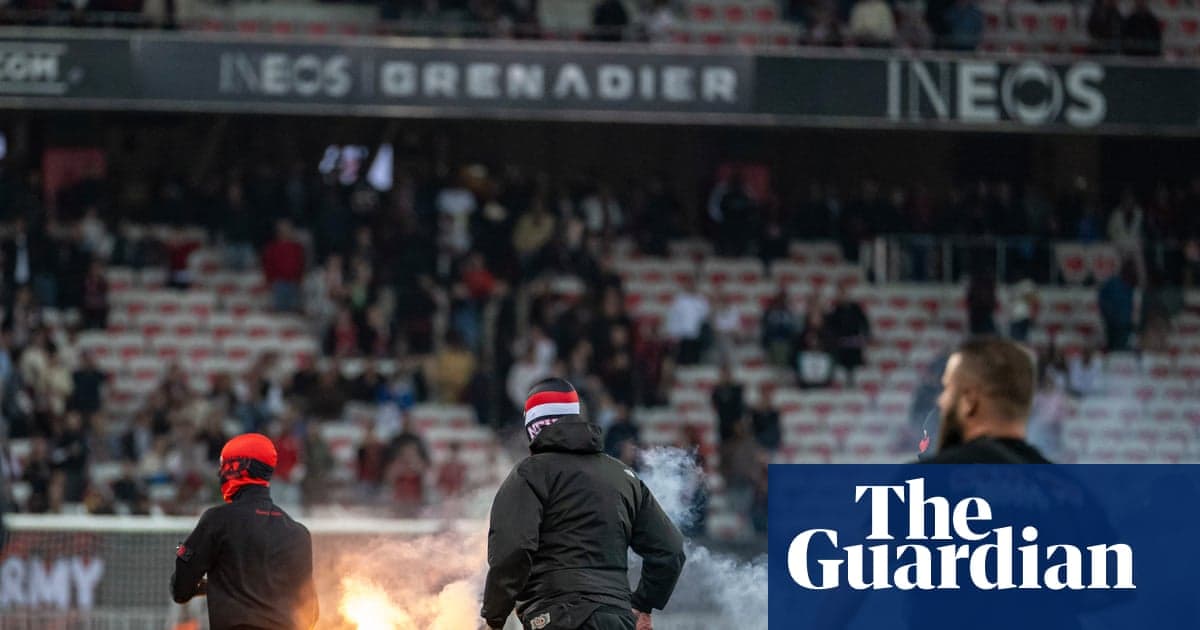
Nice’s ultras poured out of the stands and on to the Allianz Riviera pitch on Sunday night, a furious tide in black and red. Players sprinted for the tunnel, staff followed, stewards were overwhelmed. A 0-0 home draw with already-relegated Metz had just condemned Nice to a relegation playoff. The reaction said everything about the scale of the collapse under Ineos.
This season started with Champions League qualifiers. It could end in Ligue 2.
Nice’s failure to beat Metz means a two-legged playoff against Saint-Étienne now looms later this month, a knife-edge tie that will decide whether a project bought for €100m in 2019 crashes into the second tier. For Ineos, who are already trying to engineer an exit after failing to turn Nice into genuine challengers to PSG, the timing could hardly be worse.
A Simple Task, Botched Completely
The assignment was as straightforward as it gets: win a home league game. Something Nice had not done since 29 October.
They could not have hand-picked softer opposition. Metz were down already, dead last, with just three league victories all season and none at all under Benoît Tavenot, who took over in January. His personal record across Metz and Bastia this season reads like a sporting horror show: no wins, nine draws, 18 defeats, two relegations. This was the side Nice had to beat to save themselves.
They didn’t. They froze.
“Get your arses into gear,” the home fans roared before kick-off. The mood in the stadium flickered between fury, nostalgia and a strange sense of celebration. One banner ordered: “Everyone to Paris,” a nod to Friday’s Coupe de France final against Lens at the Stade de France. A huge tifo honoured club captain Dante, who had hoped this might be his final appearance at the Allianz Riviera before retiring at 42.
Any hint of celebration vanished quickly. The anger swallowed everything else, just as the looming playoff against Saint-Étienne now dwarfs the cup final. Nice co-president Jean-Pierre Rivère has already admitted the obvious: “It is no longer a priority at all.”
Nice will go to Paris with their thoughts elsewhere, much like Reims did last season. Reims lost the cup final to PSG, then collapsed in the relegation playoff against Metz. Yehvann Diouf played in all three of those games for Reims before joining Nice in the summer. He knows how quickly a season can disintegrate. He will be desperate not to live the same nightmare twice.
Ineos Turn Off the Tap
The warning signs were there, scattered across the campaign, but few believed it would come to this.
Targets were vague from the outset. A return to Europe was mentioned, but no one dared specify which competition. With Ineos shifting their attention and resources towards Manchester United, Nice felt the squeeze. The investment slowed, then all but stopped.
Key players left. Evann Guessand and Marcin Bulka were sold. Their replacements were nowhere near the same level. Kevin Carlos, brought in to fill Guessand’s role, has yet to score a league goal. Others simply chose to go elsewhere. Mahdi Camara turned down Nice to join Rennes.
Franck Haise saw the cracks early. In the autumn he complained he did not have the squad to challenge for Europe. Later he went further, saying he simply could not “create a group” from the players at his disposal. The fans listened. Their anger grew.
It was not just the players in the firing line. Sporting director Florian Maurice felt the heat. So did Fabrice Bocquet, who briefly replaced Rivère as president.
The atmosphere around the club darkened. In November, Terem Moffi and Jérémie Boga were attacked by fans as they stepped off the team bus at the training ground after a defeat at Lorient. Both forwards left soon after. Bocquet also departed. By the end of the year, Haise was gone too.
Puel’s Return and a Club in Pieces
Rivère’s big decision in the aftermath was to bring back Claude Puel. It has backfired spectacularly.
Convinced Haise had lost his edge, the club agreed to part ways in December and handed Puel the reins. The numbers since then are brutal: two league wins in 18 matches. His conservative tactics, puzzling team selections and inability to arrest the slide have been hammered by supporters and pundits alike.
But Puel is only one part of a wider decay. As boos rained down almost non-stop during the lifeless draw with Metz, it became impossible to tell who the supporters were targeting. The players? The coach? The board? Ineos? The sound felt all-encompassing. Everyone, it seemed, was guilty.
The tension was visible in the stands. At half-time, the ultras moved from the second tier down to the first. No one believed they were just looking for a better view. When the final whistle confirmed the playoff fate, the dam burst. They surged on to the pitch, forcing the players to flee.
The trouble did not stop there. Unrest continued around the stadium deep into the night. Staff, VIP guests and journalists were held inside the Allianz Riviera until after midnight as security tried to regain control.
Puel attempted to acknowledge the fury, saying the fans’ “disappointment is legitimate”. Rivère called for “unity”. The words rang hollow. The fractures at Nice feel structural now, not emotional. No one inside the club looks remotely capable of repairing them. With talks ongoing over a potential sale, Ineos may soon decide it is no longer their problem. If they walk away this summer, they will leave behind a scorched landscape.
Nantes Implode, Coach Vahid Walks Away
Nice were not alone in chaos on the final day.
At Nantes, the situation disintegrated even faster. Already relegated, they hosted Toulouse in a match that lasted just 22 minutes. The club’s owners stayed away, citing safety concerns. They were right.
Ultras unleashed black flares, an ominous, theatrical show of rage, then stormed the pitch in large numbers. Players, officials and staff sprinted for the tunnel. One man stayed.
Vahid Halilhodzic stood his ground on the pitch, facing supporters, many masked in balaclavas, and tried to reason with them. Eventually, even he had to retreat, walking slowly towards the dressing room, anguish and disbelief written across his face.
“In the 40 years of my career as a player and then a manager, I have never experienced that. It will be deeply engraved in my memory,” he said afterwards. He confirmed it would be his last memory in football. That is how “Coach Vahid” bows out: alone on a pitch, pleading with his own fans as his club implodes.
A Strange Coronation in Paris
On a night dominated by violence and bitterness, Paris offered a different kind of surreal image.
PSG had already wrapped up the Ligue 1 title with victory over Lens in midweek, but the trophy presentation had been delayed. The plan was to lift it after Sunday’s Paris derby against Paris FC.
There was a problem. Paris FC, the home side, had their own post-match ceremony lined up after securing safety in Ligue 1. They had no intention of turning their celebration into a backdrop for PSG’s coronation.
So PSG improvised. Before kick-off, they erected a small stand in front of the away end, a makeshift stage for their title party. The whole thing felt oddly muted, almost awkward – a low-key celebration for a club judged by what it does in other competitions.
On the pitch, the champions slumped to a 2-1 defeat. Luis Enrique had already made it clear his focus lies elsewhere, on the Champions League final against Arsenal. His team played like it.
Across France, the scenes told very different stories: a title party in a borrowed corner of a rival’s stadium, a legendary coach walking away from a riot, a fallen project on the Riviera staring at the abyss.
For Nice, the question is brutally simple now: is this just a crisis, or the end of an era? The answer will come against Saint-Étienne, with the club’s entire future on the line.

