.svg&w=384&q=75 "GoalGist logo")
Canada's Historic World Cup Win Overshadowed by Koné's Injury
Canada finally had its World Cup moment. A first-ever victory on the global stage. A 6-0 demolition of Qatar. A hat trick from Jonathan David in front of a roaring crowd in Vancouver on June 18, 2026.
And yet, as the final whistle went, nobody was talking about the scoreline.
They were talking about Ismaël Koné’s leg.
A historic night turns sickening
Midway through the second half of this Group B match, with Canada already cruising, the stadium’s noise dropped to a stunned hush.
Koné took a touch in midfield. Qatar’s Assim Madibo came in from behind. The tackle sent the 24-year-old sprawling, his left leg trapped and twisting under the weight of the challenge.
Koné hit the turf and grimaced, immediately in trouble. Teammates sprinted towards him, frantically waving to the bench. Within seconds, players were turning away, some with hands on their heads, others calling for medical staff.
Canada captain Stephen Eustáquio, one of the first to reach him, did not hide what he saw.
“I saw his leg. I saw that something wasn't right,” he said later, the image clearly burned into his memory.
On the touchline, Canada coach Jesse Marsch and his staff had the same view. The collision unfolded right in front of the bench. Marsch said you could hear the “bones snap.”
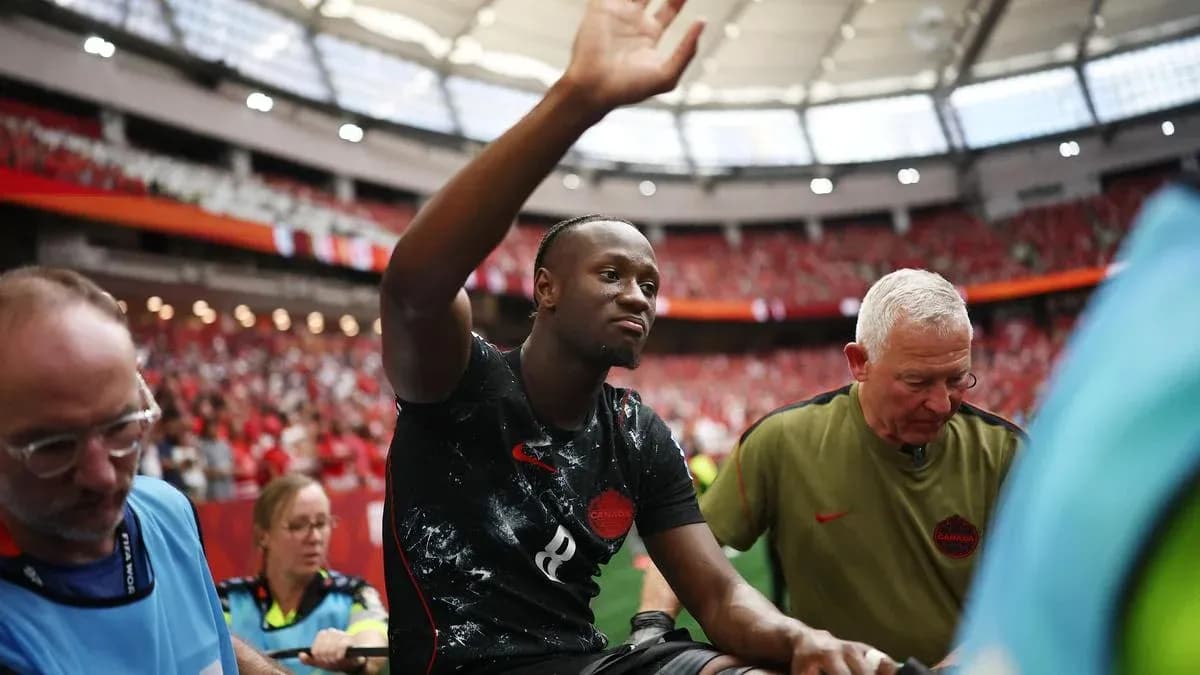
Koné’s teammates formed a protective ring around him as medics worked, shielding him from cameras and the crowd. The midfielder was eventually stretchered off, the atmosphere inside the stadium heavy and shaken despite Canada’s dominance.
Madibo received a straight red card for the tackle. It was Qatar’s second dismissal of the night after Homam Ahmed had already been sent off in the first half, leaving the Gulf side to finish the game with nine men.
Playing on through the shock
Koné was rushed to a local hospital, where, according to Marsch, he was being prepared for surgery and surrounded by family.
“Everybody was crushed when it happened, but we had to find a way to stay focused, we knew that Ismaël wanted us to finish the job," Marsch said. "There's a lot of thoughts that go through our heads right now, we're all thinking about him, but we're all very proud of what we are.”
The details of the injury have not yet been officially disclosed, but images from the incident showed his lower left leg visibly out of place, a scene that left players and fans visibly shaken.
On the pitch, Canada still had a game to finish. The response was ruthless and emotional in equal measure.
Less than 10 minutes after Koné left the field, his replacement, Nathan Saliba, arrived in the box and added Canada’s fourth goal of the night. There was no wild celebration. Instead, Saliba lifted Koné’s jersey to the sky, an immediate tribute to a teammate whose tournament – and perhaps season – had just been torn apart.
The gesture hit home. The crowd roared again, this time with a different edge: pride, anger, sympathy, all wrapped into one.
David’s hat trick and a pointed message
Jonathan David had already taken command of the match with a hat trick, leading Canada’s attack in the kind of performance supporters had long hoped to see on this stage. But his thoughts drifted quickly from goals to the tackle that changed the tone of the night.
“If there's a play where you cannot win the ball, there's no point,” he said afterwards. “It's just to hurt people.”
It was a blunt assessment, cutting through the usual post-match platitudes. For a team celebrating its first-ever World Cup win, there was no masking the bitterness.
Marsch revealed that Madibo had personally apologized to Koné, a small human moment amid the chaos. It will not heal the injury, but it mattered enough for the coach to mention.
Inside the Canadian camp, the joy of a landmark victory was already intertwined with a sense of loss. This was supposed to be a night about arrival, about a team stepping fully into the World Cup spotlight. Instead, it became a reminder of the sport’s harshest side.
“We're going to miss (Koné),” Eustáquio admitted. “He has that X factor that our team really needs.”
Canada leaves Vancouver with three points, six goals, and history made. But the image that lingers is not of David’s finishing or Saliba’s tribute. It’s of Koné on the turf, teammates shielding him, a stadium holding its breath, and a World Cup campaign that suddenly feels very different without one of its brightest sparks.

