.svg&w=384&q=75 "GoalGist logo")
Bottesford Town FC: Chasing Gold at Special Olympics
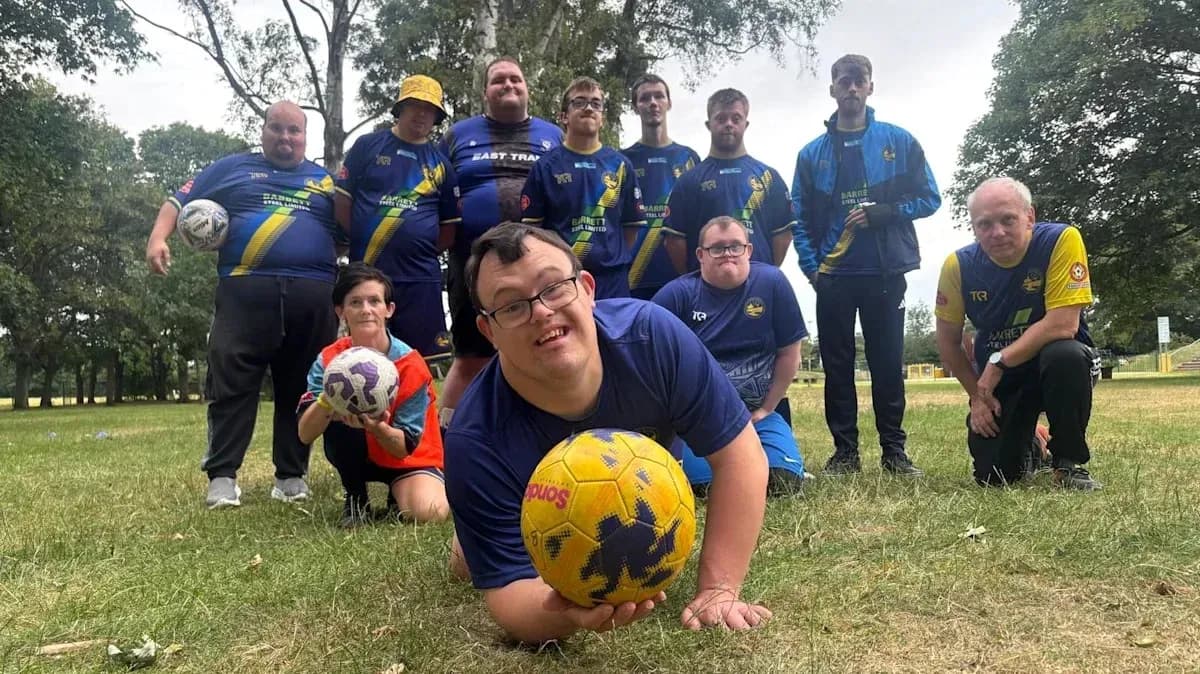
On a warm July evening in Scunthorpe, while England’s stars chase a World Cup dream in New York, a very different kind of football ambition plays out in the shade of Central Park’s trees.
No TV gantries. No roaring stands. Just a cluster of players in their own colours, cones laid out on the grass, and a coaching team driving them towards Special Olympics gold.
From small steps to the national stage
This Bottesford Town Football Club side began life about a decade ago as a team for young adults with Down’s syndrome. Since then it has grown, both in numbers and in scope, to welcome players with autism, ADHD and a range of learning and intellectual disabilities.
When these players first came together, the goals were modest: build confidence, make friends, learn the basics of the game. The early sessions were about small steps – a completed pass, a first tackle, a shy smile turning into a loud laugh.
Now those same players are drilling like a squad with something serious on the line.
They are preparing for the Special Olympics GB National Summer Games at Alexander Stadium in Birmingham, a four‑day festival of sport running from 26 to 30 August. For them, it is not a sideshow. It is the pinnacle.
Jake’s corners and a shot at gold
Ask Jake how he feels about it and the answer comes back instantly.
“I feel happy,” he says, already thinking about his role. He takes corners, and he is proud of it. He talks through how to “wrap” the ball into the net, offering his own set-piece tutorial.
He has history on this stage. Silver at the Special Olympics in 2017. This time the target is clear: score two goals, come home with gold.
Special Olympics GB exists to give people with intellectual or learning disabilities the chance to compete, train and belong in sport all year round. The organisation estimates there are about 1.5 million people living with an intellectual disability in Great Britain. Its mission is to change as many of those lives as possible through opportunities like this one.
Jake’s journey tells you why that matters.
A mother’s push and a club that opened its doors
His mum, Sue, has been there from the very start – fundraising, driving, organising, doing whatever it took to keep the team alive. Her other son, Aiden, also has disabilities and is now learning to coach the group he grew up around.
The team, she explains, was born out of frustration as much as hope.
“My son Jake, he’s got Down’s syndrome and he loves playing football but struggled to play it mainstream,” she says. “He found it too difficult and couldn’t keep up with the team.”
So she went to Bottesford Town FC and asked for something different: a space where Jake and his friends could actually play, not just watch from the sidelines.
“For Jake to be able to play football was just such a big thing for him,” she says. “It’s his passion. He loves football and he wanted to be able to play it.”
That chance has given them far more than a weekly kickabout. Skills have sharpened. Friendships have hardened into something deeper.
“When your child is born and you find out they have a disability, it’s a complete unknown,” Sue says. “But my commitment was always that my boys would access as much as possible in their lives.”
Bottesford Town FC, she adds, have been “amazing” in backing that commitment, opening up their facilities – from the indoor sports hall to the 4G pitch that keeps them training all year round.
Covid setbacks and a £10,000 hurdle
The path to Birmingham has not been smooth.
The team were accepted into the Special Olympics in 2021, only to see the Games cancelled because of the Covid-19 pandemic. For some players, that blow cut deep.
“It set quite a few of them back. Jake was one of those who struggled,” Sue admits.
The biggest obstacle, though, has been financial. To get two teams to this year’s Games – covering travel and accommodation – they have had to raise £10,000. For a grassroots disability side, that figure might as well be Champions League money.
They have chipped away at it, event by event, donation by donation, because the alternative is unthinkable: players who have trained for years missing out on the experience of a lifetime.
Training ramps up, belief grows
Manager Michael Potts can feel the intensity rising as August approaches.
The sessions are “ramping up”, he says, and the excitement is obvious. The 4G surface has helped them develop, giving them a reliable platform to work on touch, passing and positioning without the winter mud that can derail grassroots seasons.
As the squad has broadened to include players with different intellectual disabilities, the coaching staff have adjusted how they work. Instructions are clearer, drills are tailored, support is more individual. The aim is simple: give every player the tools to contribute.
Mason, the goalkeeper, stands as one of the last lines of that effort. He talks about a “rock solid” defence in front of him, and he means it.
Asked what advice he would give to England’s men as they hunt their own trophy, he doesn’t hesitate: train hard, and make sure the goalkeeper gets his distribution right – focus on “throwing the ball out” properly.
He carries his own big‑tournament memory too: a saved penalty at his last competition. That moment fuels his belief that he can help deliver gold this time.
Taylor, a defender who joined the team a decade ago, nods to the progress they are making in training. His guidance to anyone thinking of joining is blunt and honest – train hard. On the pitch, he fancies himself to chip in with goals as well, predicting four.
Chasing dreams under the trees
As the evening cools and the light dips behind the trees in Central Park, the session winds down. Cones are collected, bottles drained, boots scuff through the grass.
From a distance, it looks like any local team wrapping up another midweek run-out. Up close, it is something else entirely: a group of players who were once told mainstream football was too fast, too tough, too unforgiving, now working with a professionalism that mirrors any squad with medals in their sights.
Their stage in August will not carry the global glare of a World Cup final. It will matter just as much to them.
Walking back through the park, the shouts and laughter still carrying on the warm air, one question hangs over this team as strongly as any tactical plan or training drill.
When they return from Birmingham, how many of those dreams born under the Scunthorpe trees will be hanging around their necks in gold?

