.svg&w=384&q=75 "GoalGist logo")
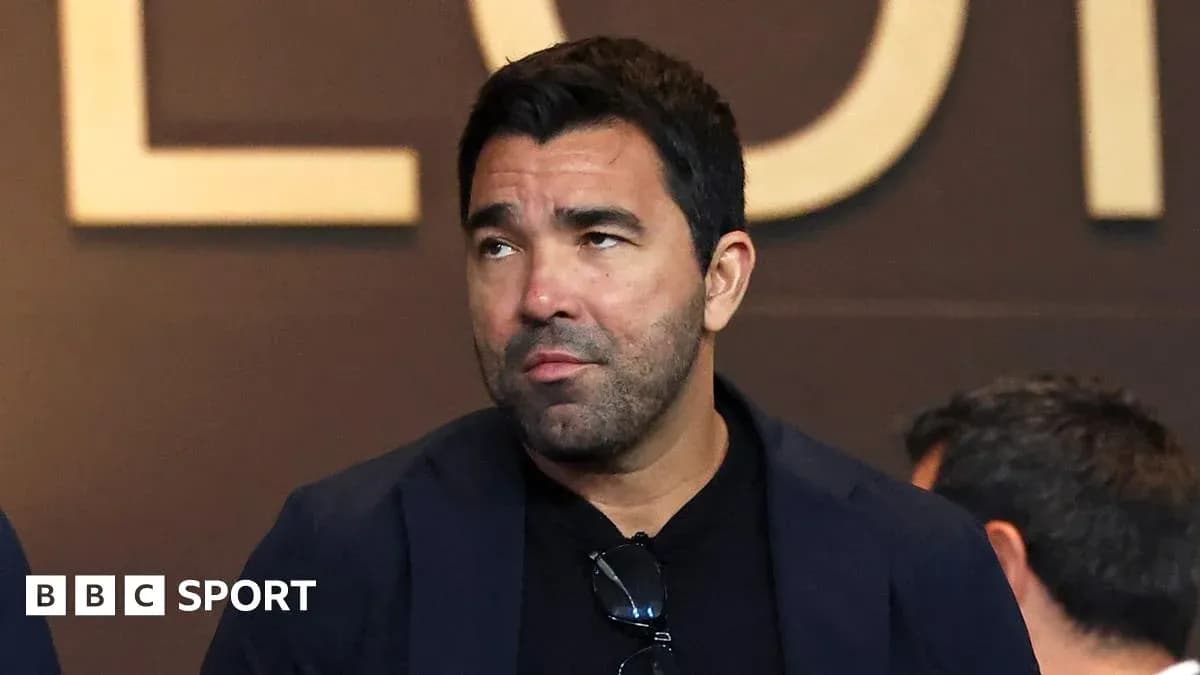
Barcelona’s New Era: Deco Sees It as Just the Beginning
Barcelona have reclaimed their place at the top of Spanish football. Two La Liga titles in a row, the latest clinched with three games to spare and sealed by a win over Real Madrid, would usually signal the peak of a cycle. Deco insists it is the opposite.
For the club’s sporting director, this is not the closing chapter of a successful team. It is page one.
The beginning of the history of this team
The image of Barcelona’s season is not just Hansi Flick lifting the trophy. It is the sight of teenagers and early‑twenty-somethings dictating games in the pressure cooker of a title race.
Lamine Yamal, Pau Cubarsí, Fermín López: three more names from La Masia’s conveyor belt, now embedded in the starting structure of a champion side. Deco looks at that core and sees something long-term.
“It is true that we won two La Ligas but these players want to win more, they believe that they can win more,” he told BBC Sport. For him, that hunger is the real prize. The medals confirm the progress; the mentality hints at dominance.
“I believe that this team for me is the beginning of the era, the beginning of the history of this team because they are so young and still want to win something important.”
Flick’s work has given Deco something every sporting director craves: a functioning, competitive side that does not need an overhaul every summer. Across the season, Barcelona strung together an 11‑game winning run that broke the back of the title race. They fell in the Champions League quarter‑finals, a reminder of the gap still to close at the very top, but domestically they were relentless.
Deco’s verdict is clear: this is not a squad that needs ripping up.
Flick’s Barcelona: evolution, not revolution
In guiding Barça to a second straight league crown, Flick has built a framework that, in Deco’s words, means the club will not have to “go to the market for four to five players.” That is a significant statement in an era when big clubs often chase entire new spines every summer.
The key pieces are already inside the building. The academy has delivered again, the veterans still anchor the dressing room, and the coach has found a blend that wins.
The question now is how to refine, not reinvent. One of the biggest decisions sits on the left side of the attack.
Rashford’s loan, Rashford’s statement
Marcus Rashford arrived from Manchester United on loan facing a complicated task. He came not as a prospect, but as a “top player,” as Deco put it, parachuted into a club where every touch is judged and every performance weighed against the badge.
On top of that, he was handed a specific responsibility: step into the space left by Raphinha.
“Marcus has helped us a lot because he came on loan, it is not easy to come on loan as a player like him because he is a top player,” Deco said. “He helped us a lot because he had the responsibility to replace Raphinha, it is not easy but he did very well.”
The numbers back that up. In La Liga, Rashford played 32 times, scored eight goals and supplied seven assists. In the Champions League, he added six goals and three assists in 11 appearances. Those are not superstar, team‑built‑around‑him statistics, but they are the figures of a forward who has contributed consistently in a side full of attacking options.
He did it without the guarantee of a starting place. Deco highlighted that reality too: “Sometimes he [is] on the bench and it’s not easy but he reacted very well and he did everything.”
The defining moment of his season in Spain came on the biggest domestic stage of all. In El Clásico, with the title race still alive and tense, Rashford stood over a free‑kick and bent in a stunning strike to break the deadlock against Real Madrid.
Deco had seen him do it before in England. This one still stopped him.
“We knew he had these kinds of skills, I saw him scoring at United many times, but this goal was unbelievable. It was a fantastic goal.”
For Deco, Rashford’s reward is fully earned. “His season was very good and we are happy he won La Liga with us. He deserves [it], he works a lot and works hard to be here. We are happy with him.”
A €35m decision
Rashford has already hinted he wants to stay in Spain next season. The loan has worked on the pitch and, by his own signals, in his life off it. The option is clear: Barcelona can sign him permanently for 35m euros (£30m).
Deco, careful not to get drawn into the specifics of the forward’s future, chose his words with more restraint there. The club will weigh the fee, the wage demands, the squad balance. The sporting director, though, has already underlined one thing: Rashford has done his part.
He arrived on loan. He adapted. He scored in the biggest game of the domestic calendar. He accepted the bench when required and still delivered a double‑digit goal contribution in the league.
For a club that no longer wants to “go to the market for four to five players,” the decision is no longer about whether Rashford can cope at this level. He has answered that. The question now is sharper, and more ambitious.
If this really is “the beginning of the era” for Barcelona’s new generation, is Marcus Rashford part of the team that turns back‑to‑back titles into something far bigger?